This page provides access to documents that don't fit into the
primary classifications in the navigation buttons above.
This index is fully up-to-date as at 31 December 2023. See also:
- The What's New Page (because the indexes are
never fully up-to-date), here
- The Search Facility, in the button at the top-right-hand side of the page
- An index of Presentations since 1995, here
(The reason that I use 'SOS' as the directory-name for this segment of my site is historical. This was originally the home-page for my Research Programme in Supra-Organisational Systems (SOS), which I ran from 1988-95 at the
A.N.U. Those details are down at the bottom).
I integrated a number of these topics together in Fundamentals of Data, Information and Information Systems (2023)
Other papers are:
This paper provides introductory and discussion material for early postgraduate studies:
Other papers are:
In this stream of work, I propose that the IS discipline has a major deficiency that needs to be urgently addressed in order to overcome the present low-grade service that it's providing even to executives, let alone to the economy and society as a whole.
I define the key term 'Researcher Perspective' to mean a particular stakeholder perspective that is adopted by a researcher as the, or a, viewpoint from which to observe phenomena during the conduct of a research project.
On the basis of considerable empirical evidence, I argue that 90% of IS research adopts a single perspective; and in almost all cases the interests of the 'system sponsor' are prioritised.
A first problem with that approach is that the interests of every other stakeholder are seriously short-changed, and in many circumstances simply ignored.
I contend that the longstanding history of low return on investment and of outright project failures is the attempted use by system sponsors to impose their will on other stakeholders. This frequently encounters resistance, both overt and covert.
This mindset has been supported by inadequate IS research, whose one-dimensionality has failed to deliver insights into the needs of stakeholders and the dynamics of the field of play.
To deliver quality research outputs, IS academics need to switch to dual-perspective research. They can then assist each of two protagonists to understand the viewpoint of the other, to anticipate the other's behaviour, and to find ways to achieve win-win situations.
Beyond dual-perspective research, many contexts arise in which the power is distributed across a number of stakeholders. In these circumstances, the only sensible approach is multi-perspective research.
Conventional, single-perspective research may be easy to perform; but its quality is so inadequate that potential clients and funders of IS research place very little value on it.
We need to grasp the nettle, develop and improve techniques that support dual-perspective and multi-perspective research projects, and deliver information of value.
The theory of researcher perspective is expressed in:
The theory was supported by the following empirical research:
- A pilot study of researcher perspectives performed in 2015, in support of a Conference Keynote presentation (Clarke 2015). It examined articles in a Volume of the Australasian Journal of Information Systems (AJIS), and a sample of articles from the same year's Australasian Conference in Information Systems (ACIS)
- A study of 212 papers presented at the Bled eConference, at 3-yearly intervals from 1991 to 2015 (Clarke 2016). It won an Outstanding Paper Award
- An examination of 60 papers from the corpus of c. 650 published in the specialist journal Electronic Markets (Clarke 2020)
- A report on over 500 papers in three years of the Basket of 8 journals, forthcoming in Information Technology & People (Clarke & Davison 2021)
The full set of papers is shown below in chronological order, with the primary sources picked out in bold-face type:
- The Missing Perspectives in IS Research
(April 2015) Clarke, ACIS Keynote Preliminaries
- The IS Discipline and Public Policy (2015) Clarke,
ICIS Panel Preliminaries
- Not Only Horses Wear Blinkers: The Missing
Perspectives in IS Research (October 2015) Clarke, ACIS Keynote
- Public Policy is Within-Scope for IS
Research (2015) Clarke, ICIS Panel
- Personal Data Markets: A Matter of Perspective
(2016) Clarke, Working Paper
- 'An Empirical Assessment of
Researcher Perspectives' (2016) Clarke, Bled eConference
- Researcher Perspective(s) and the
Role of Perspective in Privacy-Related Research (2016) Clarke, Uni
Leipzig
- Content Analysis in Support of Critical Theory
Research: How to Deliver an Unwelcome Message Without Being Shot (2017)
Clarke, Bled eConference
- Personal Data Markets and Privacy: A Critical Content
Analysis of Published Works (2017), Clarke, Working Paper
- The Critical Analysis of Published Works:
How to Establish a New Research Technique in the IS Discipline?, and
slide-set (2018) Clarke, IS Foundations Workshop,
ANU
- Whose Data is it Anyway? The Researcher Perspectives
Evident in IS Privacy Research' (2019) Clarke, Working Paper
- The Challenges Involved in Establishing a
Research Technique' (2020) Clarke, in AJIS
- Through Whose Eyes? The Critical Concept of
Researcher Perspective (2020) Clarke & Davison, in JAIS
- Researcher Perspective in Electronic Markets
(2020) Clarke in EM
- Researcher Perspective in the IS Discipline: An
Empirical Study of Articles in the Basket of 8 Journals (2020) Clarke
& Davison, in IT&P
The work on Researcher Perspective, in 1.5 above, required a new research technique for the Critical Analysis of Published Works. This was regarded by some reviewers as being contentious, and hence had to be itself the subject of research in order to achieve publication of the empirical papers. That resulted in the following series of papers:
- Management Aspects
- Licensing Aspects
- Reviewing Aspects
- Plagiarism Aspects
- Citation Aspects
- The Political Economy of Academic Publishing
- Fighting Against the AIS's Back-Sliding
- Origins and Nature of the Internet in
Australia (1998, 2001, 2004)
- Key Aspects
of the History
of the Information Systems Discipline in Australia (2006)
- A Retrospective on the
Information Systems Discipline in Australia (2008)
- Notes on the Writing of Histories of ICT
and IS (2011)
- The First 25 Years of the Bled eConference:
Themes and Impacts (2012)
- Morning Dew on the Australian Web: 1992-95
(2012)
- 25th Bled eConference - Special Section,
and The
Special Section of 9 Papers (2012)
- Infrastructure for Electronic Interaction: The
State of Play in 1987 (2012)
- A Perspective on the Future of the IS Discipline
(2012)
- Whose History? (2013)
- Morning Dew on the Web in Australia:
1992-95 (2013)
- Electronic Interaction Research
1988-2012 through the Lens of the Bled eConference (2013)
- What the Dickens is 'The Ghost of ChrIStmas
Future'??, (2013, for a Panel at ACIS, Melbourne)
- 30 Years of the Bled eConference: From Past
to Future (2017, Panel Session, 30th Bled eConference)
- The Information Infrastructure of 1985 and
of 2018: The Sociotechnical Context of Computer Law & Security
(first-named author, with M.R.Wigan), Computer Law and Security Review 30, 4
(Jul-Aug 2017) 677-700
- 40 Years of I.T. and A.I. and What It Means for the Next
20 Years, and the slide-set, and video-recording (Jun 2022, for Fulbright
University Vietnam)
- Beyond Artificial, and Beyond Intelligence: Old-AI is
Dead, Long Live New-AI and AC (Review Version for TTS, Aug 2022)
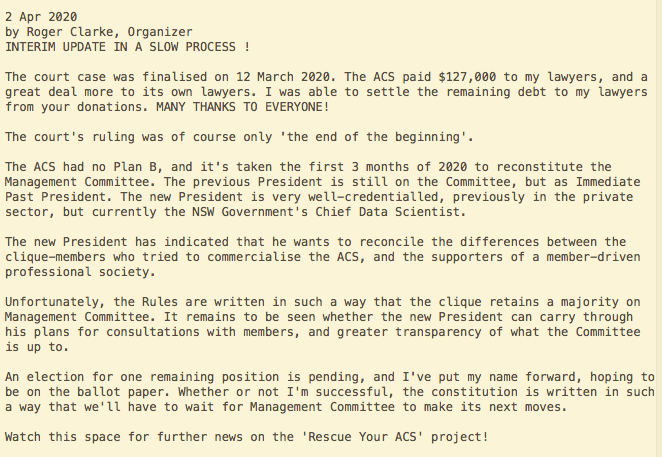
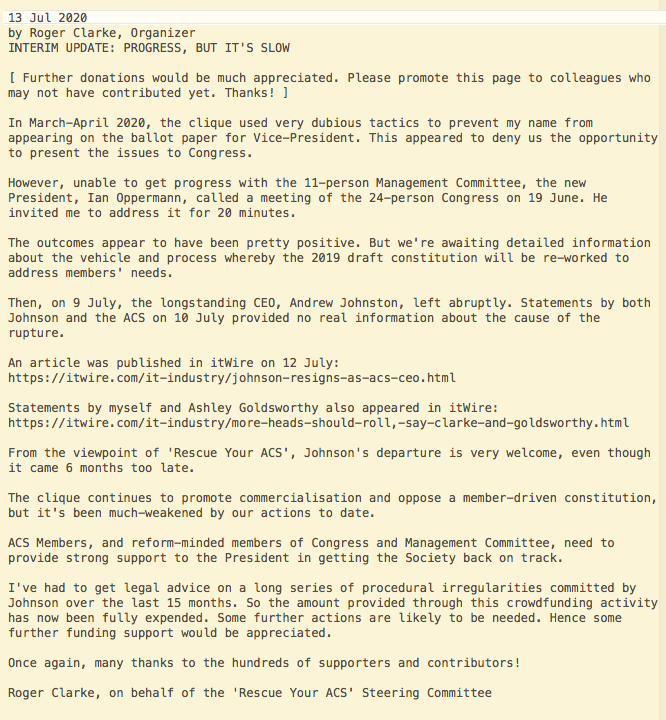
In October 2019, I belatedly discovered that a clique had gained control of the Australian Computer Society, had achieved considerable progress in commercialising it, was well-advanced with plans to corporatise it with a constitution that centralised power in the Board, and presumably would have later privatised the organisation, its $40-50m p.a. revenue streams and its accumulated assets.
After only just failing to defeat the corporatisation proposal at the AGM in 2019, I pursued a Federal Court action based on the large number of procedural irregularities that had been committed. Having won that, I assembled a powerful Steering Committee to fight the proposal. Because I was denied access to communication channels to the 10,000 voters, I assembled an email-address list of 400 members and used that and two media outlets as channels to pursue the matter. Multiple members of the Steering Committee used their own reputations and contacts to build and maintain pressure.
Phases 1-5 below below track the unpleasant process, Oct 2019 - Nov 2020.
The subsequent Phases 6-8 track the rebuilding process undertaken in 2021-22.
Key documents are in bold-face type:
- Phase 1: Discovery, General Meetings (Oct-Nov 2019)
- Phase 2: The Court Case (Nov-Dec 2019)
- Phase 3: Clique Intransigence (Jan-Sep 2020)
- A Constitution for the Australian Computer Society:
Background and Principles (7 Jan to 20 May 20)
- ACS in turmoil as numbers and
expenditure questioned (itWire, 3 Feb 20)
- Open warfare over 'disingenuous'
ACS (Innovation Aus, 6 Feb 20)
- Industry heavyweight unloads on ACS
(itWire, 11 Feb 20)
- ACS will reassess plans to change legal
structure (zdNet, 10 Mar 20)
- ACS settles Federal Court
debacle (Innovation Aus, 11 Mar 20)
- Here we go again – ACS court
case over (itWire, 11 Mar 20)
- Oppermann elected ACS
President, pledges reconciliation (itWire, 12 Mar 20)
- Oppermann charts new ACS course
(Innovation Aus, 16 Mar 20)
- Crowdfunding Interim Update
, archived here
(2 Apr 2020)
- Clarke Still Frozen Out As ACS
Internal Dramas Continue To Flow (Computer Daily News, 16 Apr 20)
- ACS reformers state their case
(itWire, 17 Apr 20)
- Invited Statement to ACS Congress
re Governance and the New Constitution (19 June)
- Slide-Set in support of the
presentation to Congress (19 June)
-
How to reinvent the Aust Computer Society, mirrored here (Innovation Aus, 22 Jun 20)
- Is ACS reconciliation possible? (itWire,
24 Jun 20)
- Steps towards a new ACS constitution, mirrored here (ACS Information Age, 25 Jun 20)
- ACS not responding, says Goldsworthy
(itWire, 2 Jul 20)
- Keep it civil, says Oppermann
(itWire, 5 Jul 20)
- Opinion: Philipson on the ACS's
problems (itWire, 5 Jul 20)
- Johnson resigns as ACS CEO
(itWire, 12 Jul 20)
- More heads should roll, say Clarke
and Goldsworthy (itWire, 12 Jul 20)
- Crowdfunding Update
, archived here
(13 Jul 2020)
-
Invisible Man Johnson still at ACS (itWire, 20 Aug 20)
- Graeme Philipson's 'Open letter
to ACS Management Committee' (itWire, 24 Aug 20)
- An alternative plan for ACS governance change (25 August), mirrored here
- Phase 4: Implosion of the Governing Committee (Oct-Nov 2020)
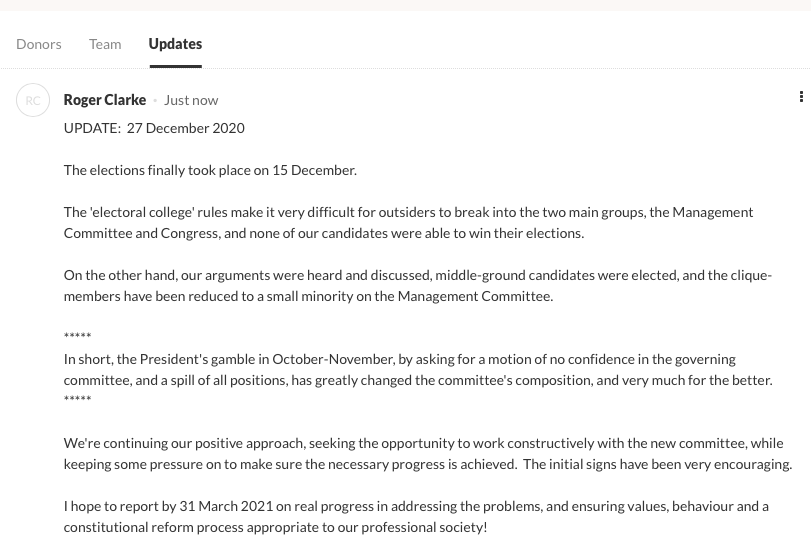
- Phase 5: Constructive Discussions and Progress, at Last (Dec 2020-)
- Phase 6: Branch Improvement Task Force (Feb-Apr 2021)
- Phase 7: Financial Transparency Working Group (Mar-Apr 2021)
- Phase 8: Constitutional Reform Working Group (CRWG, May 21 - Nov 22)
Lead authorship on all of the following documents:
- Economic, Legal and Social Implications of Information
Technology (MISQ, 1988)
- Asimov's Laws of Robotics: Implications for
Information Technology (IEEE Computer, 1993)
- Ethical Issues in the Preparation and Submission
of Research Papers in the I.S. Discipline (ICIS, 2000), incorporated into Research
Ethics in Information Systems: Would a Code of Practice Help? (CAIS, 2001)
- slides on ethical and social aspects of IS, and
references (2002)
- Ethical and Social Aspects of I.T. - Property in Bits - IP's Impact on IP,
PowerPoint slides (2002)
- Research Use of Personal Data (2002)
- ENUM - A Case Study in Social
Irresponsibility (2002)
- Is Social Irresponsibility Alive and
Well? (2002)
- Privacy Statement Template
(2005)
- Your Health Records: Privacy Versus
Quality of Care (Panellist's Statement, Melbourne, 2007)
- Revised Version of the AIS Code of Research Conduct (2008, lead-author,
for the Association for Information Systems)
- AIS Privacy Policy Statement (2008, lead-author, for the Association of
Information Systems)
- Cyborg Rights (IEEE
Technology and Society 2011)
- Ethical Considerations in Computer
Science Research (2013)
- What Drones Inherit from Their
Ancestors (2013)
- Inadequacies in the UK's Data Science
Ethical Framework (EDPL, 2016)
- IT and Data Ethics (ANU RSCS Lecture, 2020),
plus slide-set and the video-presentation
- Do Ethical Guidelines have a Role to Play in Relation to
Data Analytics and AI/ML? (2020), and supporting
slide-set, and video'd presentation
- IT and Data Ethics (ANU RSCS Lecture, 2020),
plus slide-set and the video-presentation
The papers are shown in chronological order, with the primary sources (all of them refereed papers), picked
out in bold-face type:
- Drones 1 of 4 – Understanding the Drone Epidemic
(2013-14)
- Drones 2 of 4 – What Drones
Inherit from Their Ancestors (2013-14)
- Drones 3 of 4 – The Regulation of Civilian Drones'
Impacts on Public Safety (2013-14)
- Drones 4 of 4 – The Regulation of Civilian Drones'
Applications to Surveillance (2013-14)
- Drones – Technical and Policy Challenges (slide-set,
for RSCS Summer Scholars, 2013)
- Drones' Challenges to Public Safety (Adelaide, 2014, plus
slide-set (12MB!))
- Drones and Privacy (for a Parliamentary Committee, 2014)
- Managing Drones' Privacy and Civil Liberties
Impacts (Melbourne, 2014, plus slide-set)
- Hobbyist Drones: Payload and Mission
Capabilities, plus Slide-Set (IEEE
Workshop, 2014)
- Managing Drones' Safety and Privacy Impacts (Presentation, 2015)
- Appropriate Regulatory Responses to the
Drone Epidemic (2015)
-
Submission re the Queensland Drones Strategy Consultation Paper (2017)
- Net-Ethiquette: Mini Case Studies
of Dysfunctional Human Behaviour on the Net (1995)
- Information Technology & Cyberspace: Their
Impact on Rights and Liberties (1995)
- Towards the Analysis of Cyberculture
that Internet Participants Need (1995)
- Encouraging Cyberculture
(1997)
- Ethics and the Internet: The
Cyberspace Behaviour of People, Communities and Organisations
(Bus. & Prof'l Ethics J., 1999)
- Human-Artefact Hybridisation: Forms and
Consequences (Ars Electronica, Linz, 2005):
- Privacy Statement Template
(2005)
- Employee Dismissal on the Basis of
Offending Images on Their Workstation (2005)
- Digital Privacy (2006)
- The Feasibility of Consumer Device
Security (2007, with Alana
Maurushat)
- Your Health Records: Privacy Versus
Quality of Care (Panellist's Statement, Melbourne, 2007)
- What 'Überveillance' Is, and What To Do About
It, plus Surveillance Vignettes (Keynote,
Wollongong, 2007)
- Lawyers' 'Nastygrams' re Trademarks
(2008)
- Cyborg Rights (2010)
- Ethical Considerations in Computer
Science Research (2013)
- Approaches to Impact Assessment (Brussels, 2014,
plus slide-set)
- The Ethics and Law of Privacy in the
Digital Age, and slide-set
(National Science Week Event, Adelaide, 2018)
- Information Technology and Dataveillance
(1988)
- A 1992 view of what university administration would
like in 2001 (1992)
- Asimov's Laws of Robotics: Implications for
Information Technology (1993)
- Techno-Reality and Techno-Literature slides,
to support A 'Future Trace' on Dataveillance:
The Anti-Utopian and Cyberpunk Literary Genres (1993, 2002)
- The Digital Persona and its Application
to Data Surveillance (1994)
- Information Technology: Weapon of Authoritarianism
or Tool of Democracy?(1994)
- 'The Purchasing-Related Electronic Information Management (PREIM) Project'
(1995, for Purchasing Australia, with David Jonas)
- Net-Based Payment Schemes (1995-96)
- Privacy Issues in Smart Card Applications in the
Retail Financial Sector (1996)
- A Vision of Consumer Payments Futures(1996)
- Book Review of Mark Dery's' 'Escape Velocity:
Cyberculture at the End of the Century' (1996), and the accompanying
'Cyberculture:
Towards the Analysis That Internet Participants Need'
- Chip-Based Payment Schemes: Stored-Value Cards
and Beyond (1996)
- The Information Infrastructure is a Super Eye-Way
(book review of Simon Davies' 'Monitor: Extinguishing Privacy on the Information
Superhighway', 1996)
- New Concerns and Regulatory Strategies (sections of
'Regulating Financial Services in the Marketspace:
The Public's Interests', 1997)
- The Monster from the Crypt: Impacts and Effects
of Digital Money (1997)
- 'Smart Cards as National Infrastructure' for the Government of Victoria
(1997, with David Jonas)
- Instrumentalist Futurism: A Tool for Examining
I.T. Impacts and Implications (1997)
- We Need Information Infrastructure to Support
Participative Public Policy Decision-Making (1997)
- Public Interests on the Electronic Frontier:
Their Relevance to Policy-Formation for I.T. Security Techniques (1997)
- Design Features for Chip-Based
ID Scheme (a section of 'Chip-Based ID: Promise and Peril', 1997)
- Technological Aspects of Internet Crime Prevention
(1998)
- The Technical Feasibility of Regulating Gambling
on the Internet (1998, with Gillian Dempsey, Ooi Chuin Nee and Rob O'Connor)
- Public Key Infrastructure: Position Statement
(1998)
- Internet Privacy Concerns Confirm the
Case for Intervention (1998)
- Community and Commerce: Is There Scope
for Reconciliation? (a section of 'The Willingness of Net-Consumers to
Pay: A Lack-of-Progress Report', 1999)
- Imminent Applications (a section
of 'Person-Location and Person-Tracking: Technologies, Risks and Policy Implications',
1999)
- What must eCommerce deliver now?? (2000)
- Introducing PITs and PETs: Technologies Affecting
Privacy (2001)
- Research Challenges in Emergent e-Health Technologies
(2001)
- Developments in the Technologies of
Surveillance (a section of 'Paradise Gained, Paradise Re-lost: How the
Internet is being Changed from a Means of Liberation to a Tool of Authoritarianism',
2001)
- Countermeasures (a section of 'Beyond
the Alligators of 21/12/2001, There's a Public Policy Swamp', 2001)
- While You Were Sleeping ... Surveillance
Technologies Arrived (2001)
- Authentication Re-visited: How Public Key Infrastructure
Could Yet Prosper (2003)
- '10-Year Online Security Vision' (for National Office of the Information
Economy, 2003, with David Jonas and Ross Oakley)
- The Internet
and Democracy (for the National Office of the Information Economy,
2004)
- The Future of the Internet in Australia
(a section of 'Origins and Nature of the Internet in Australia', 2004)
- Critical Developments in Bus@ness (Slides,
2004)
- Human-Artefact Hybridisation: Forms and
Consequences (2005):
- Surveillance in Speculative Fiction: Have
Our Artists Been Sufficiently Imaginative? (2009)
- Cyborg Rights (IEEE
Technology and Society 2011)
- Big Data Quality: An Investigation using
Quasi-Empirical Scenario Analysis (Bled, 2015)
- Surfing the third wave of computing: a
framework for research into eObjects (2015)
- Scenario Analysis for Locational Information
Futures (Proposal, 2022)
- Beyond Artificial, and Beyond Intelligence: Old-AI is
Dead, Long Live New-AI and AC (2022)
- Future Studies: Of What, For Whom, and How? Examples
from Research into the Surveillance Society (2022)
Between 1988 and 1995, while I was a full-time academic at the A.N.U., I ran
a Research Programme in what I called 'Supra-Organisational Systems' (SOS),
and most
of my research and publications were undertaken within that
Programme. Although
I've long since returned to full-time consultancy, I've sustained my links
with
academe, and continue to conduct research and
publish refereed articles, in areas that build on my SOS Research
Programme.
My primary areas of interest during the period 1988-95 were:
- 'supra-organisational
systems'. I and my colleagues and students published a long list
of papers under the aegis of this Programme. I distinguish
several sub-classes of SOS:
- inter-organisational systems (IOS), by which I
mean one-to-one relationships between organisations;
- multi-organisational systems (MOS), where there
are multiple organisations (> 2), and m-n relationships;
- 'extra-organisational systems'
(EOS), which is another term of my own, in which non-organisations
are involved too, generally very small businesses without an IT
Manager, and people (e.g. ATMs and EFT/POS);
- public systems, in which organisations are
incidental participants (FIDONET and the WELL are longstanding
examples, and of course P2P
has in recent years become mainstream and explosive);
- strategic information systems
theory, which is one of the primary perspectives from
which I undertake my research. I ran a panel at ICIS'95 in Amsterdam
on the
application of strategic IS theory in low-competitive contexts
like government, charities and industry associations;
- eCommerce. This is really a sub-set of SOS
of course, but worth distinguishing. There's
a host of sub-topics within this field, so see the separate document
for an outline of what I think it is;
- information infrastructure. My work here
has been variously in the economic and public
policy aspects, and applications in teaching and research;
- data surveillance and information privacy.
Once again, this is a pretty big
area. It's also one that interests very few people, so I've buried
the details in a separate document few readers will bother looking
at. {That was written
in 1995. In fact, the large DV segment of this site has been getting
about 1 million hits p.a. for some years now);
- miscellania. I'm a dilettante of the very worst kind - no role
model for a good academic at all (or, indeed, for an
income-maximising consultant). A few of the other things I've
fiddled around with at various times are:
- organisational aspects of information
technology, including observations on
the future of IT in organisations,
specifically universities, and proceedings
of international conferences in 1989
and 1991;
- legal aspects of IT, including intellectual
property, software
escrow, judicial understanding of IT, and liabilities
arising from the use of IT artefacts (Clarke 1988a, 1988b, 1989b,
1989c, 1990b, Clarke & Tyree 1990);
- economic aspects of IT, in particular
cost/benefit analysis applied to Government IT projects and
the economics of expert systems;
- social aspects of IT, including conference notes
on the Computers, Freedom & Privacy Conferences of
1993 in San Francisco,
1994 in Chicago and
1995, again in San Francisco (and
for several later events as well);
- Asimov's Laws of Robotics, and their
implications for information technologists;
- the generations of application
development software, information
technology architecture and hardware/software products such as
the AS/400;
- networked multi-media in teaching and research.
Some early evidence of the work in this area undertaken by myself and
my colleagues
could once be found in the home-pages of my erstwhile Department.
During the period 1988-95, collaborative work was undertaken with a range of
organisations, including industry associations (EDICA, now ECA, and
Tradegate)
and agencies of the governments of Australia and of several States
(in particular
the then Information Exchange Steering Committee, and the
Departments of Administrative
Services, Purchasing Australia within that Department, the
Department of Finance
and the Department of Transport).
I spent over five years of my business career outside Australia,
in the United
Kingdom and Switzerland. I have subsequently maintained my associations with
German-speaking countries through participation in many international
conferences, frequently as a member of the program committee, and as an
editorial board member and referee for many international journals. From time
to time, I undertake field-work overseas, and have been invited as a Visiting
Professor at the Universities of Bern (Switzerland) and Linz (Austria). Links
have also been established with the EDI World Institute, based in Montreal.
I collaborated with staff and students at other Australian and overseas
Universities, in Australia (Curtin Uni. of Technology), Austria (Linz), Belgium
(Namur), Canada (McGill and UBC), Germany (Hohenheim-Stuttgart), Singapore (NUS
and NTU), Slovenia (Maribor), Switzerland (St Gallen), The Netherlands
(Erasmus, Limburg), the United Kingdom (Sussex and Cranfield) and the United
States (Denver and Arizona at Tucson).
In addition to undertaking research myself, working with academic
colleagues,
and employing casual research assistants, I supervised research candidates in
the Graduate Programs in Commerce and in Computer Science & Technology at
the Australian National University. (Subsequently, I've supervised doctoral
and Honours candidates in Computer Science and elsewhere at A.N.U. In my role
as a Visiting Professor at U.N.S.W. in the Baker & McKenzie
Cyberspace Law
& Policy Centre, I've also supervised several law doctorates).
Created: 15 February 1995 -
Last Amended: 31 December 2023
by Roger Clarke
- Site Last Verified: 15 February 2009
This document is at www.rogerclarke.com/SOS/index.html
Mail to Webmaster -
© Xamax Consultancy Pty Ltd, 1995-2022 -
Privacy Policy