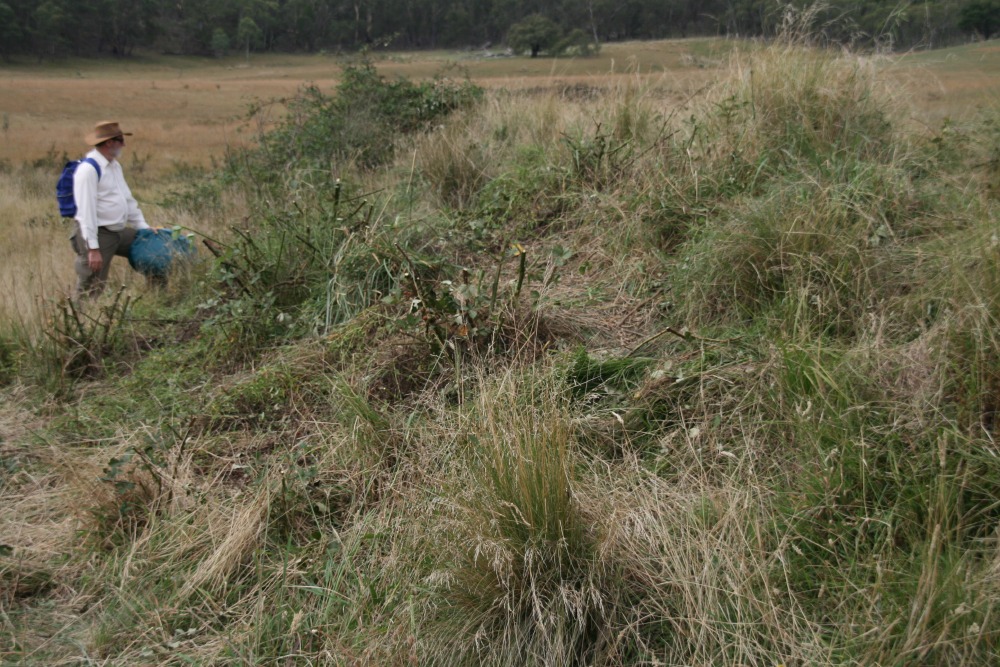
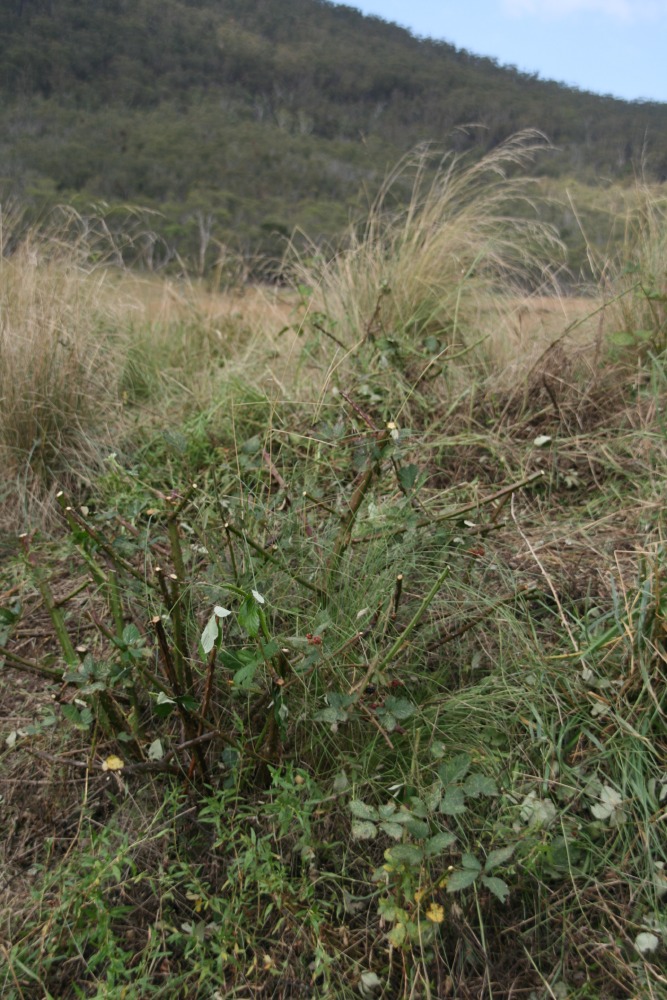

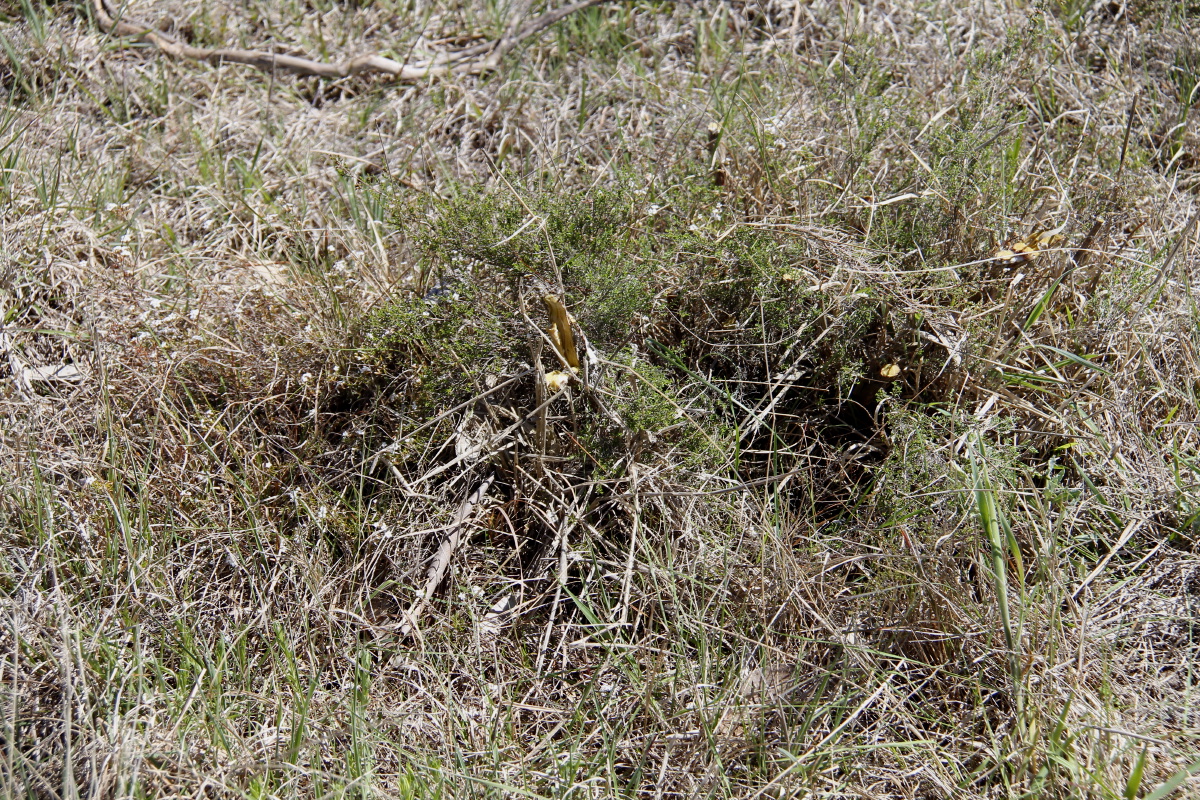
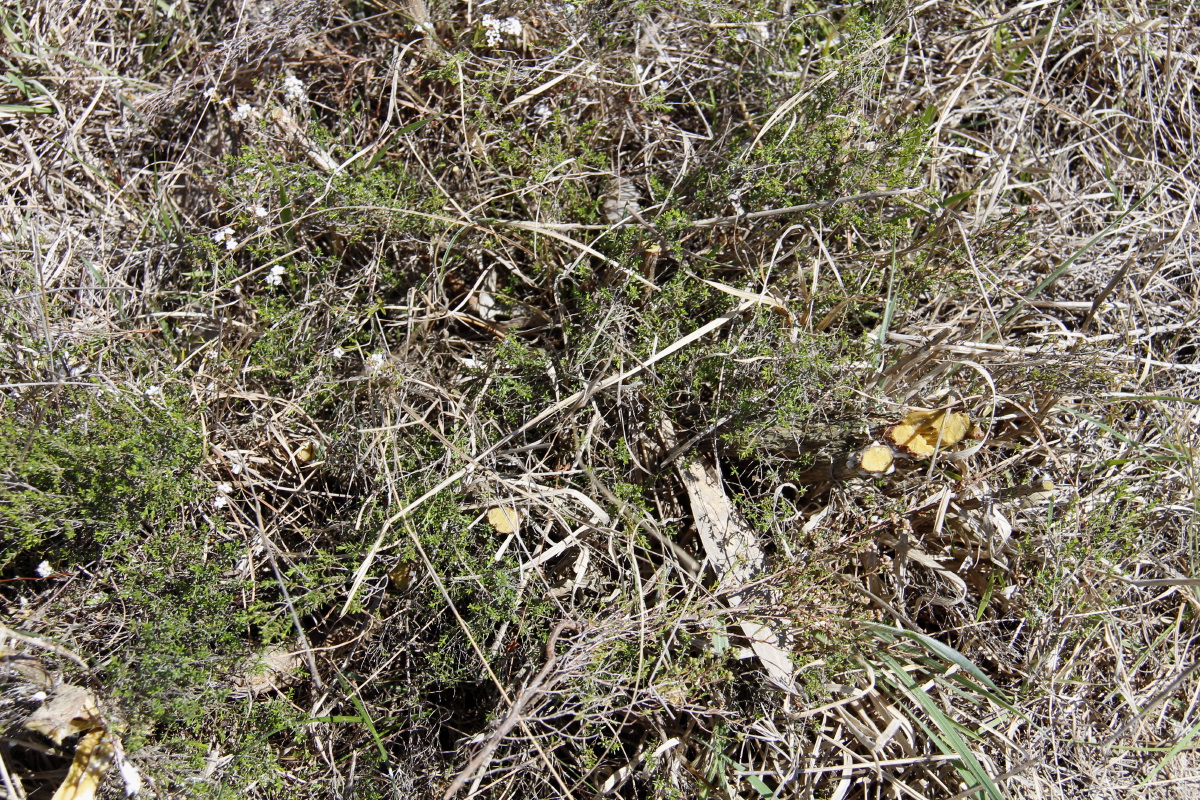
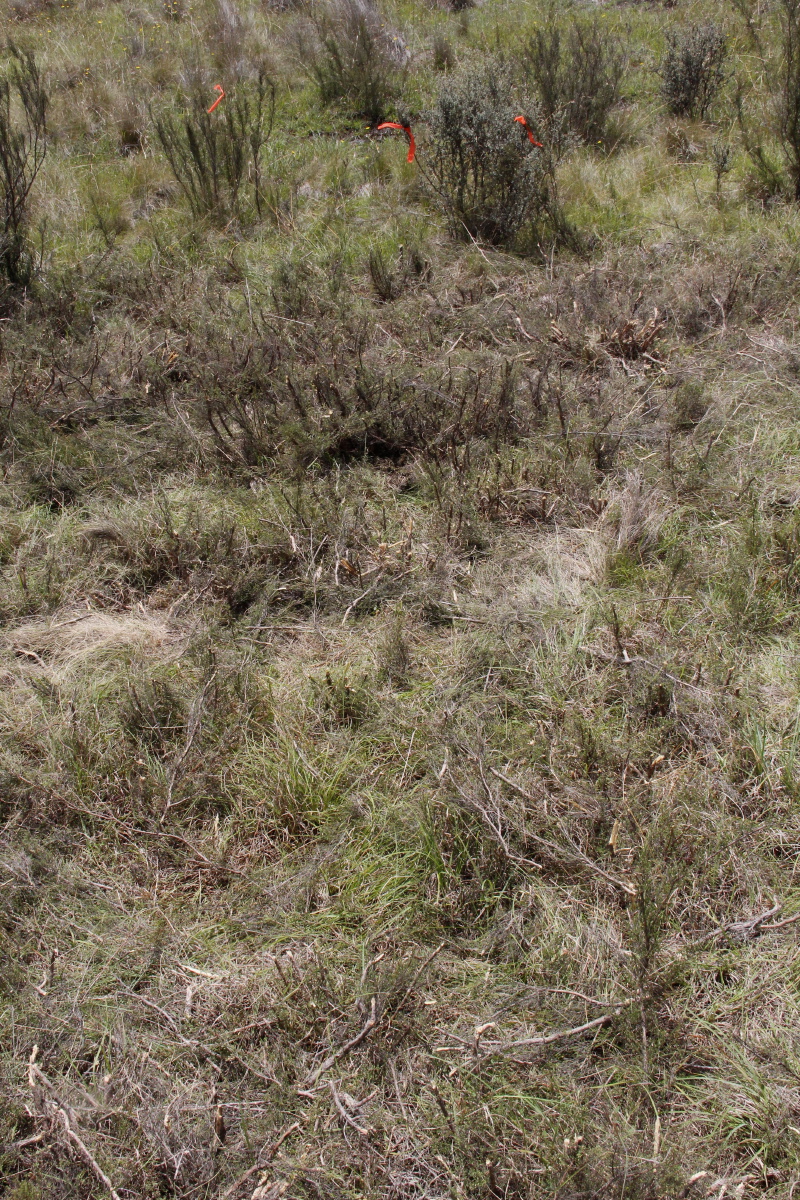
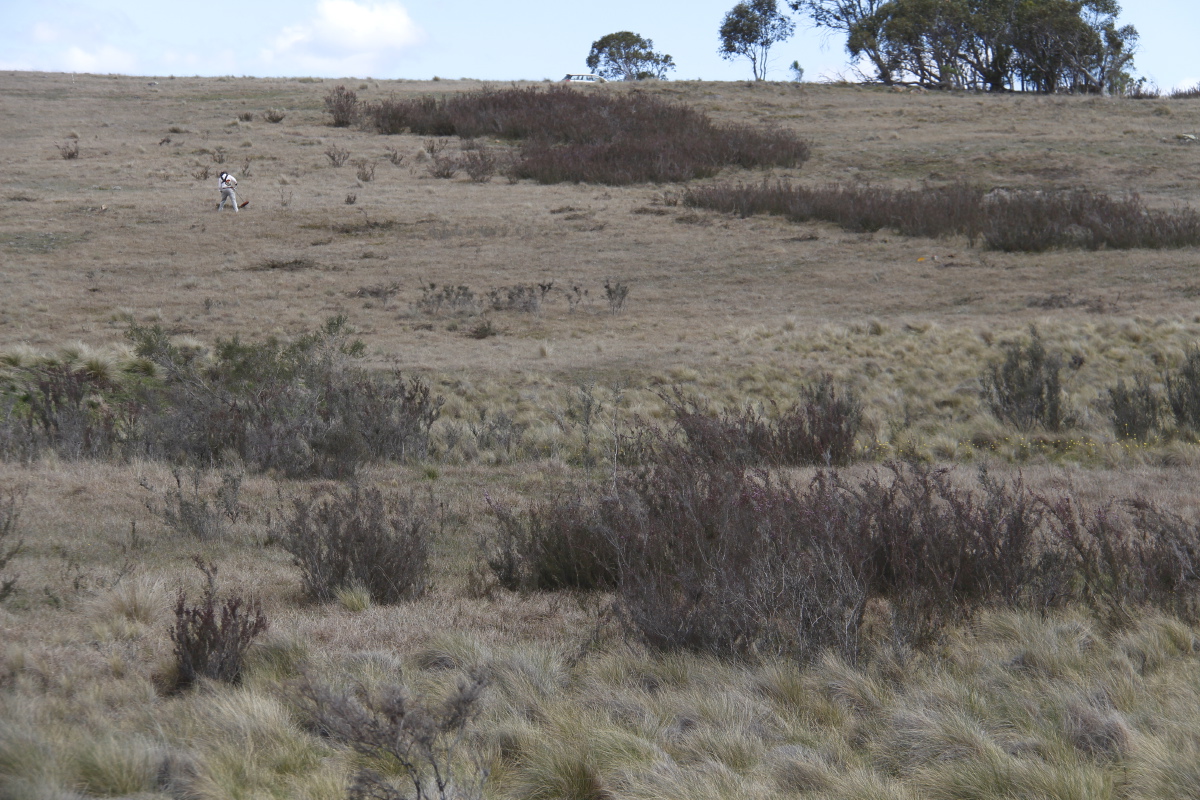
Northern bush half-cut, southern bush
cut-and-painted
Southern bush after cut-and-paint
Large northern bush half-removed
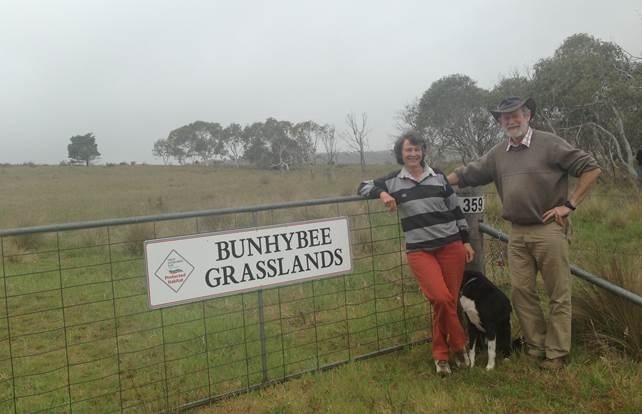
This is a page within Roger and Linda's
Bunhybee Grasslands Web-Site.
Bunhybee Grasslands is a 49 hectare / 120 acre conservation property 35km south
of Braidwood, in southern N.S.W.
You can follow through the internal links, or you may find it easier to use
the Site-Map.
The property is subject to a Conservation Agreement, and a Plan of Management (7.4 MB of PDF!!). We have an Action Plan in place. A critical portion of that is the Weed Control Plan.
This page contains a cumulative report on implementation of the Weed Control Plan.
It contains information about the activities we've undertaken since we purchased Bunhybee in late 2008:
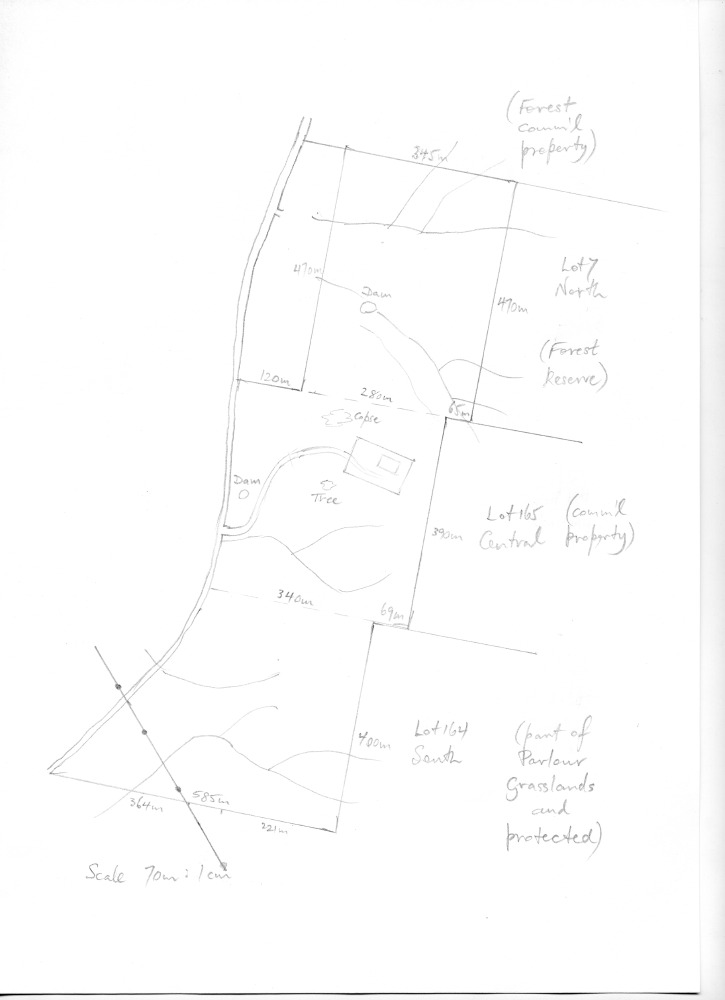
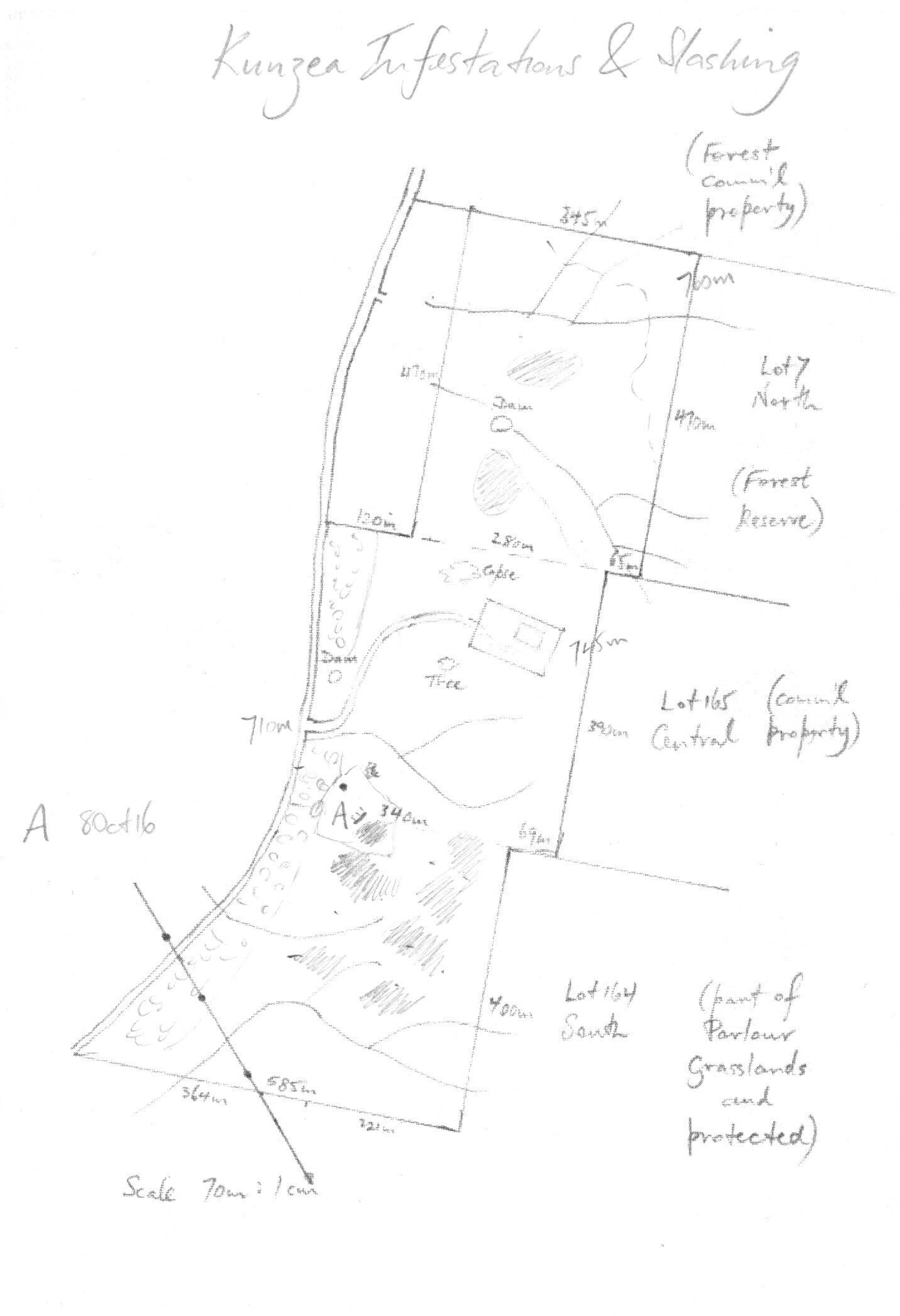
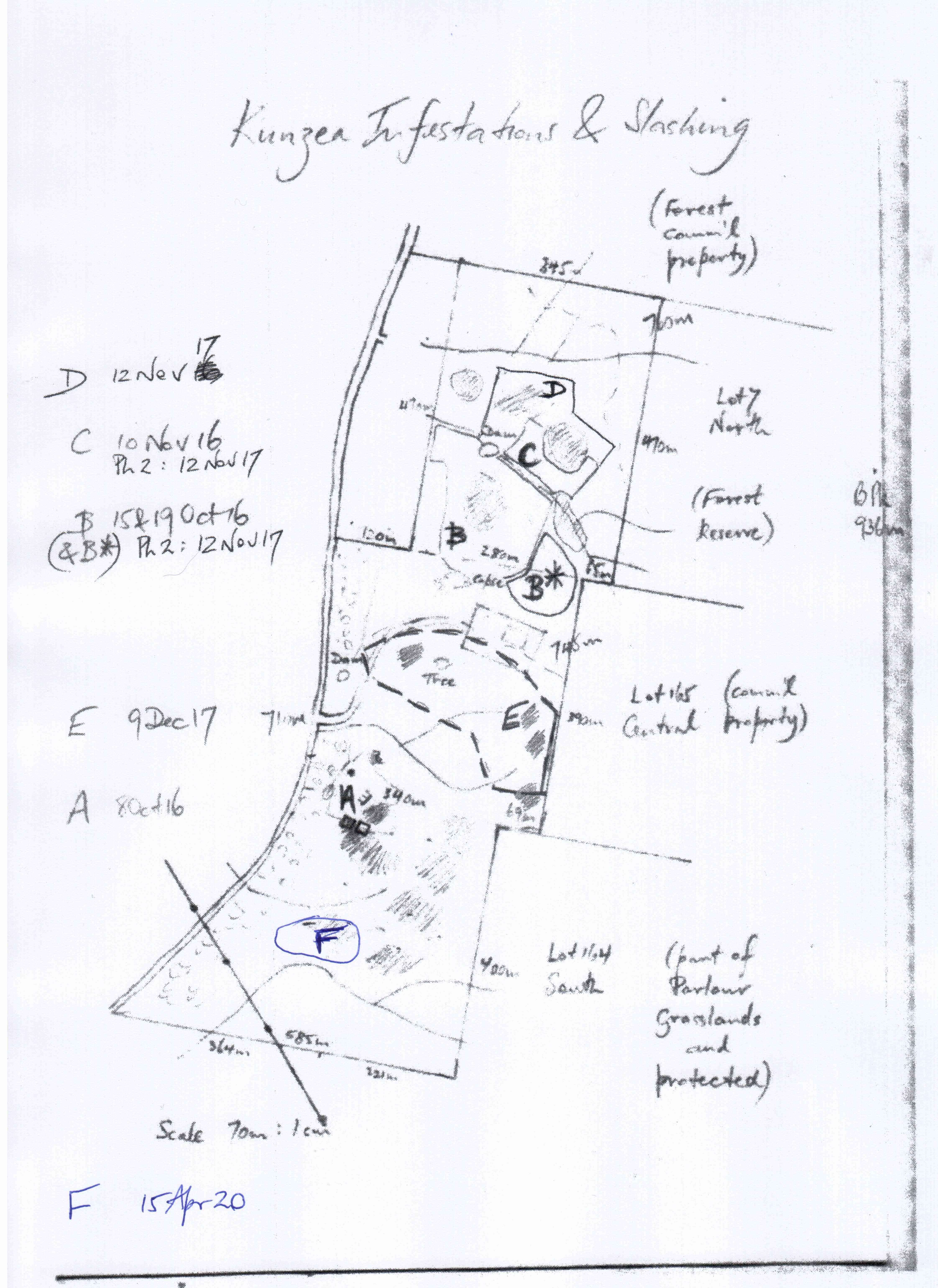
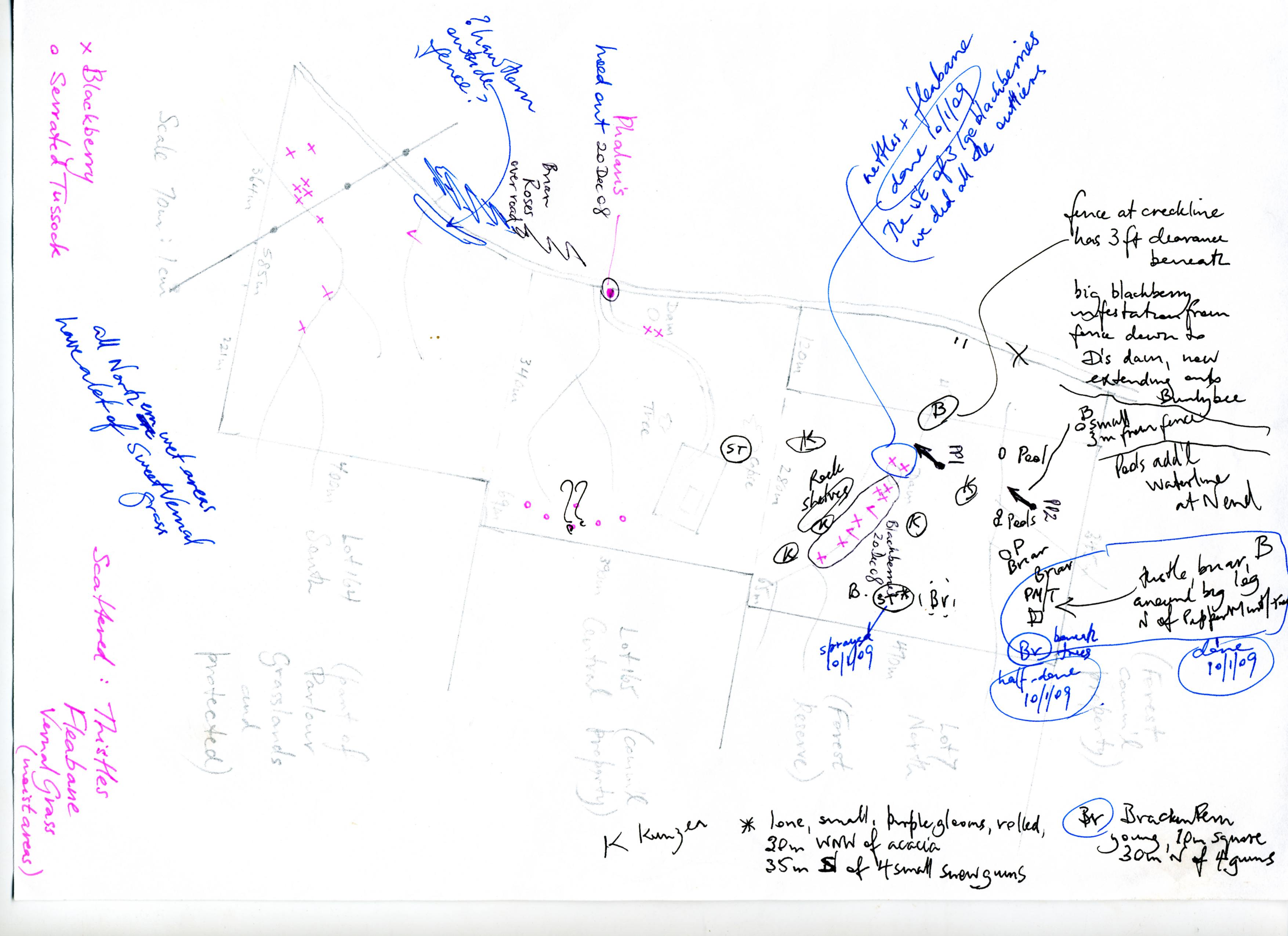
Based on our inspections of the property and information provided by NCT, we compiled this map of the weed infestations and related data.
Pre-NCT (to early 2007?). We don't know the sequence of prior owners and sale dates. And we don't know what weed attack work had been undertaken prior to NCT's purchase of the property. On the one hand, it appears to have never been intensively grazed and never to have been fertilised, presumably because of the limited water and hence limited stock-holding capacity. On the other hand, it's in great shape, which means either that the native species are extraordinarily healthy and resistant to invasion by foreign species, or that successful weed attack work has been previously conducted.
NCT (early 2007 to early 2008?). We don't know the date NCT acquired it. They conducted a small amount of work on serrated tussock, in [in late 2007 or early 2008?]. They reported what they referred to as "some isolated infestations" (about 5 locations on the upper slopes of the northern block, mostly about 50m from the forest boundary), all of which were small tussocks. They hand-pulled (because the work was conducted during a non-seeding phase of the year), avoiding soil-disturbance and leaving the tussocks on site.
They consider that larger plants are best done with chemical spraying but saw none on Bunhybee although there were some on the Parlour Grasslands, immediately to the south.
No other weed attack work was undertaken by NCT between their purchase of the property and our purchase of it from them on 22 Dec 2008.
Central and Northern blocks – toured, searching for and documenting weeds
Central and Southern blocks – toured, searching for and documenting weeds
Main northern waterline – worked down the waterline, trimmed then cut-and-painted blackberries as far down as the dam, leaving the cuttings lying on rocky ground
Northern block generally – attacked isolated fleabane, thistle and large sorrellNorthern and Central blocks – checked tussocks, searching for serrated tussocks (none found)
Title was finally transferred from NCT to ourselves, so we could now visit and work on the site without trespassing.
In Northern block, central-east:
In Peppermint corner, adjacent to the peppermint gum:
In Peppermint corner, under the trees, in the extreme NE corner:
In Northern block, centre:
In the main dam wall:
In Northern block, in the main dam wall:
|
|
|
Northern bush half-cut, southern bush
cut-and-painted |
Southern bush after cut-and-paint |
Large northern bush half-removed |
In the Middle block:
In the Middle block:
We finally made a start on the Southern block:
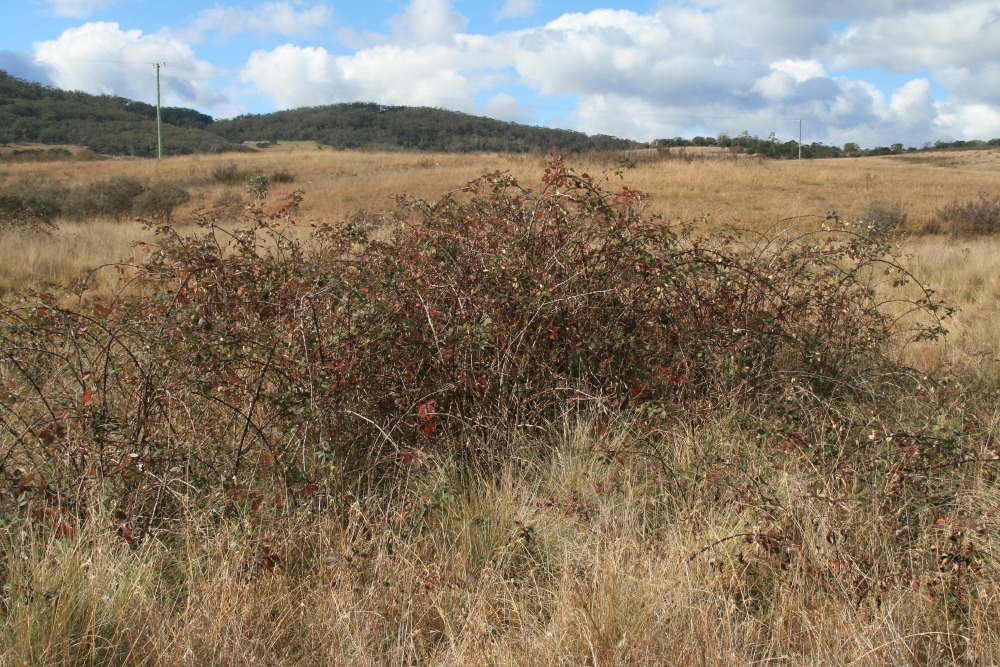 |
 |
The bush before the attack |
The bush after the attack. (We ran out of time to finish the cut-back) |
No weeding done, but:
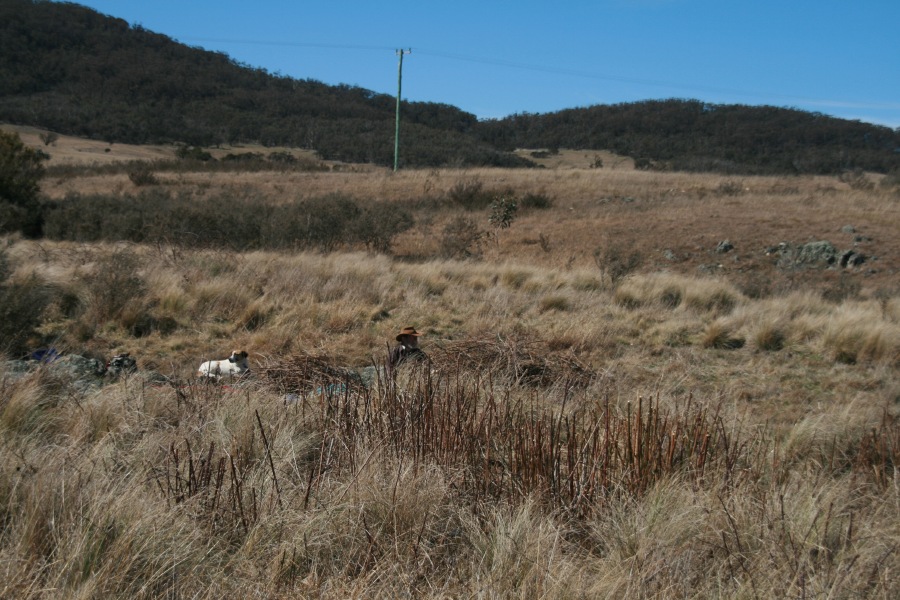
Two activities in preparation for cutting-and-painting the remaining blackberries in spring / early summer (each about 2 hours):
 |
 |
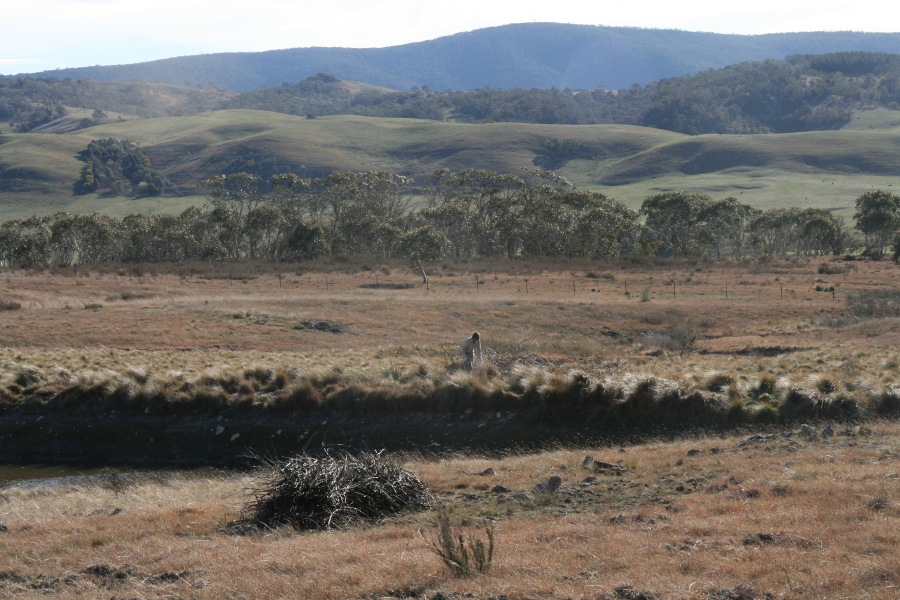 |
The main Southern infestation, after prep |
The main dam, northern bush, during the work |
Late on in the work |
The pig-damage is continuing. The rain has been very limited, and the main dam is very low, although there was some moisture in the southern water-line. The small dam was again looking to be being spring-fed.
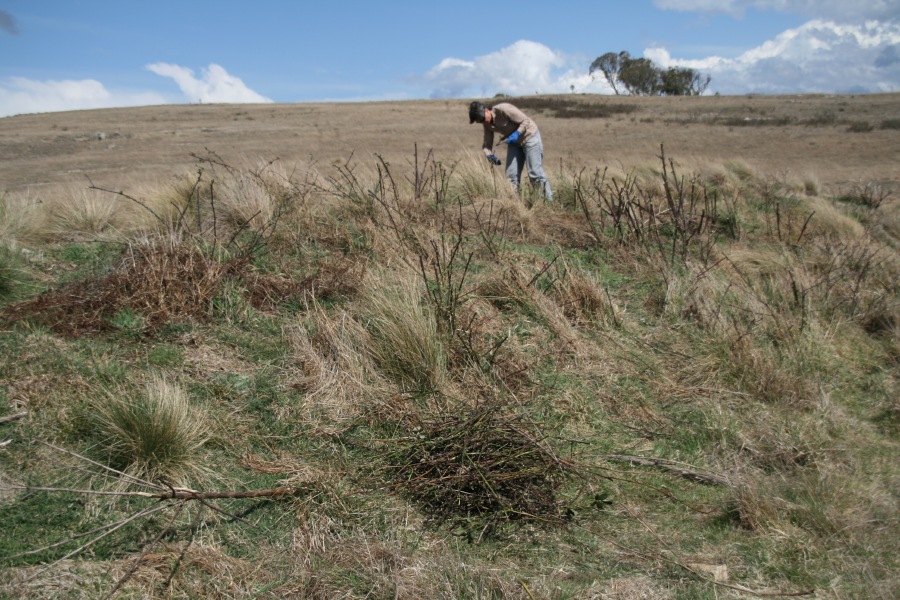
In the Northern block:
 |
 |
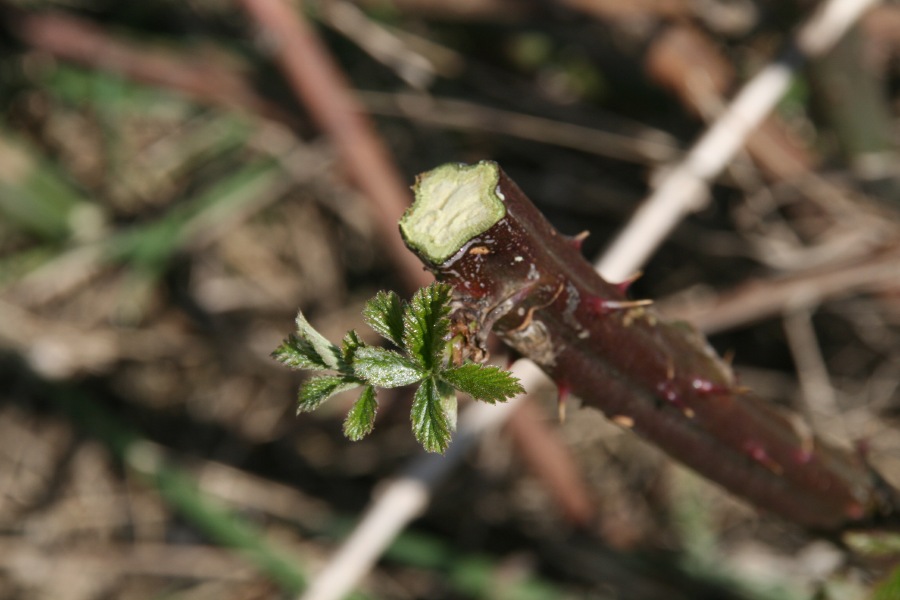 |
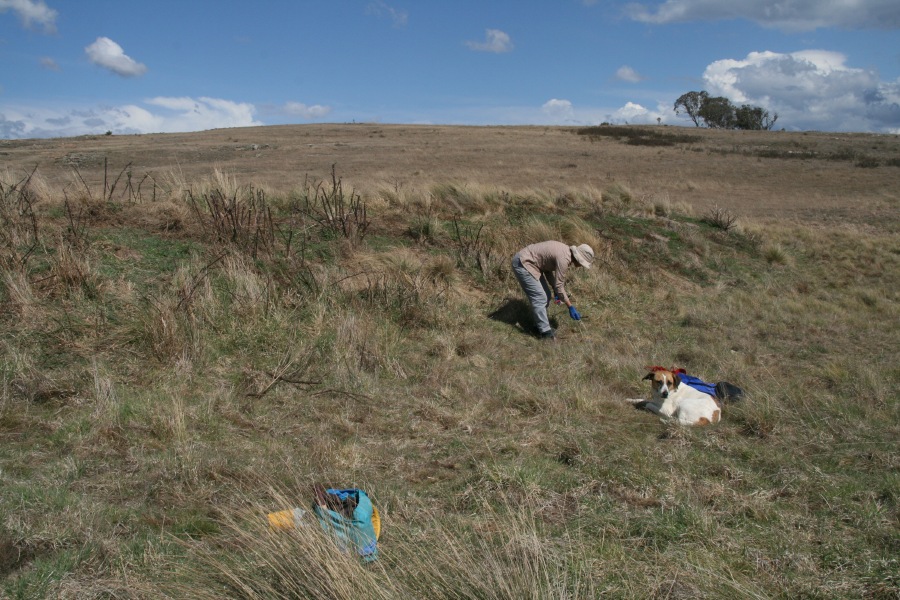 |
The end of the bush |
The act of cut-and-paint |
The result |
The work-party |
 |
 |
 |
|
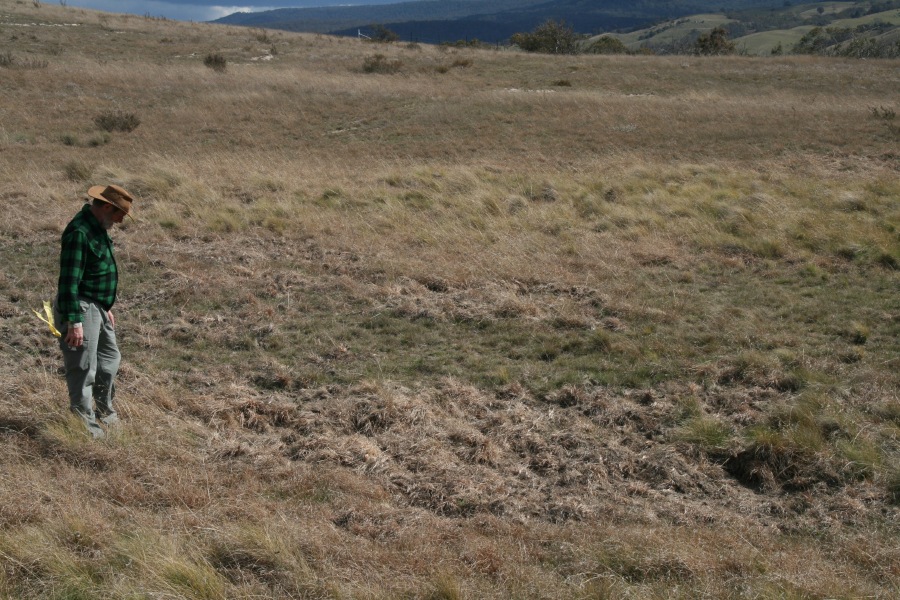
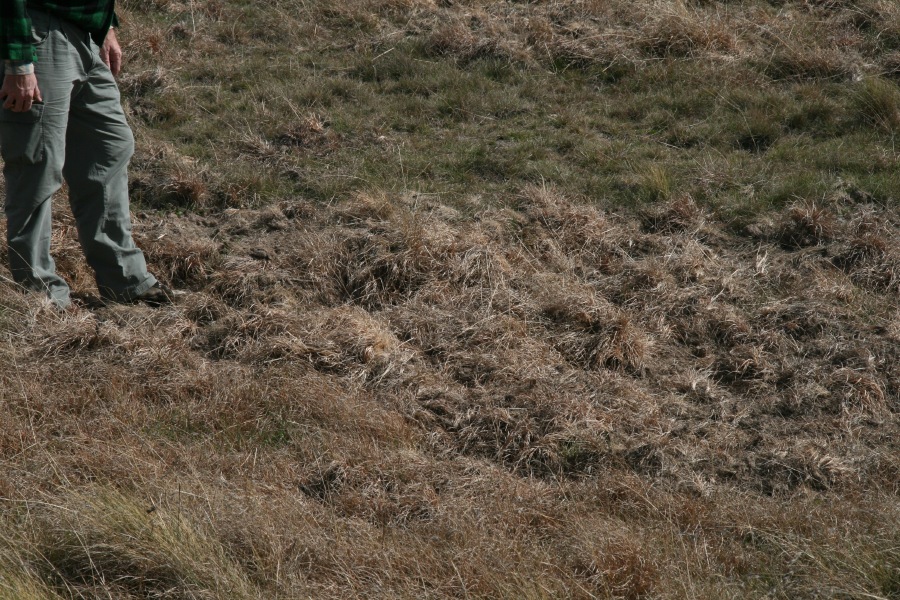
Pig-damage |
From southern end ... |
... of the dam wall |
In the gateway area:
We established dam-height measurement-points and took initial height-measures:
Visited with friends, with no intention of doing any work. Which was lucky, because it was cold, very windy, and with some rain. Quick observations at the main dam were:
The late-summer attacks on blackberries still appear to have been highly successful. The early-summer attacks appear to have been very effective, but with some re-growth necessitating re-visit in February-March.
Finally, the day had come for the assault on the serrated tussock! We felt we'd done enough trials, and learnt enough about recognising it and reliably distinguishing it from other grasses, especially a rather similar stipa – which was later identified as Stipa setacea. And it would have been dangerous to defer it any longer.
We considered using weedicide, but were concerned about the residue problem and the sheer nastiness of the chemicals needed to kill it. Here's the approach we selected (and documented in the serrated tussock part of the Weed Control Plan):
The downside of this approach is the broken ground; but the property has shown itself capable of recovering from pig-damage, and there were plenty of other species around to fill up the spaces.
We attacked two areas:
We took four large rubbish-bags of grass to the Mugga Lane tip. The contractors, Corkhills, assured us that the regular 18 months of composting was enough to kill all seeds.
A tour of the southern block was undertaken, starting in the NE corner, along the eastern side, then zig-zagging in castle ramparts formation back to the western side.
Admittedly it was blowing a gale, but not one serrated tussock was seen. Half-a-dozen thistles were pulled out from the top of the waterline. There are several blackberries at various points down the waterline, and more briar rose than elsewhere on the property, including a cluster of 20-30 half-way down.
We also took out 20 enthusiastically re-growing thistles on the wall of the small dam.
On the northern block, halfway between the copse and the house-site:
Most of the time was spent in the waterlines in the southern block:
In the moist area between the gate and the small dam, about 10 thistles, which we dug out of the soft ground
In the above areas generally, occasional healthy-looking fleabane offered themselves as victims
Near the SW corner, continued the attack on Bunhybee's largest blackberry bush on the lowest-lying land close to the SW corner. What we'd cut back on 10 May 2009 had mostly re-grown; but the clearance we did then of old canes made it much easier going this time. It was about 40 sq.m. (8m x 5m).
We did two-person hack-back and cut-and-paste on 3/4 of it. We'd previously deposited cuttings on the rock-shelves in the creek-line, but these were now covered with water (with zero re-growth from the old cuttings). So we picked a clear area of healthy grass 15m West of the bush, and piled and pressed the cuttings there.
There are two more bushes to be done, close by in that waterline. They have been encouraged by the recent rain, which left evidence of water-flow and multiple pools down the southern waterway.
 |
 |
 |
 |
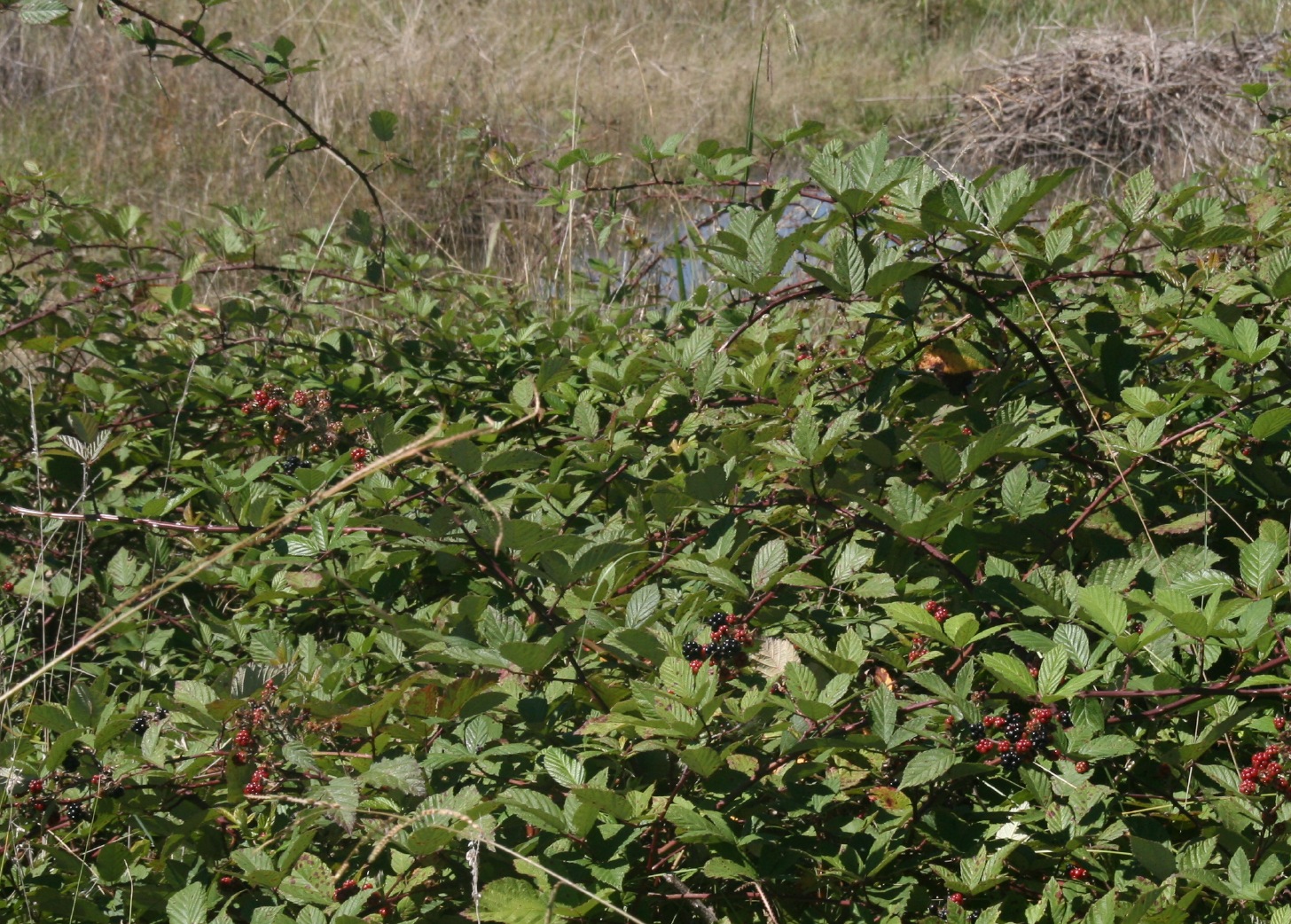
Blackberry Condition |
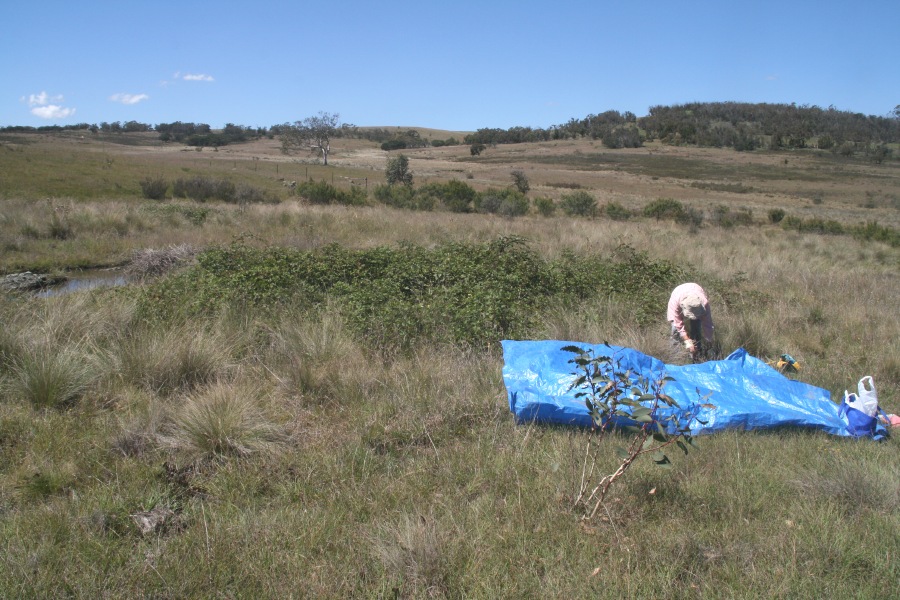
The Big Bush – Before ... |
... Near the End (only the clump on the right remains) |
What's Left to do of the SW Cluster |
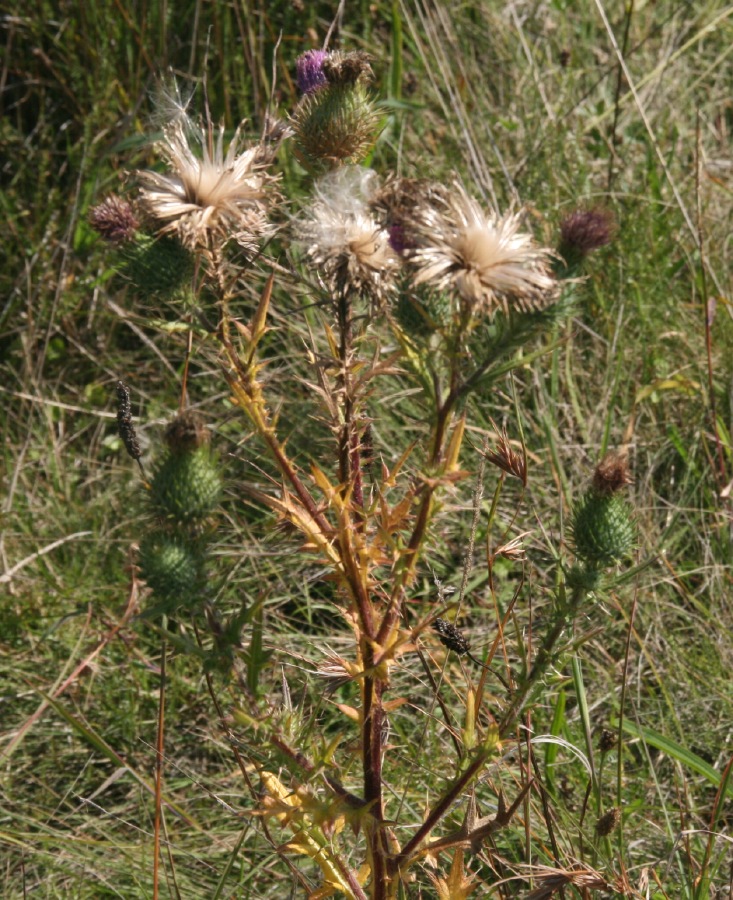
The blackberries were nearing ripeness, the rose-hips were partly ripe, and the thistles were a mix of already blown off, ready to release, and still flowering (in many cases, on the same plant). So (what with a hot summer and a busy holiday period) we've already missed the opportunity to eliminate them before this year's seed is spread.
 |
 |
Briar Rose and Thistle in the SW corner |
Condition of Cirsium vulgare Black (or Spear) Thistle |
After commitments in Canberra on Sunday morning, we did 4 hours late afternoon, and 3-1/2 hours Monday morning, staying in Braidwood overnight. On Sunday we finished the big bush, and the nearby second-biggest bush, again with Roger doing the hack-back and Linda the cut-and-paint.
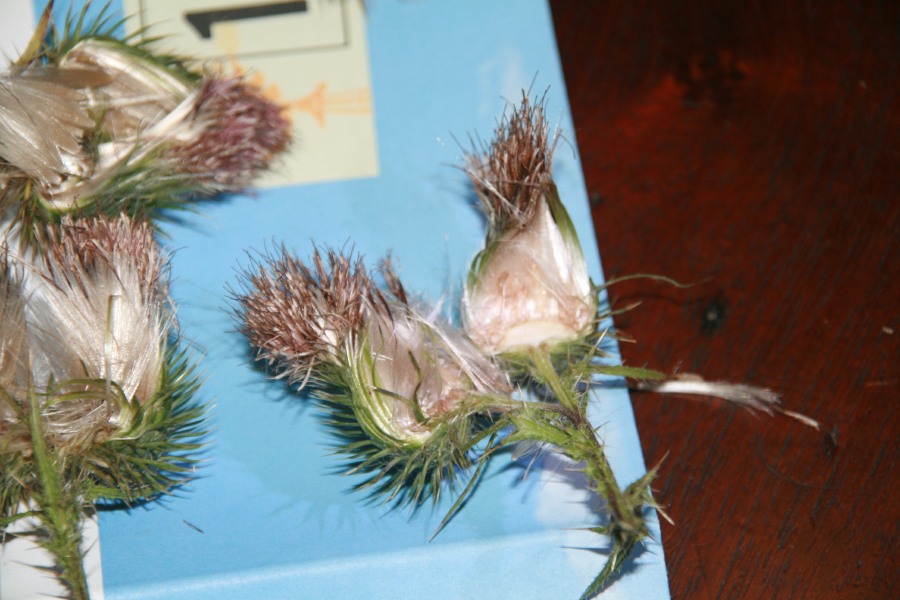
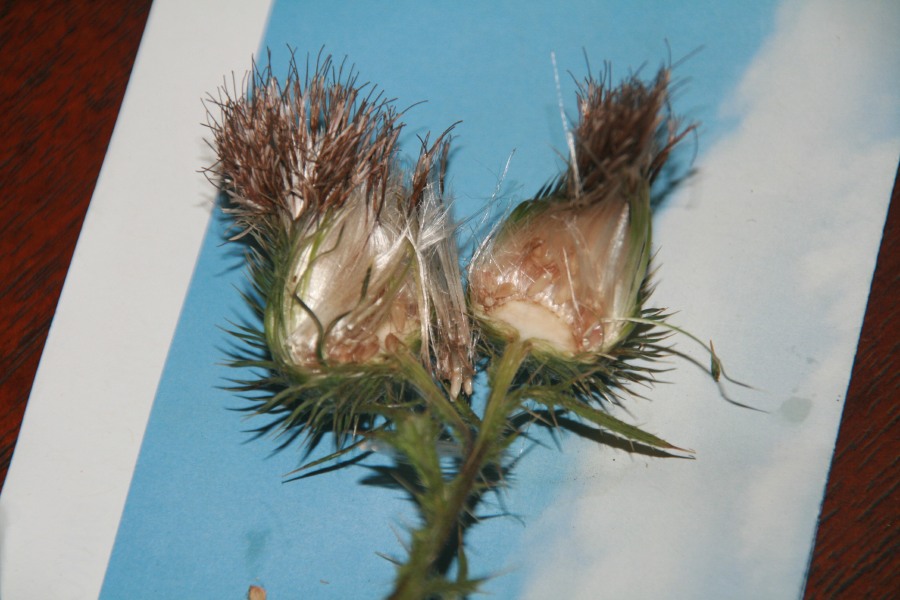
We also did the thistles at the very bottom of the water-line, close to the southern boundary, heading and bagging, and pulling the stalks from the soft soil. We collected some sample heads, and Linda later dissected them, in order to identify the seeds, and to understand at what stage viable seed is in the heads. The fully-mature head of Cirsium vulgare, even while still entirely green, may contain viable seed. Old closed heads likewise. Old open heads have probably already released it. Click on the image to enlarge it:
 |
 |
 |
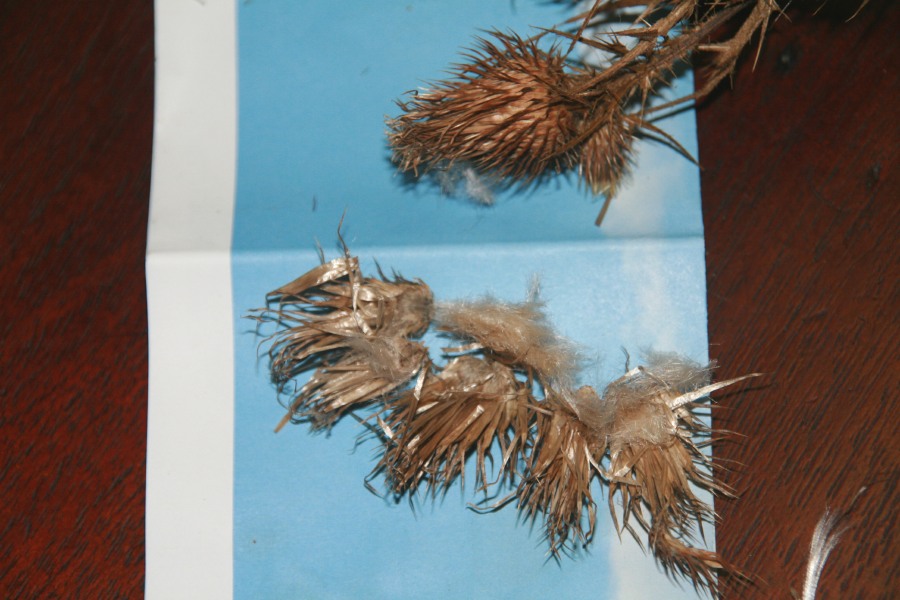 |
Mature, unopened heads |
... showing viable seed ... |
... still inside |
Old heads, after releasing seed |
On Monday, Roger did the remaining bushes at the end of the southern waterline, and we did the thistles in the half-acre or so in the waterline just upstream, i.e. in the section below where it turns from running west to running south. We also did several briar roses and fleabane, as the opportunity presented itself.
On Monday, Linda used the back-pack (for the first time), to spray the driveway, from about 40m in, back to the gate and in the parking area outside. (Linda found some suspect African love-grass, to be checked)
A very successful work-session, which brings us close to completing the first round of weed-attack work on the property.
An 'inspection' visit, with Roger's sister and brother-in-law, on Echidna Ridge and north block only. Feb 2010 saw a record rainfall of 257mm, so there was a lot of autumn growth, a full dam, and a healthy northern waterline.
The dam wall has a lot of thistles (cirsium and a couple of carduus), some resurgent young blackberry (deep in what is now very thick grass), a moderate amount of fleabane, and some paspalum.
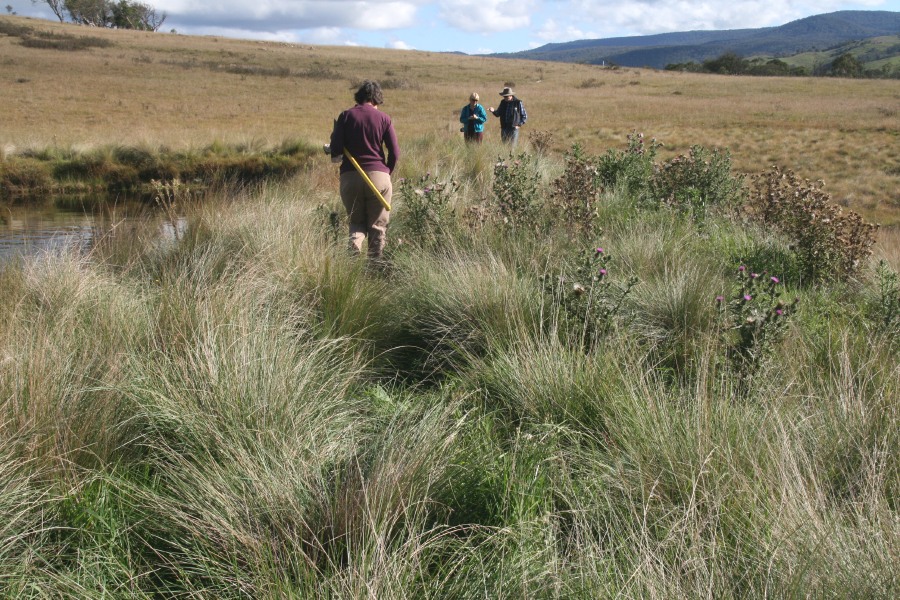 |
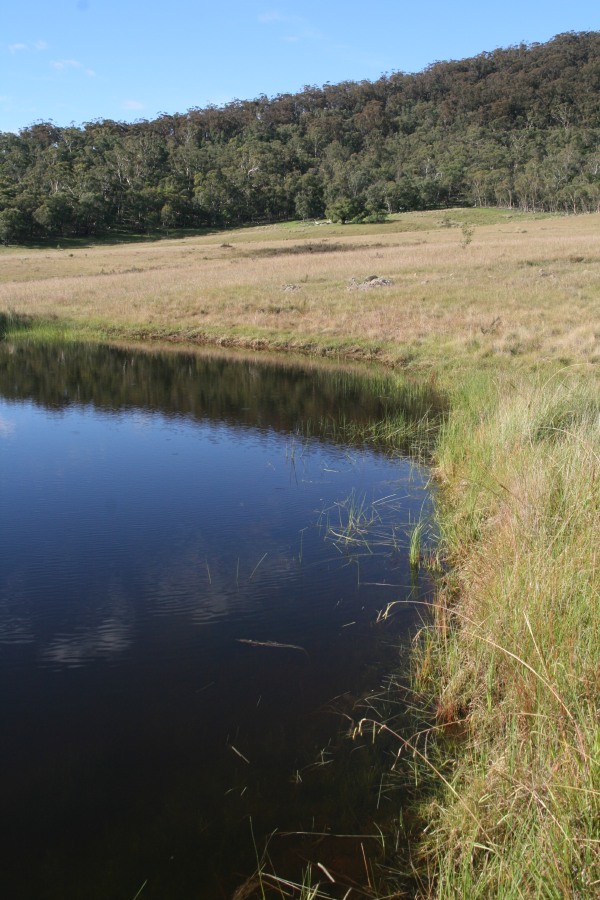 |
Thistles |
Paspalum |
The waterline has a whole two blackberry bushes: the one just above the dam is resurging, plus one small one at the very top, 15m from the eastern fence.
Picnic Corner was largely free of anything serious, although there was some fleabane (as there was everywhere), plus a few first-season thistles.
Linda noted suspect serrated tussock north of the house-block on Echidna Ridge, and mixed in with the Stipa setacea adjacent to the copse.
We attacked the dam wall, Linda cutting-and-painting the young, foolish and not very healthy blackberry runners. Clearly they were mostly new shoots from plants we did over last autumn. It still took nearly 3 hours' work though. That included a few re-shoots from the big bush at the bottom of the waterline, just above the dam.
Meanwhile, Roger be-headed c. 25 thistles and 30 fleabane, then pulled or chopped the remnants. Maybe 15 more of this year's thistles were well-and-truly finished and most of the seed had flown. The other 25 had many new heads and flowers as well as some old heads. (The biggest was 72 heads, and assuming 50 seeds per head, there were 3,500 seeds in that one plant ...).
All of the new thistle rosettes that were apparent in the long grass (i.e. next year's seeders) were then pulled or chopped. Many were more than dinner-plate size and very, very healthy.
The blackberry cuttings went on top of the crumbling pile on the nearest rock-shelf. The thistles were put in one pile immediately below the dam, with the young foliage covering the remaining old heads in the hope of reducing the amount of seed-escape. The new heads and flowers came back to Canberra, to go to the tip with the green-cuttings service.
This was our last chance for the year, close to the end of autumn, and WE FINISHED THE FIRST ROUND OF WEED CONTROL ON THE PROPERTY, 18 months after buying it.
We did the remaining blackberries:
We checked the three blackberry-cuttings piles that are not on rock-shelves. None showed any signs of throwing shoots. But we turned all three over, to expose the cuttings that had been until now the most protected, and to open up the grass that had been covered.
We did the last 15 briar roses in the water-course close to the SW corner, and a couple more further up that water-line. We took a dozen fleabane that didn't seem to have yet shed their seed, and the one remaining thistle that still had closed heads
What with spending 6 weeks overseas (mainly walking up mountains and photographing alpine flowers), we didn't get out to Bunhybee for 3 months. Michael Martin from Palerang Council then called to say that they were going to be in the area, inspecting for noxious weeds; so we joined Michael and Steve for half-an-hour or so, as they satisfied themselves we have it under control right now.
They picked half-a-dozen young serrated tussock in the areas just east of the copse, and on the eastern end of Echidna Ridge. But we think that the ones they pointed out beside the drive on the curve above the gate are actually Stipa (setacea?). Otherwise, all looked good, with a fair bit of rain obviously having fallen in the last couple of months, full dams, water lying in the waterlines, and a small spring coming up under the gateway area. Very little growth yet though, and no flowers at all. So presumably it's been a cool winter there too.
And the owners uphill have finally put 20 or so yearlings on their property.
The visit was primarily to work on the Photo-Points with Nicky Bruce from NCT. Observations relevant to weed-work were as follows. 1. The soil was moist, there were pools at many points along both the northern and southern watercourses, and the main dam was overfull (see right, above – right up to the marker-rocks on the southern end, and with a trickle around the SE corner). 2. There was very little sign of new growth (presumably because the winter had hung on until mid-September). 3. There was virtually no sign of any blackberry regeneration yet, either in the main dam-wall (see right, below), nor in the southern watercourse. |
 |
 |
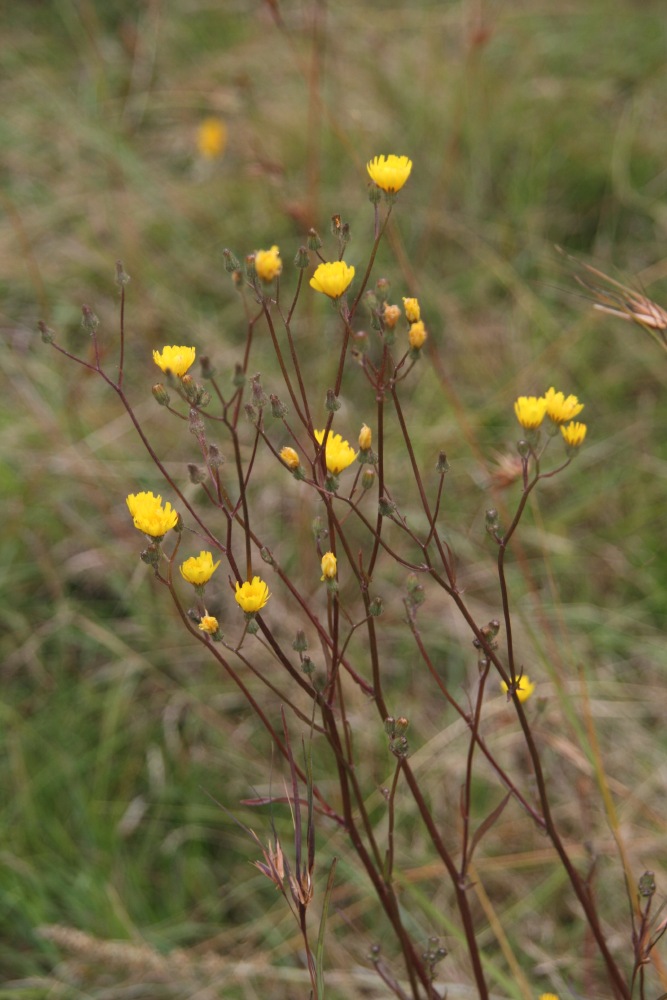
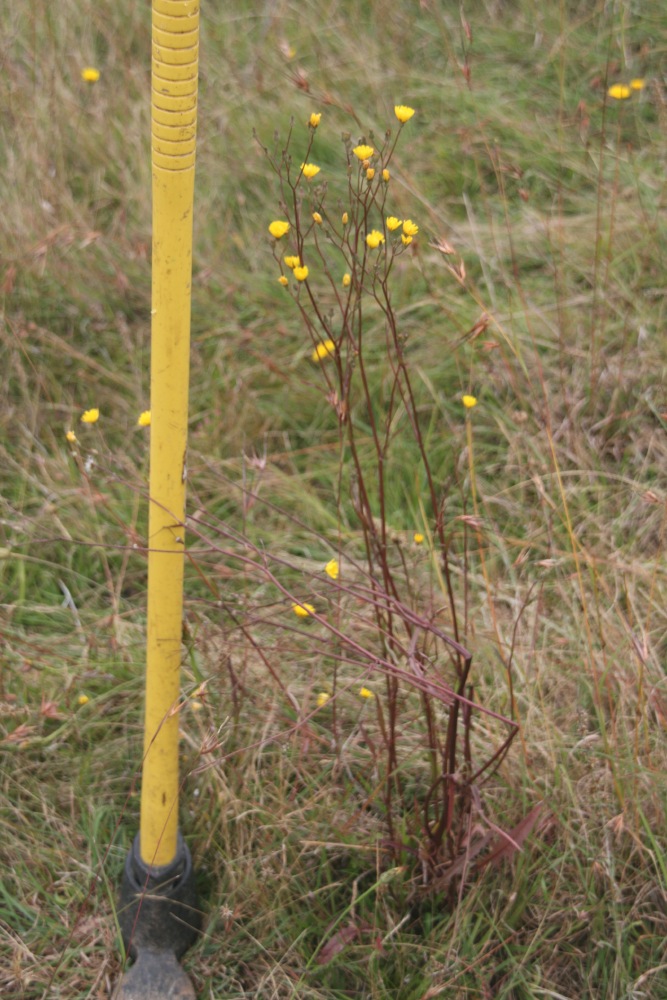
We visited mainly to see the spring flowers. We noted a few serrated tussock needing to be attacked within a couple of weeks, and Hawkweed / Tolpis umbellata appeared to be in greater abundance than in previous years.
The Yorkshire Fog and Sweet Vernal Grass were both higher than the natives and hence easier to find and possibly to treat. We are wondering about using 'Zelma's method' on introduced grasses that are intertwined with native grasses.
We took Le Gang out for their first visit. We noted a couple more serrated tussock, and:
Roger visited alone (Linda interstate) specifically to do this year's serrated tussock run. I left at 08:30 and went straight there and worked 10:00-12:30 (to avoid the 28-degree day), returning via Braidwood and the Mugga Lane Tip (at 14:45, with 40 cars queued in front of me).
The seeds were well-developed, and dark, and the stems pulled out very easily. But the stems hadn't yet lengthened, nor taken on the mauve hue of full ripeness, and it appeared unlikely that any had yet floated away. In short, the timing was perfect for (a) reliable recognition, and (b) minimum seed escape.
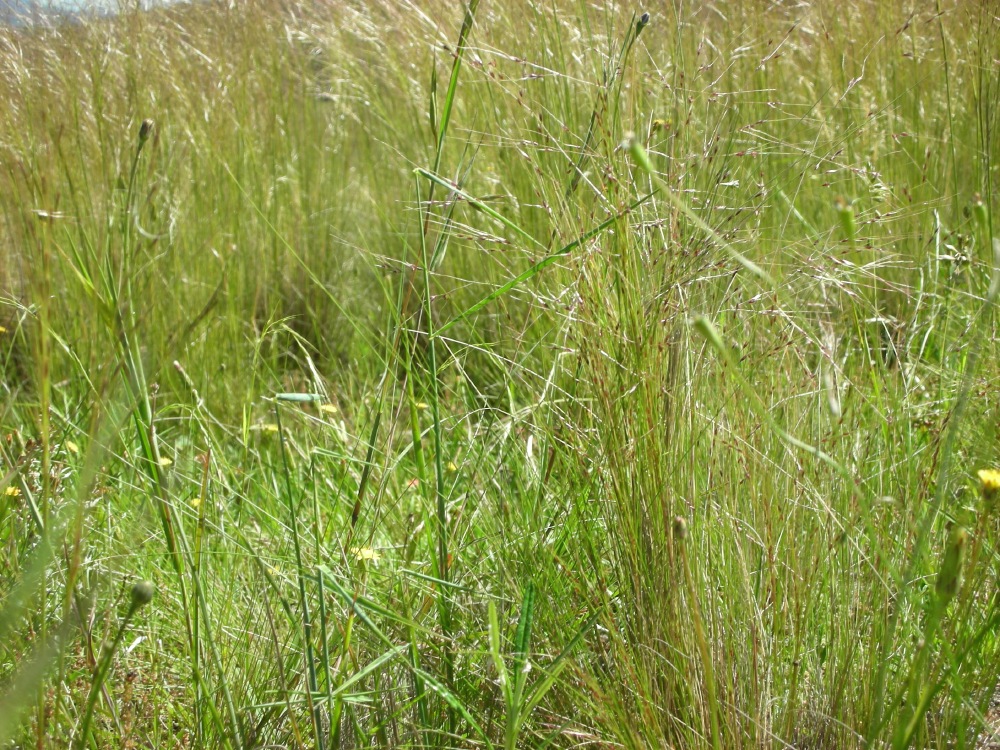
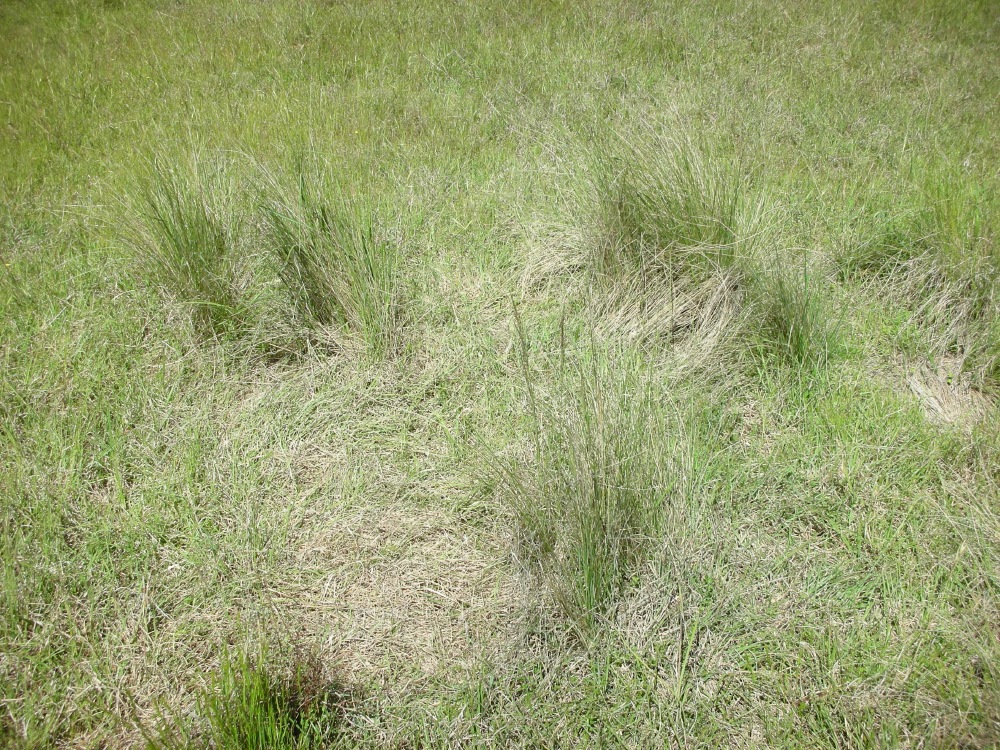
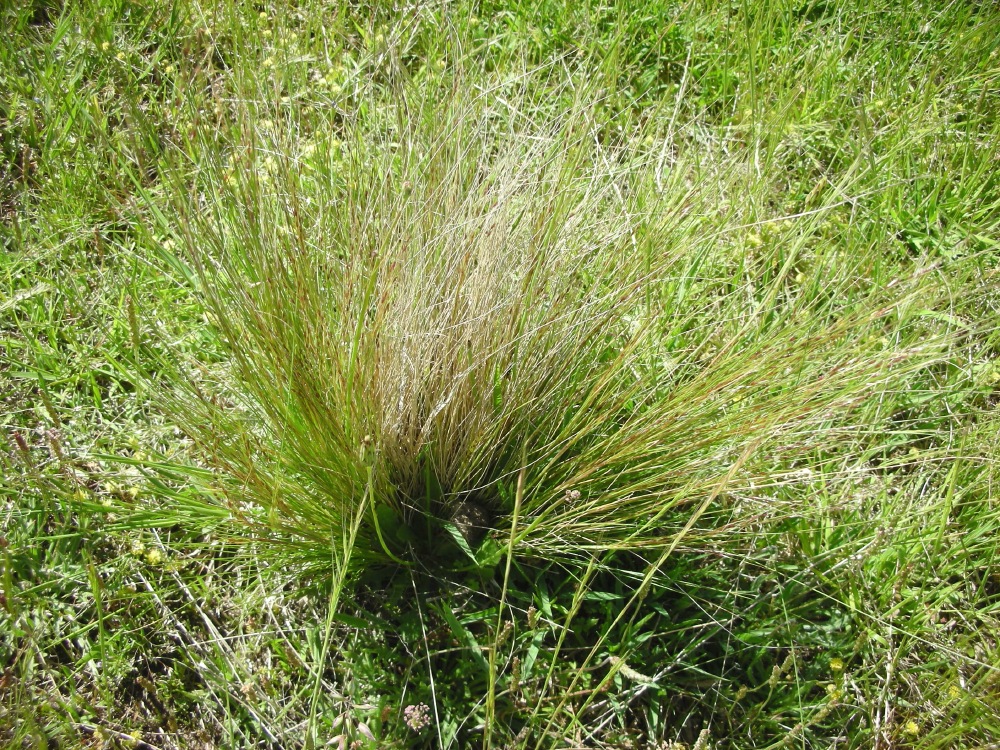
I was surprisingly confident about distinguishing the Nassella trichotoma from the several Stipa species that have generally similar appearance. The Stipas had generally lengthened their stems, and had full heads (but not yet with ripe seeds). They were greener than the Serrated Tussock, which had a sandy appearance. Suspects were easily detected at distance. But it was necessary to check that the tussock contained dark seeds, because Stipas often contain dead strands that can appear relatively dark against the live stems.
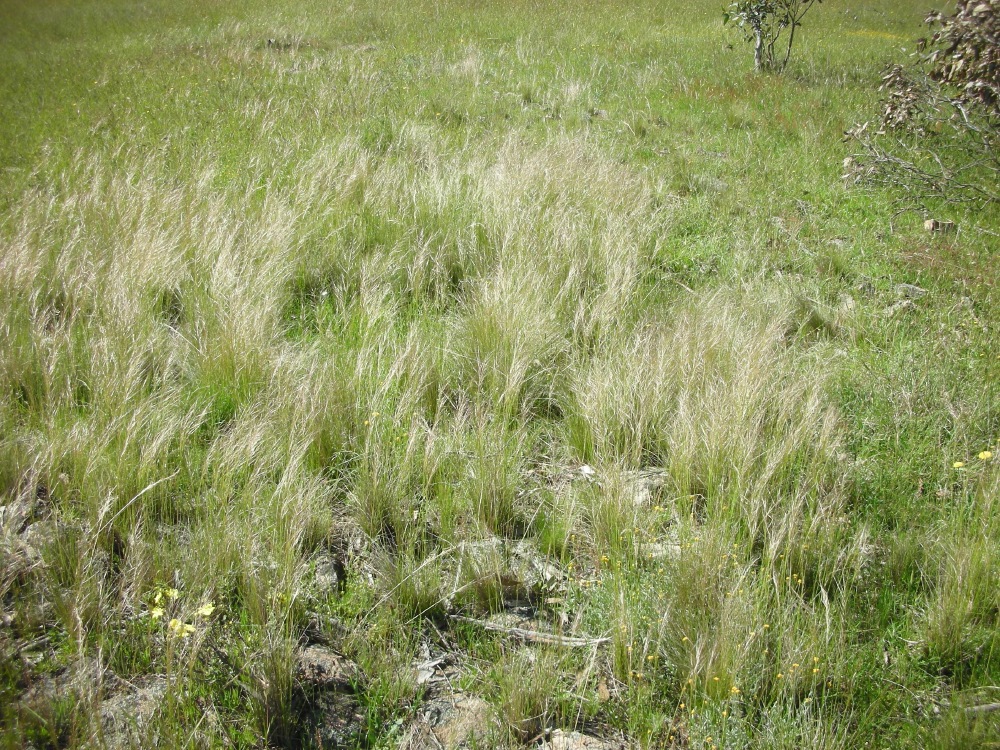 |
 |
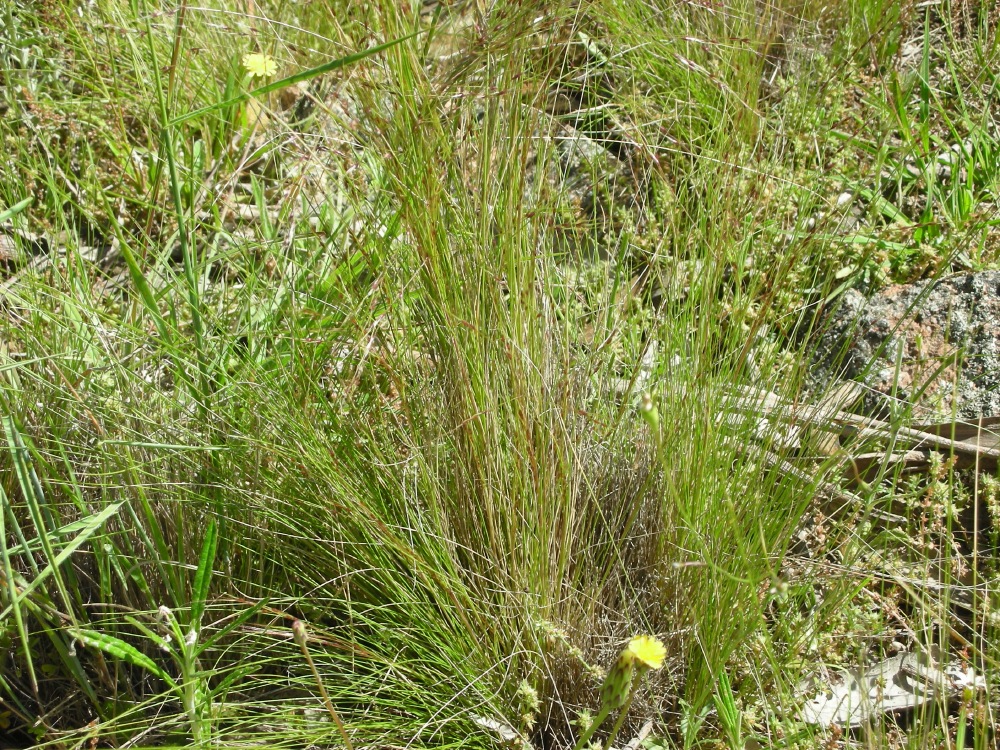 |
Austrostipa setacea, just east of the copse, with several S.T. hiding top-right |
The S.T. with the A. setacea above |
And the S.T. alone |
 |
 |
 |
Healthy Poa on the middle ridge 100m south of the Peppermint |
... close-up |
S.T. nearby, close-up |
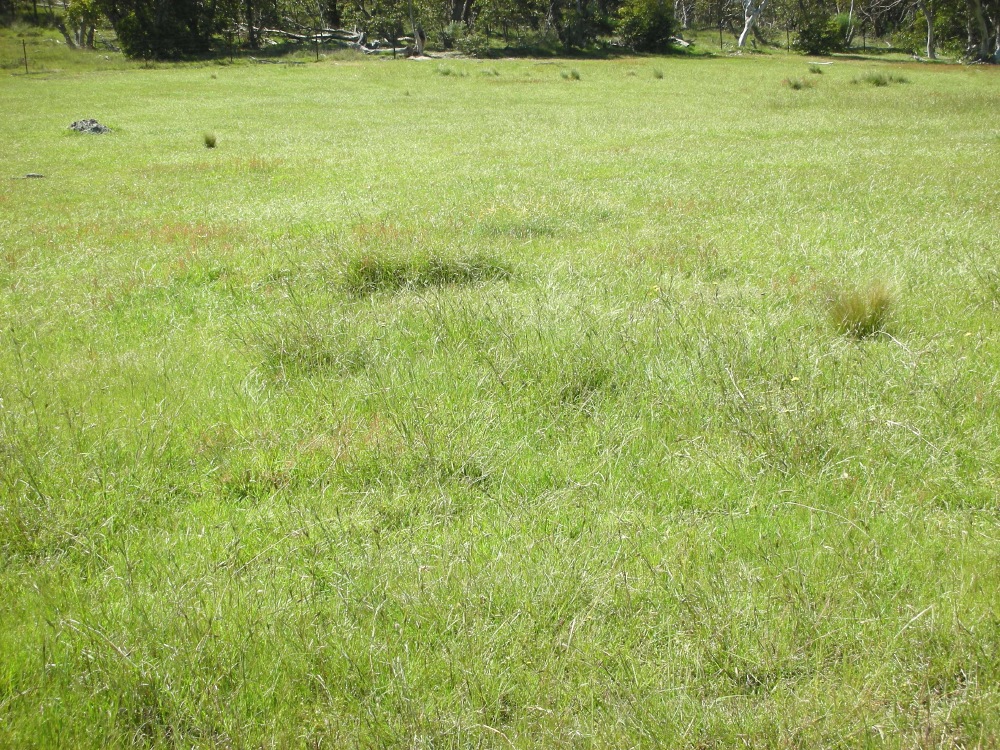 |
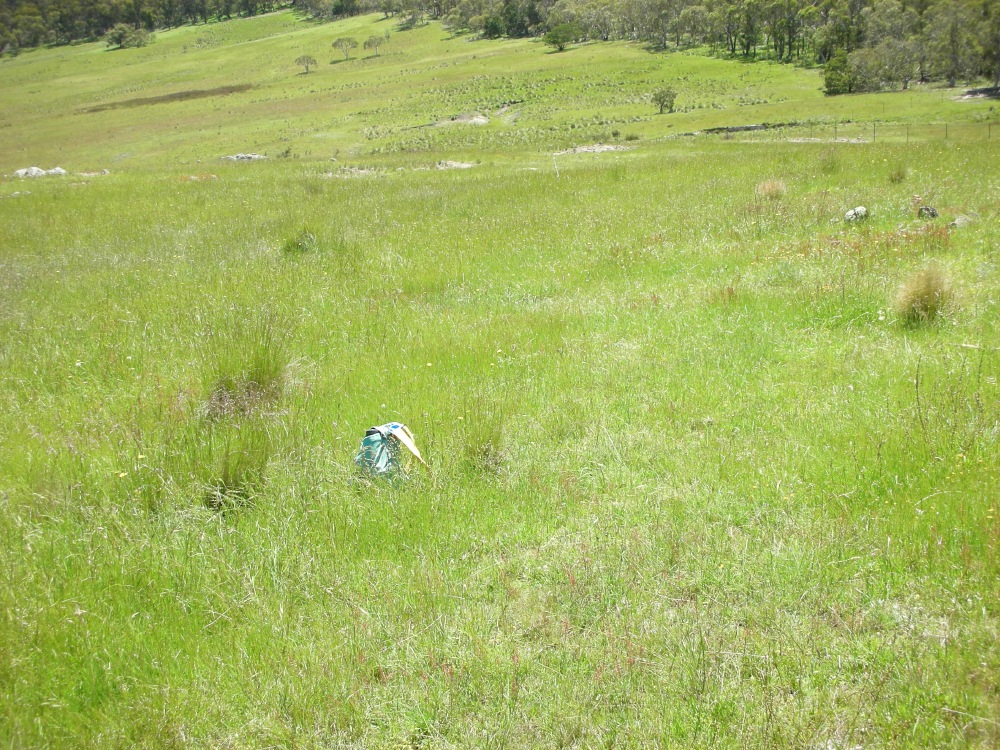 |
 |
Two S.T. on the northern ridge, from distance |
Two S.T. on the eastern end of Echidna Ridge ... |
... and from closer up |
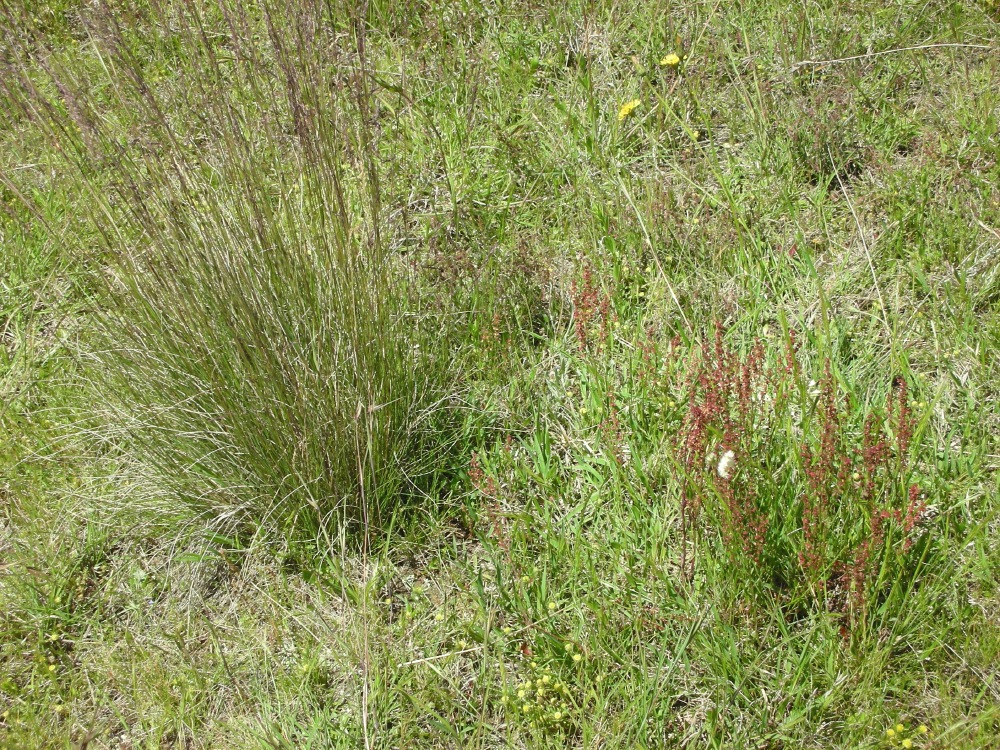 |
 |
|
A Poa or Stipa with a mauve head ... |
... and another |
I used the hand mattock to chip out all of them. (The three largest would have been easier with the two-handed mattock, because the roots were wider and deeper). I didn't shake the dirt off the roots, for fear of also shaking out seeds, but saw no evidence of any losses. I bagged all the plants, and dropped them at the (Canberra) green matter recycling area on the way home. The locations worked on (which are all that we're currently aware of) were as follows:
I failed to walk over to Picnic Corner and deal with the half-dozen thistles – which was a bit dumb, given that I had secateurs and bags with me.
I pulled up the only two Fleabane I saw during the day.
There had been close to 100mm of rain during the preceding week, and both Jerrabatgulla Creek and the Shoalhaven were the highest we've seen. There was plenty of water in the water-lines (including some flow in the main, northern line), a full main dam, and water in the small line adcaent to the path. There was no sign of any damage anywhere in the northern and central blocks (but we didn't get down to see the southern waterline). The spring on the road just outside the entrance was evident again, bunt not doing much damage.
Linda did a trial of Zelma's method on the Yorkshire Fog, The test-area is just inside the gate, on the left of the track, north 10m, then east 15m, staying south of the line of bushes.
At the end of the day (with the wind easing off), Linda trial-sprayed the centres of Yorkshire Fog clumps either side of the bend in the track, and the centres of a few Phalaris clumps (5 litres of water, with 50ml of glyphosate plus dye).
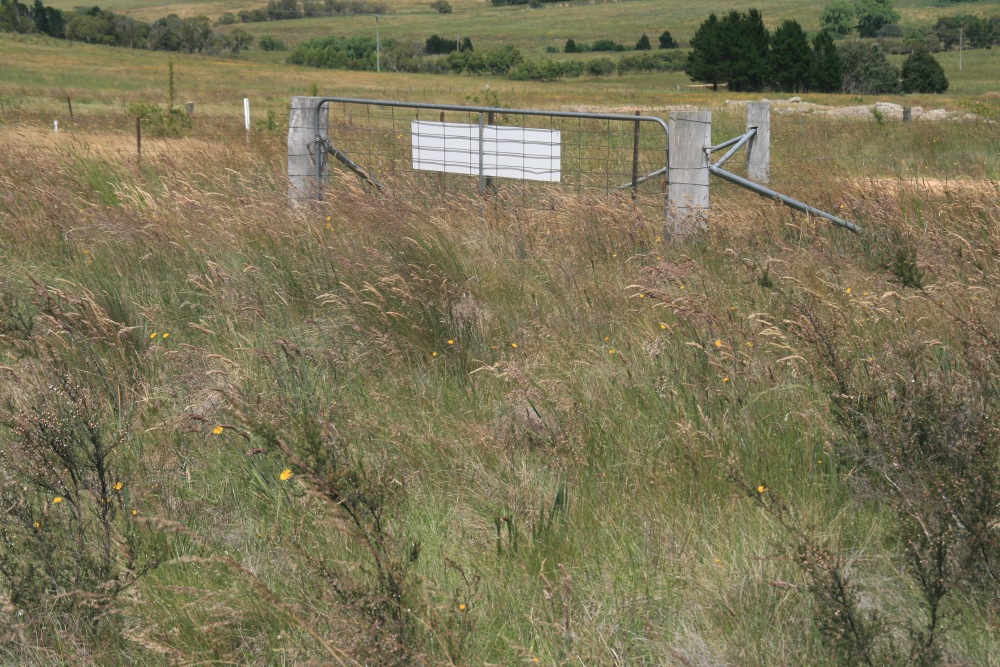 |
 |
 |
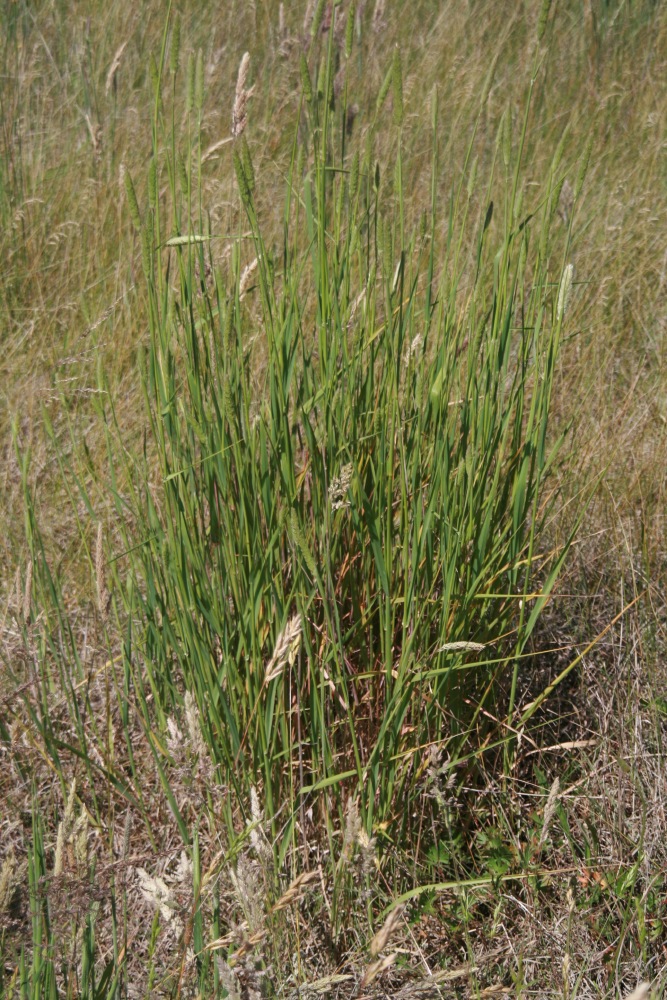 |
Yorkshire Fog ... |
... in the Zelma's Method Test Area ... |
... and sprayed |
Phalaris, sprayed |
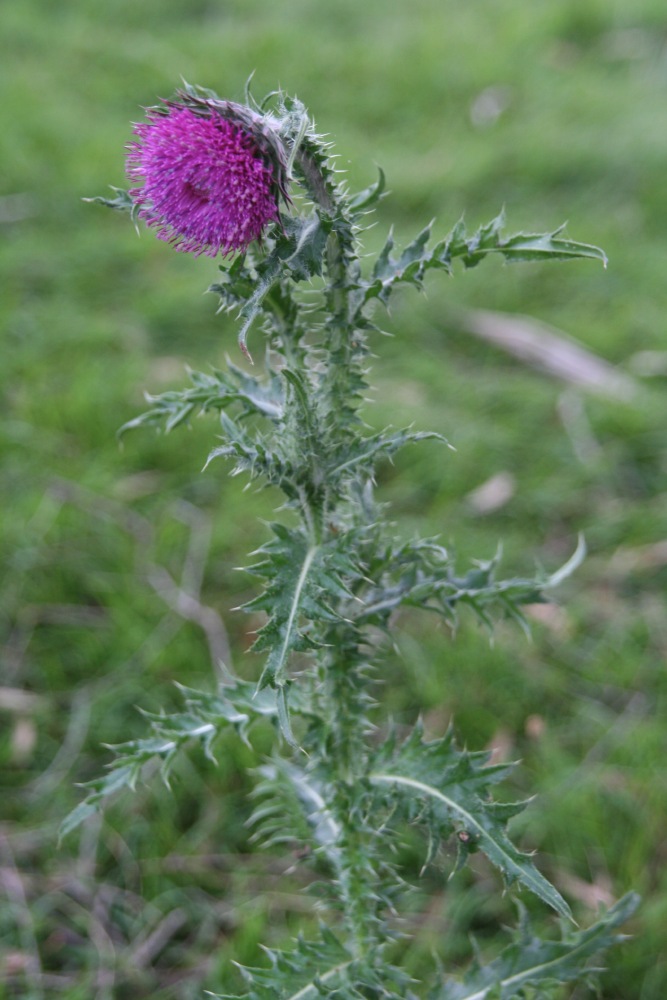
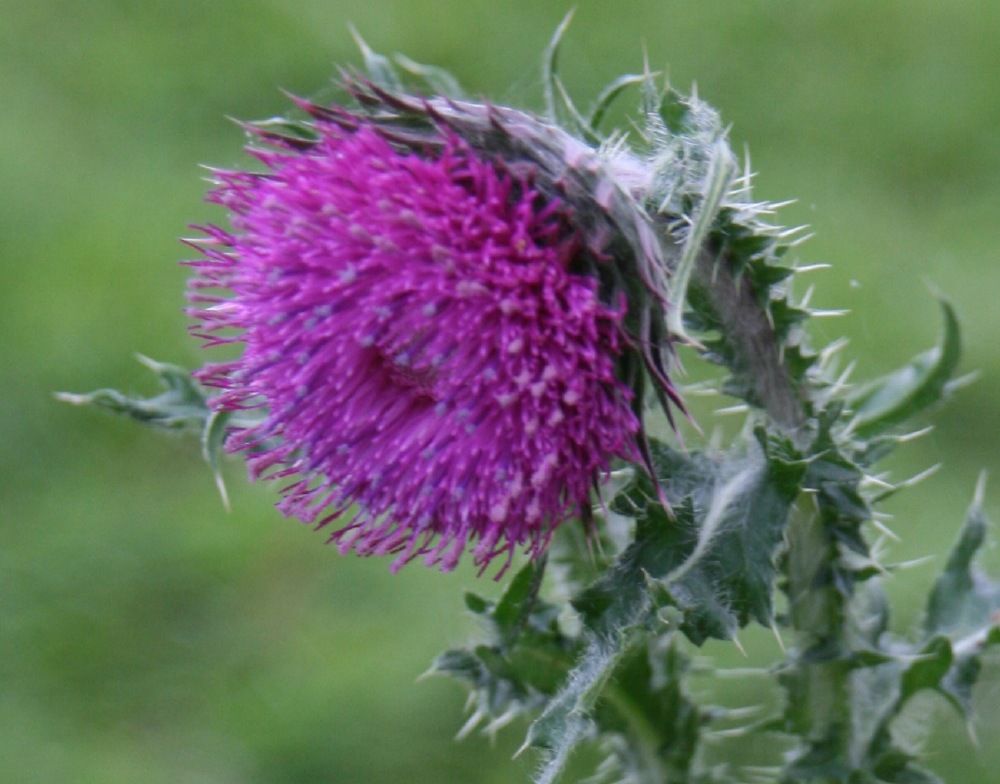
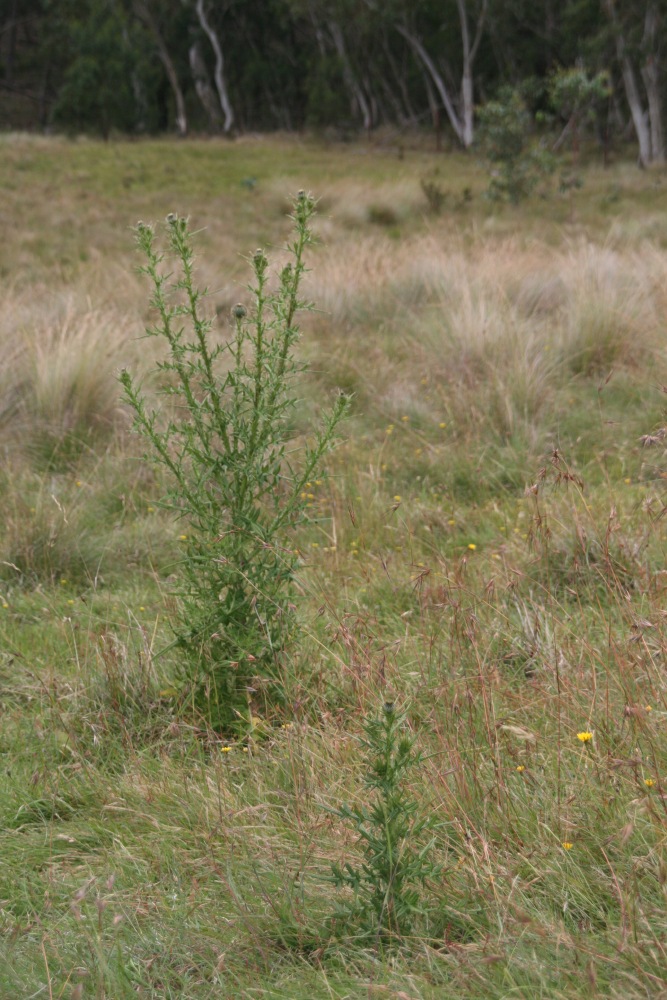
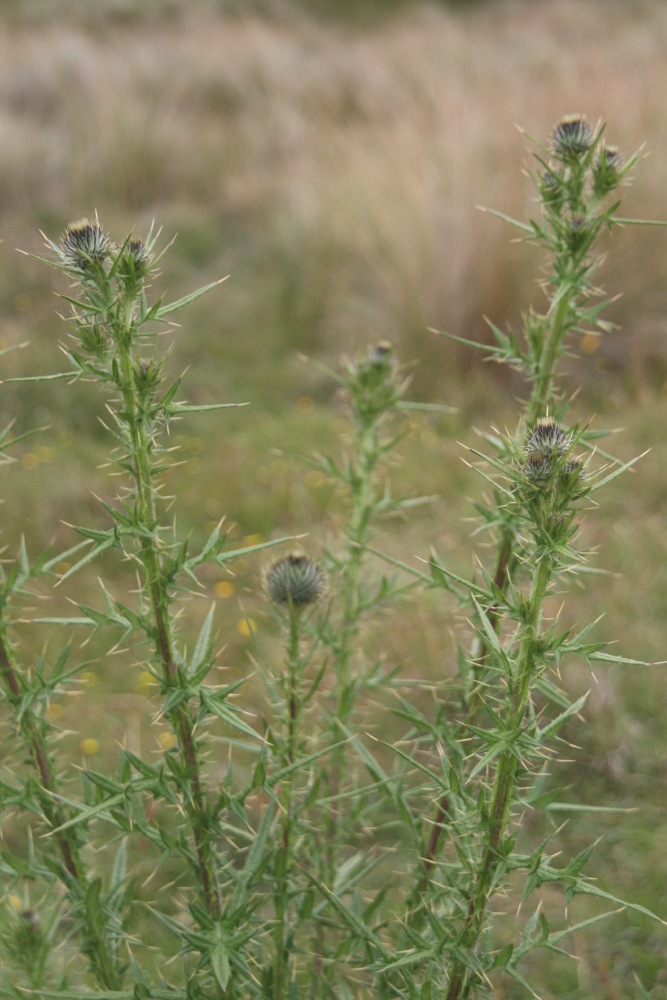
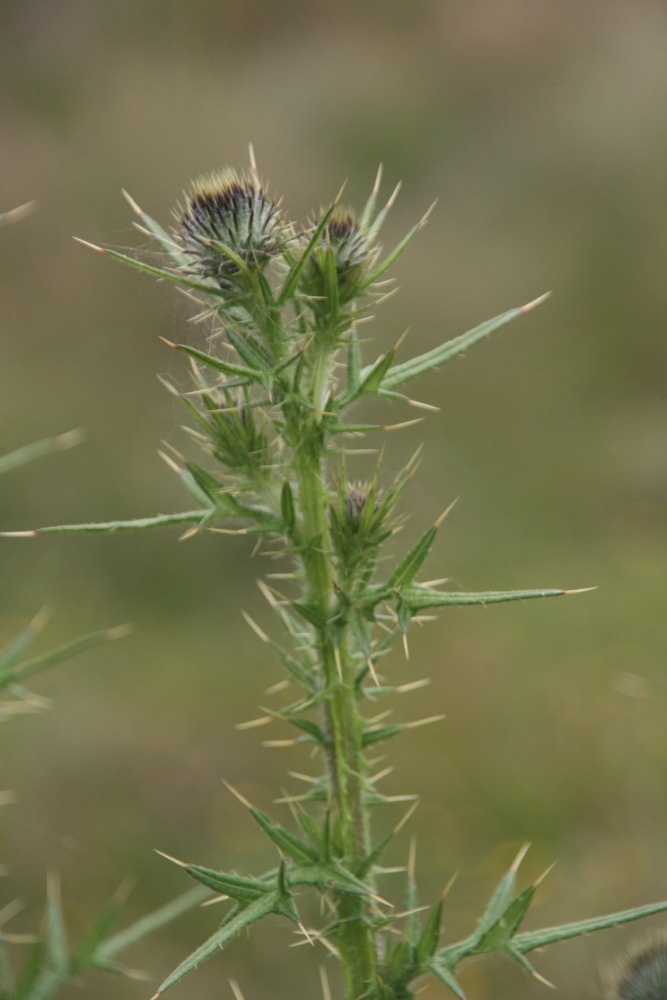
Roger dealt with a dozen thistles on the main dam wall, half-a-dozen under the trees in Picnic Corner, and a dozen near the large fallen log, several of them very large. Linda dealt with a dozen thistles on the small dam wall. Only a few needed to be headed and bagged first. We're not entirely sure of our species, but there seemed to be more Carduus nuttans and less Cirsium vulgare. And there was a new species – 4 or 5 plants, two very large, alongside the large fallen tree – Carduus tenuiflorus (Winged slender thistle), which has a much smaller purple flower.
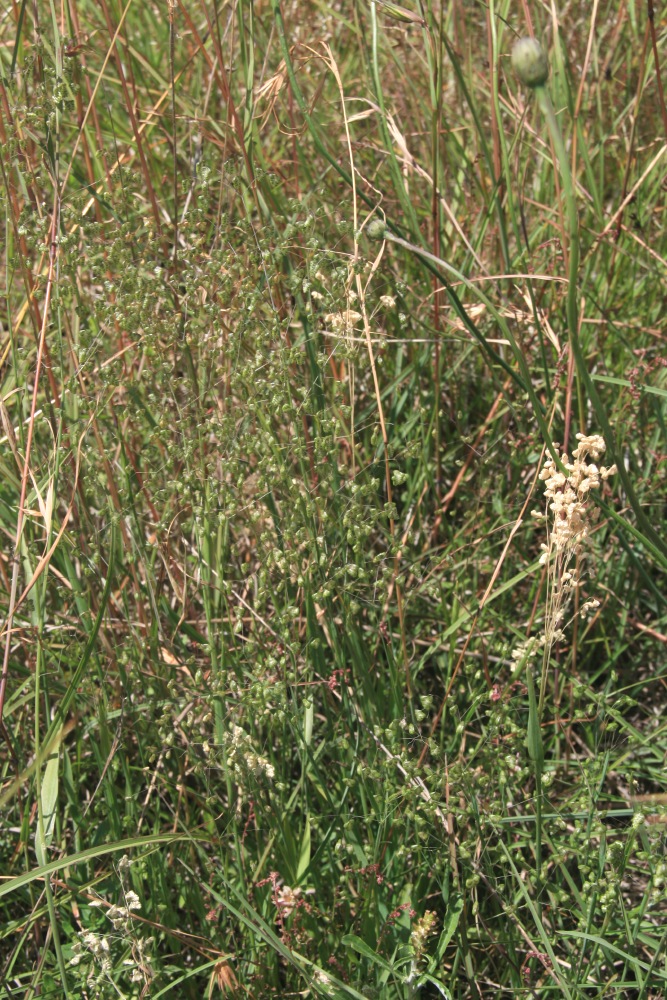 |
 |
 |
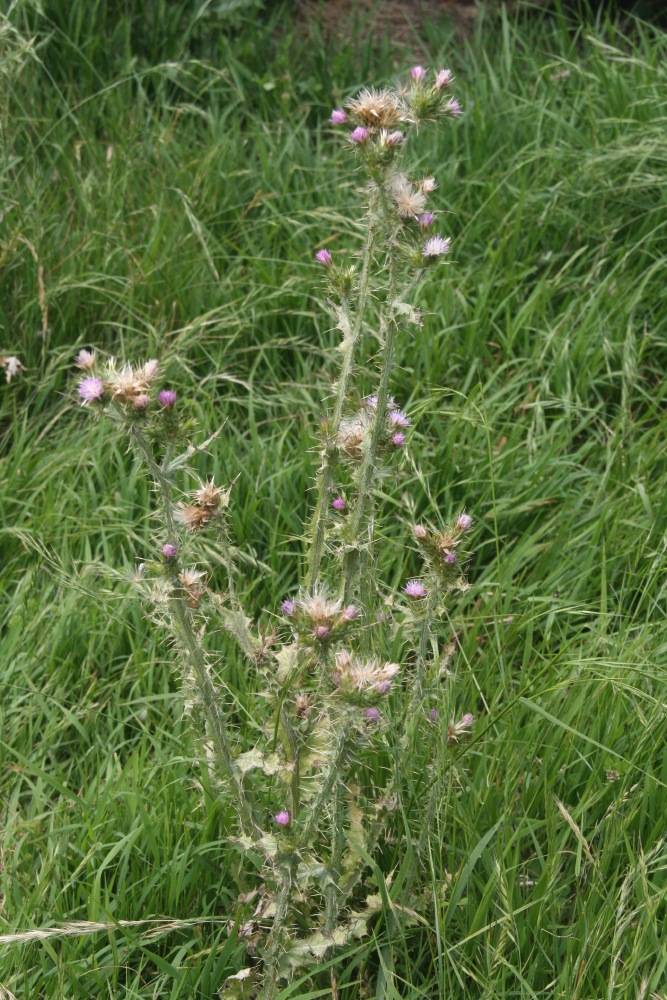 |
Briza minor |
Carduus nuttans |
Carduus tenuiflorus ... |
... Winged Slender Thistle |
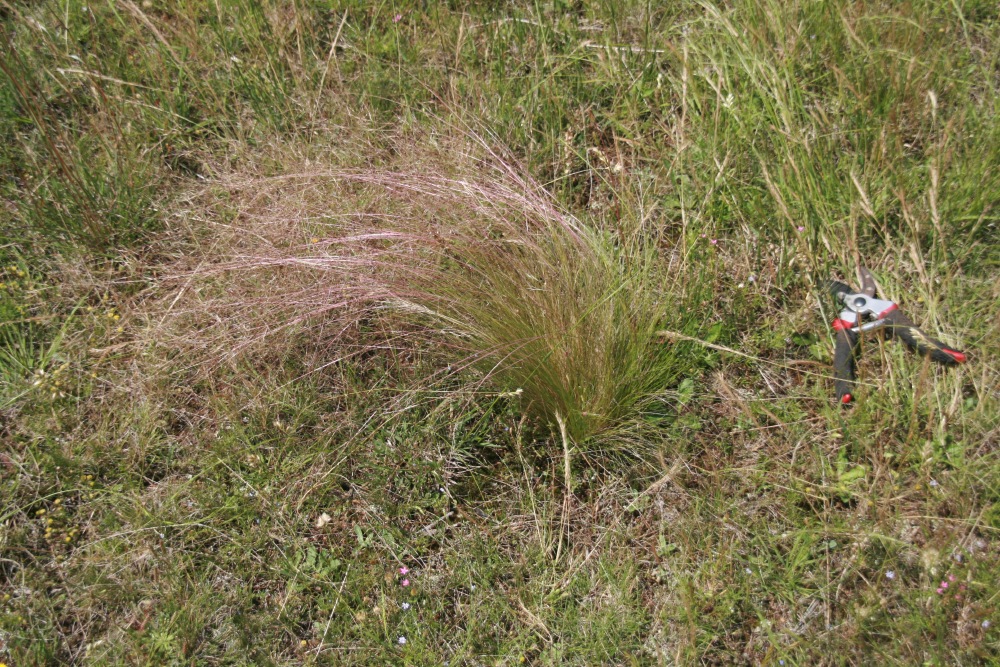
During the circuit, Roger found 8 serrated tussock that he'd missed in the previous round, one or two in each of the areas it's previously been found in. Most were obvious from 20m and even 50m distance – pale straw from distance, mauve stems from nearby, a very fine tree with very dark seeds in it fromclose-up. The difficult ones were the 3 tightly interwoven with Stipa setacea just east of the copse. All but two had to have the seed-heads carefully headed (secateured or drawn) and bagged. The seedless tussocks were left root-up.
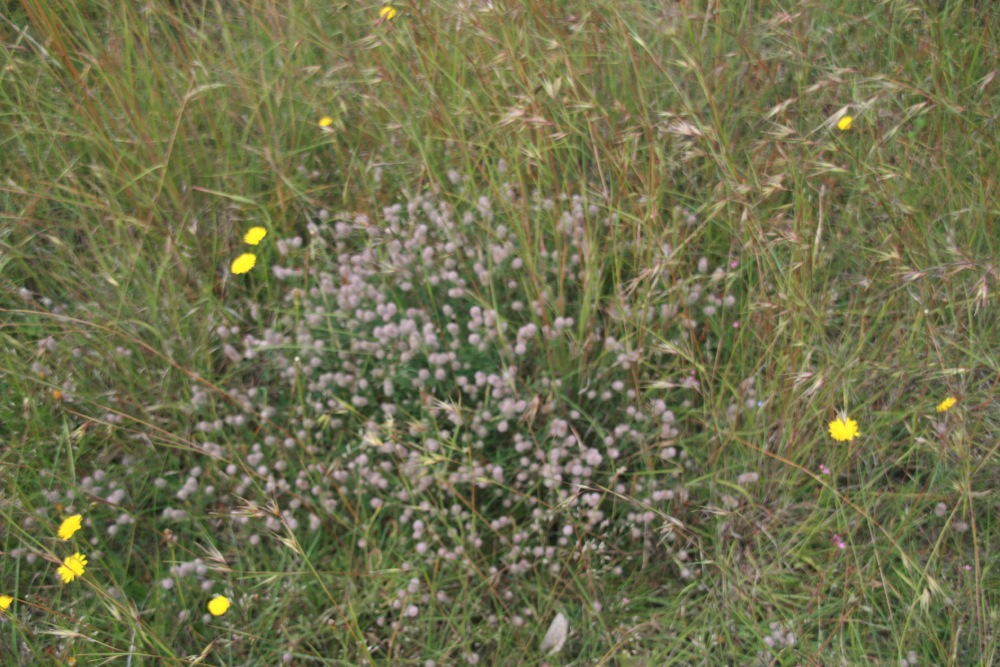
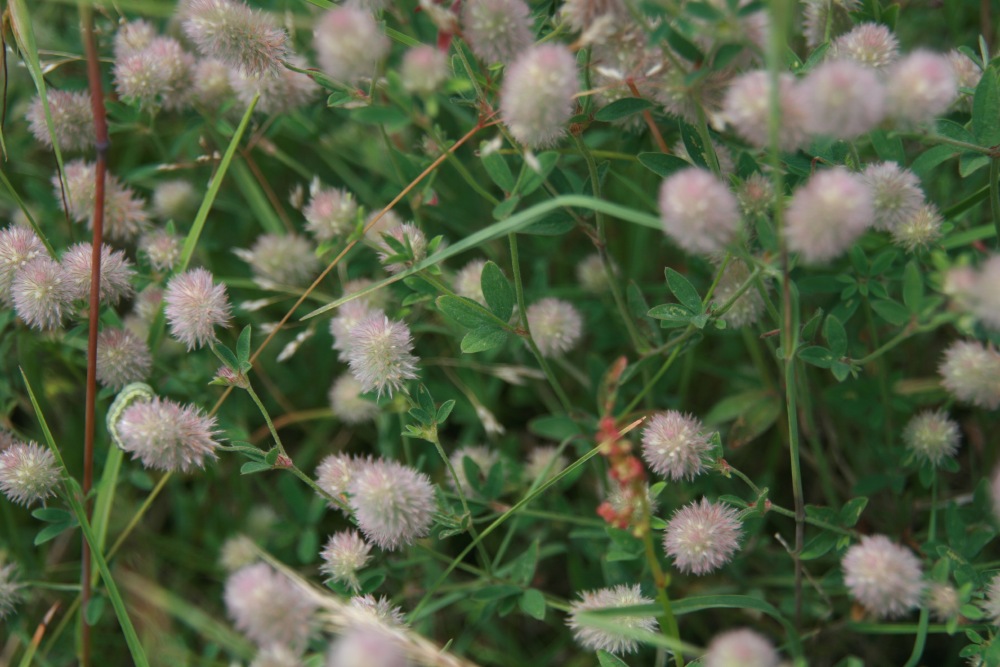
We found several clusters of Trifolium arvense (Hare's-Foot Clover) – also a new species – in the area just SE of the copse. Pulling them out was a bit tedious, because they seem to have multiplied very quickly.
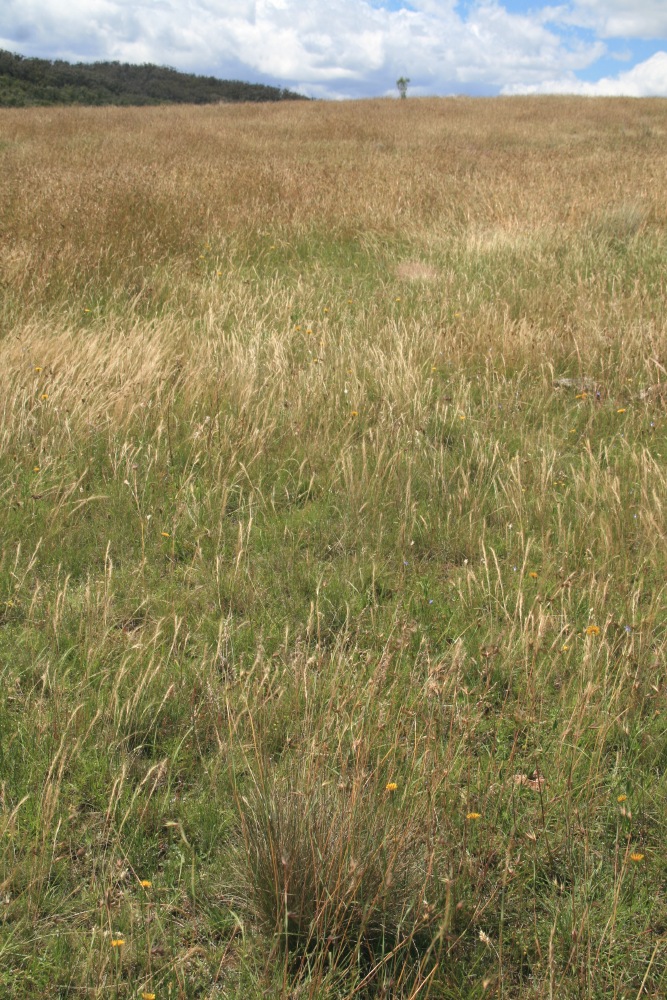 |
 |
 |
 |
Serrated tussock, from distance ... |
... and close-up mauve stalks |
Haresfoot Clover ... |
... Trifolium arvense |
The main purpose was to thin the Themeda. The report on that is on the Grasses page. During our travels, Tim Booth picked out about a dozen Serrated Tussock that we'd missed in various locations on Echidna Ridge. The heads were partly flown and partly intact, and needed to be drawn and bagged, and the tussocks uprooted. Tim also commented on some Vulpia / Fescue near the gate and on the very eastern end of Echidna Ridge.
| While Roger was accompanying Tim on the rounds, Linda unloaded 3 x 10 litres of diluted glyphosate mainly on Yorkshire Fog, working inwards from the gate-area and south along the snow-gum fringe, plus the growth in the driveway. That included some small natives, but she left the Poa lab growing there as a 'scraper', to get un-wanted weed off the bottom of cars going up the drive. | A photo on 20 March suggests too much collateral damage:  |
An inspection of the southern blackberry site suggested some limited re-growth – amidst deep grass from the wet season, far too much of it Yorkshire Fog:
 |
 |
||
No Blackberries ... |
... and few Blackberries |
||
 |
 |
 |
 |
Holcus lanatus Yorkshire Fog (Intro'd) ... |
... 50m south of the Gate ... |
... further south ... |
... between the creeklines |
Things had been a bit busy for the 11 weeks since Tony (Roger's Dad) passed away on Christmas Day 2010, so the late-summer attack on the blackberries was a bit later then intended. Fortunately, the summer's been long (although not hot, and unusually wet). So we weren't too late, and few plants were showing red leaves or other autumnal signs. Unfortunately, the summer has been a fantastic growing-period, not just for the natives, but for the blackberries as well.
We'd hoped to knock off all the new blackberries in the lower end of the southern waterline, and get up to the dam-wall in the northern block to attack those as well. Some chance! What we achieved was:
 |
 |
 |
SW corner blackberries ... |
... 80% done that day ... |
... by late afternoon |
We did the second half of the job we'd intended to finish on 12 March. It was an overcast day with occasional light showers. There had been reasonable rain beforehand, the waterways were all full, the upper southern waterway was actually trickling, and there was vegetation growth on and in the main dam that we hadn't seen before:
|
 |
After a long break away from the property (including 5 weeks overseas), we re-visited, with friends, on an overcast and cold day. Weed-relevant activities were:
We finally got back after a further 2-1/2 months' break away from the property over the dead part of the year (including 4 further weeks overseas for Linda).
The long drought of 2000-09 (77% of average annual rainfall) broke about the beginning of 2010. Calendar 2010 was 1045mm (138%), and the 9 months to Sep 2011 523mm (100%). The days immediately before our visit were also very wet, and the dams were full, the waterlines trickling, and the frogs in such full voice that a human presence nearby made little difference to the sound.
Although there had been one short period of high temperatures in mid-September, winter was still very much hanging around, and the spring was what appeared to us to be late, with only Leucopogon virgatus (white), the beginnings of Kunzea (mauve), and a couple each of Diuris chryseopsis and Leptorhynchos squamatus (both yellow) evident, in a long walk. On checking, it was indeed well behind 7 Oct 2009, and even behind 27 Sep 2010.
The weed-related work was as follows:
A short visit, with friends from the Mühlviertel in Austria, to show them the place, and to check what was in bloom, in preparation for the following weekend.
A FOG visit, with 7, incl. Margaret Ning and Sarah Sharp, plus us and our Austrian friends. The tour was only only on Bunhybee for 2 hours plus lunch, and continued on to Parlour. The route taken was up the Gateway Gully to the east, then north to Echidna Ridge, and west to the copse.
The observations relevant to weed management were:
A quick trip, partly because we wanted to be home to cook for one another's 35th anniversary dinner, but also because the weather looked dodgy. We finally caught the Braidwood Museum while it was open 11:10-12:30, and got to the land in time for lunch.
The summer had been very late, and very cool (record low December average maximum in some places in SE NSW) and moist (not wet) summer, with soft ground, a reasonably high dam-level, and some healthy pools along the northern water-line:
 |
 |
 |
 |
 |
 |
 |
 |
 |
 |
We've always regarded Conyza bonariensis as a nuisance rather than a threat, and have simply eased the occasional plant up by the roots. But the 2011-12 summer was cool and wet – 480mm in the 4 months Nov-Feb, or 170% of average, including Feb rainfall 240% of average, at 167mm. This created perfect conditions for Fleabane, so a full-day attack was necessary. A passing local said it had also rained heavily on 14 Mar, 4 days earlier. The southern creekline was running, even the gateway creekline was trickling, and the Jerrabattgulla and Shoalhaven were flowing strongly.
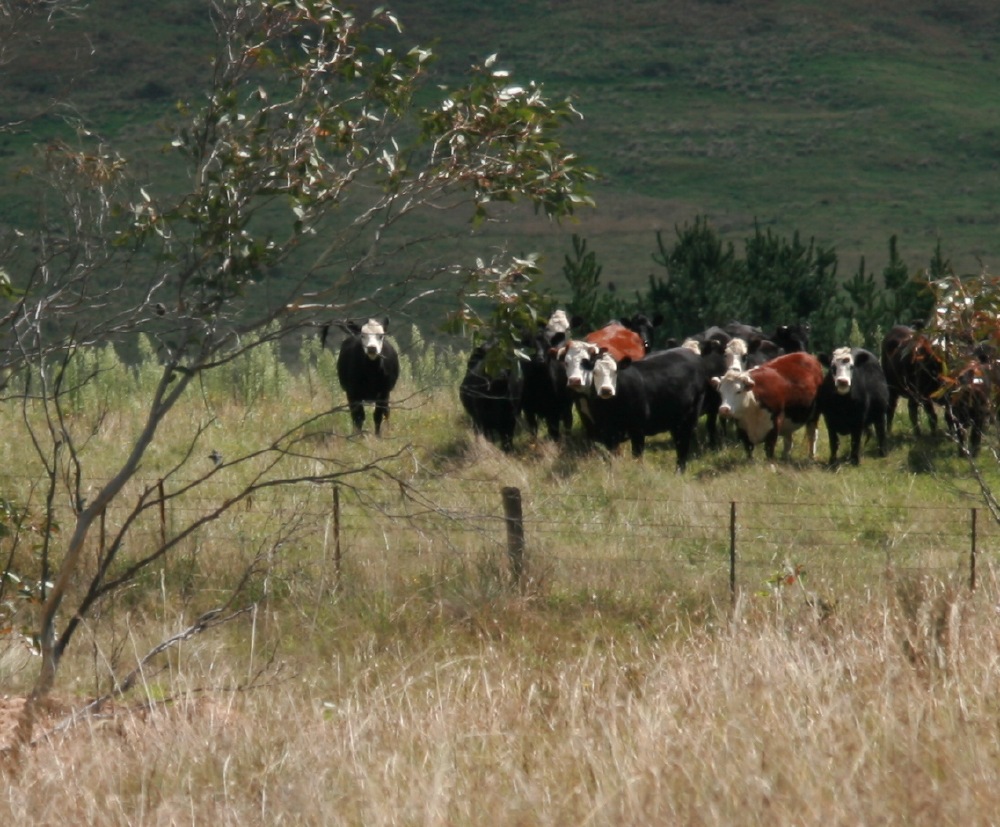 |
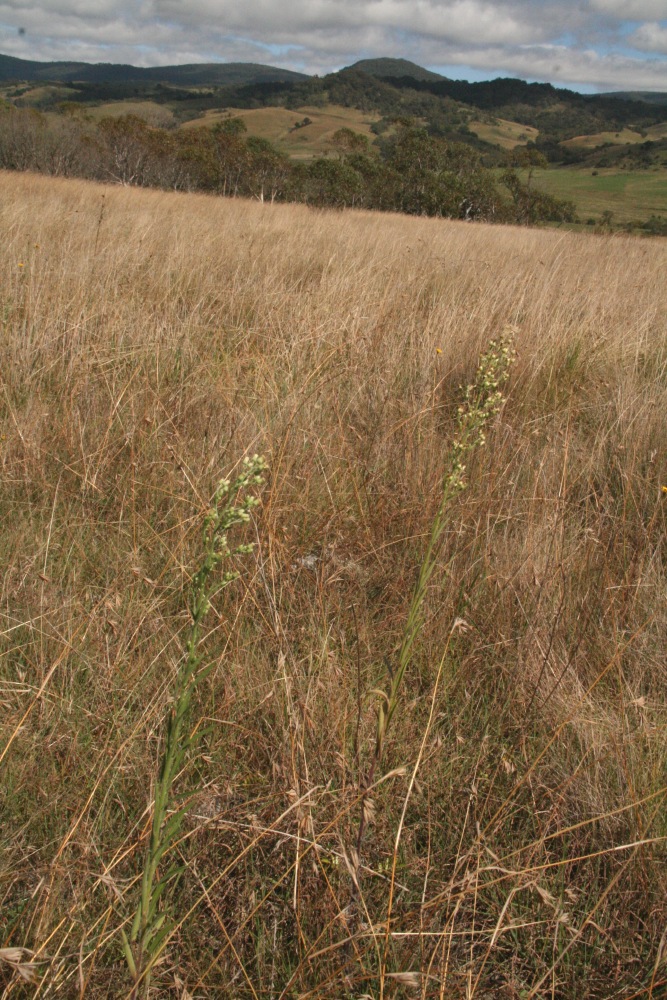 |
 |
 |
 |
Strong fleabane growth next-door, left of the cows |
A couple of healthy 4-footers on Bunhybee |
A mature seed-head - must be bagged |
A nearly-mature seed-head - ditto |
A not-yet-mature seed-head |
The primary areas of Fleabane found were:
We were delighted to find virtually none in the open areas of the central and southern blocks, and only small numbers in the southern waterline. We didn't get any further north than the slopes of Echidna Ridge.
We eased the plants up by the roots. With the 20% that had seeds yellow or opening (which was particularly prevalent on the north face of Echidna Ridge) we bagged the heads of plants >60cm high, or the whole of small plants. In the moister areas, it was necessary to beat the soil and smaller plants off the roots in order to prevent regrowth. We don't actually know when fleabane seeds become viable, but are working on the assumption that the light-green, not-yet-yellow seed-heads aren't.
We also removed the small number of Thistles we found – mainly in the section between the gate and the small dam, and on the wall of the small dam. Linda cut-and-painted a few small outlier Blackberries that we'd have likely missed in the planned Autumn assault in a few weeks' time.
Finally, Linda planted a couple of Linum marginale in the scrape above the small dam. We've seen only a few on the property, and Rainer Rehwinkel had suggested that it could be necessary to provide genetic diversity by bringing some in from elsewhere.
We returned to finish the fleabane, and work on the blackberries in the northern block. The ground was moist, the waterlines were lush, and the dam completely full and trickling out in the NW corner. There were fewer weeds on the main dam wall than in the previous years, with a lot of Poa lab. and far smaller quantities of both thistles and blackberries. A recently-dug wombat hole could represent a threat. We were joined by our friend Robert Portner from Grundbach (Kanton Bern), making a big difference to the work done in the day. We also met up with Trish Downes, who is conducting historical research in the area. |
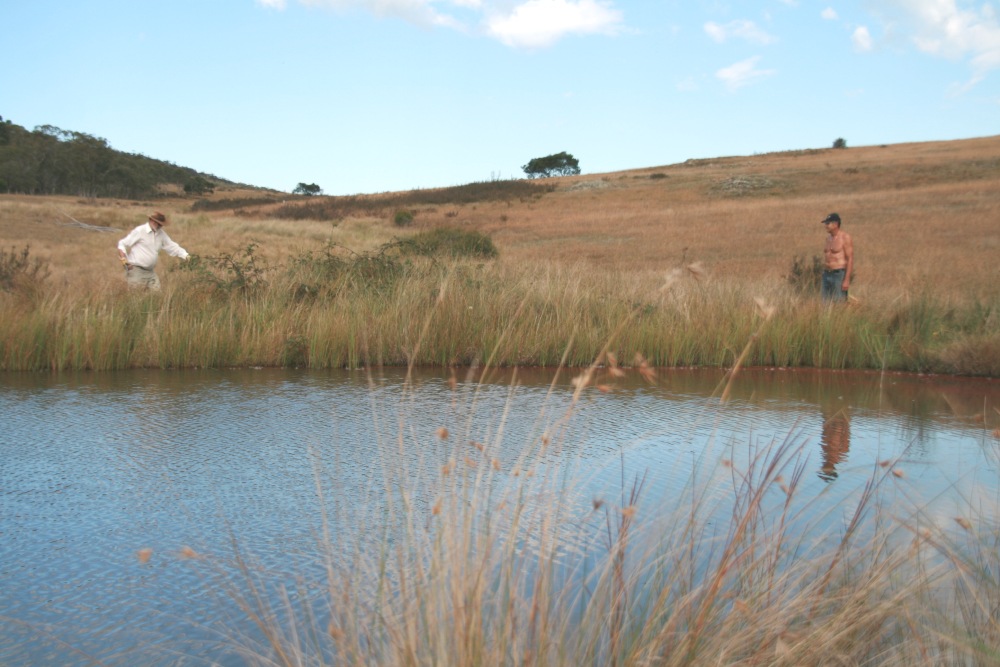 |
 |
We did the following:
We returned to attack the southern block, accompanied by Georgie and Margie. The area was sodden, with all waterlines trickling – moreso than we've seen before.
Recent rainfall has been Nov 161.2 (82.2) Dec 82.2 (59.2) Jan 69.4 (71.9) Feb 167.0 (74.5) Mar 219.0 (81.9) – which is average annual rainfall (698 mm) in 5 months, cf. 367mm average = 190%. No figures are currently available for Gilston for April.
We picked up the pockets of fleabane, in and near the snow-gum forest working southwards.
We then attacked the vigorous blackberry re-growth in the (soggy) lower watercourse in the very SW of the property. We suspended the intended walk up the waterline in favour of the enemy we could see.
There were very few thistles or briar rose.
[Linda thought she saw a patch of Austrostipa densiflora about 30m from the southern boundary and 20m from the western fence (along the road). It will need to be checked when it has seedheads.]
We walked a loop around the complete block, in the company of Rainer Rehwinkel from NSW Dept of Environment and Kathryn Wells from DE and K2C. It was a remarkably cool day, with a couple of sleet-showers driving up the Tallaganda Range and drifting across to us. The dam was full and the waterlines were wet. Gilston's rain-gauge showed only 260mm for the 6 months Apr-Sep 2012 (80% of average), but the effects seem to still be being felt from the 380mm in Feb/Mar 2012 (cf. 150mm average).
After discussion with Rainer, we've lowered the priority on attacking the Yorkshire Fog, on the grounds that it's been advantaged by the moisture from late 2009 to early 2012, will reduce as the inevitable dry develops, will tend to remain in most areas rather than expanding widely, and is difficult to attack in any case. Rainfall in the 19 months Sep'09 to Mar'12 totalled 2500mm - 1230mm in the last third of 2009, 820mm in 2010, 450mm in the first quarter of 2012 – cf. an expected 1190mm (750mm p.a.), i.e. 210% of the long-term average.
We've now prioritised the Sweet Vernal, which Rainer sees as a bigger issue. It's in the gate area, scattered in small numbers in many areas, particularly at the head of Gate Gully on the southern slope, and in some quantity on the slope to the west of the South Block waterline (Blackberry Swamp).
There were of course a few scattered young blackberries, but the only disappointment was the number of them in the South Block waterline.
We saw no serrated tussock, almost no fleabane, and only a single thistle (beside the large, dead trunk in Picnic Corner).
There had been 88mm of rain 7-12 Oct (cf. 68cm long-term avge for Oct). The ground was moist and there was water in the water-lines; but there was no moisture on the grass or foliage. There was a possibility of showers, but none eventuated.
The purpose of the day was to tackle the Sweet Vernal Grass (Anthoxanthum odoratum). Some clumps stood proud from the surrounding vegetation and spraying was likely to cause little collateral damage. Some clumps were both intensive and extensive, and hence the risk had to be taken that whole segments of grasses might be laid waste. (We take comfort in the fact that bare areas, such as pig-damage, recover quickly, with interim flatweed, but largely dominated by native species). In some areas, individual SVG plants were tightly interwoven with native grasses, and hence collateral damage adjacent to them was unavoidable.
We used 10ml of Glyphosate to 1 litre of water, and as narrow a spray-head as we've been able to get – about 10 litres in all – in the following areas:
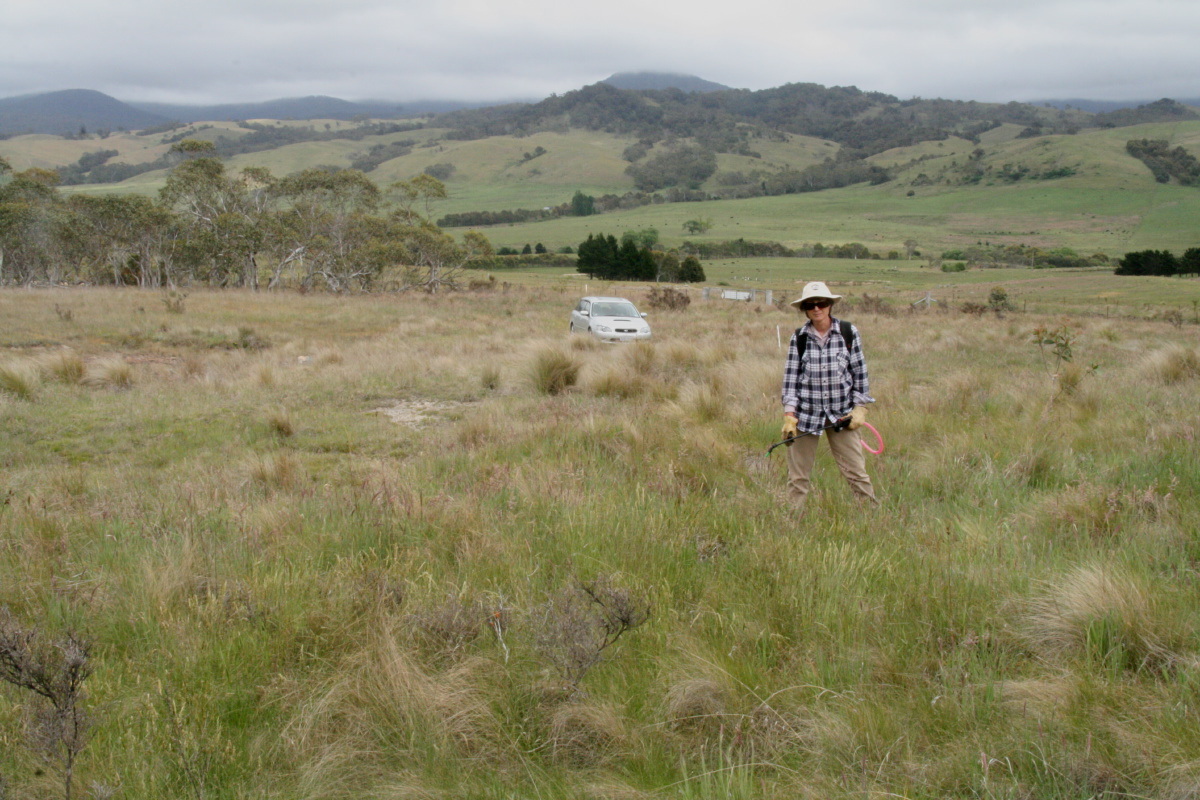 |
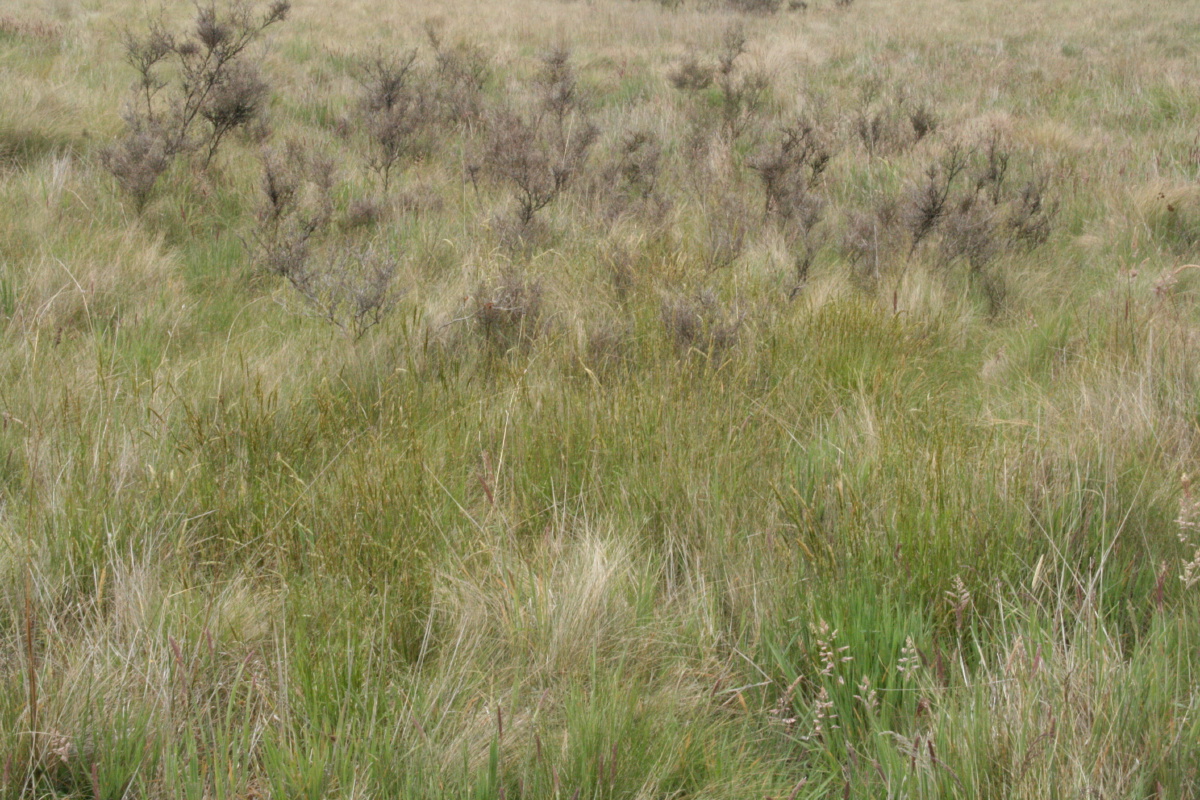 |
 |
Infestation ... |
... closer ... |
... and closer still |
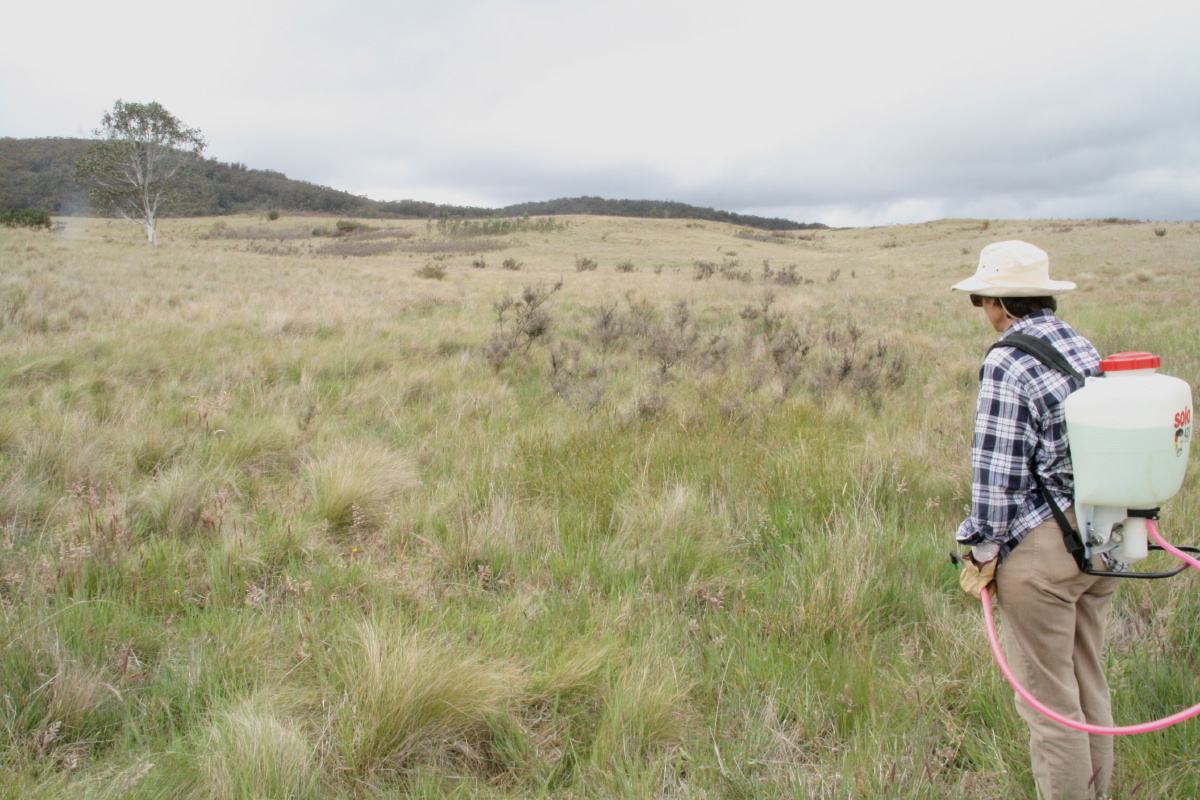 |
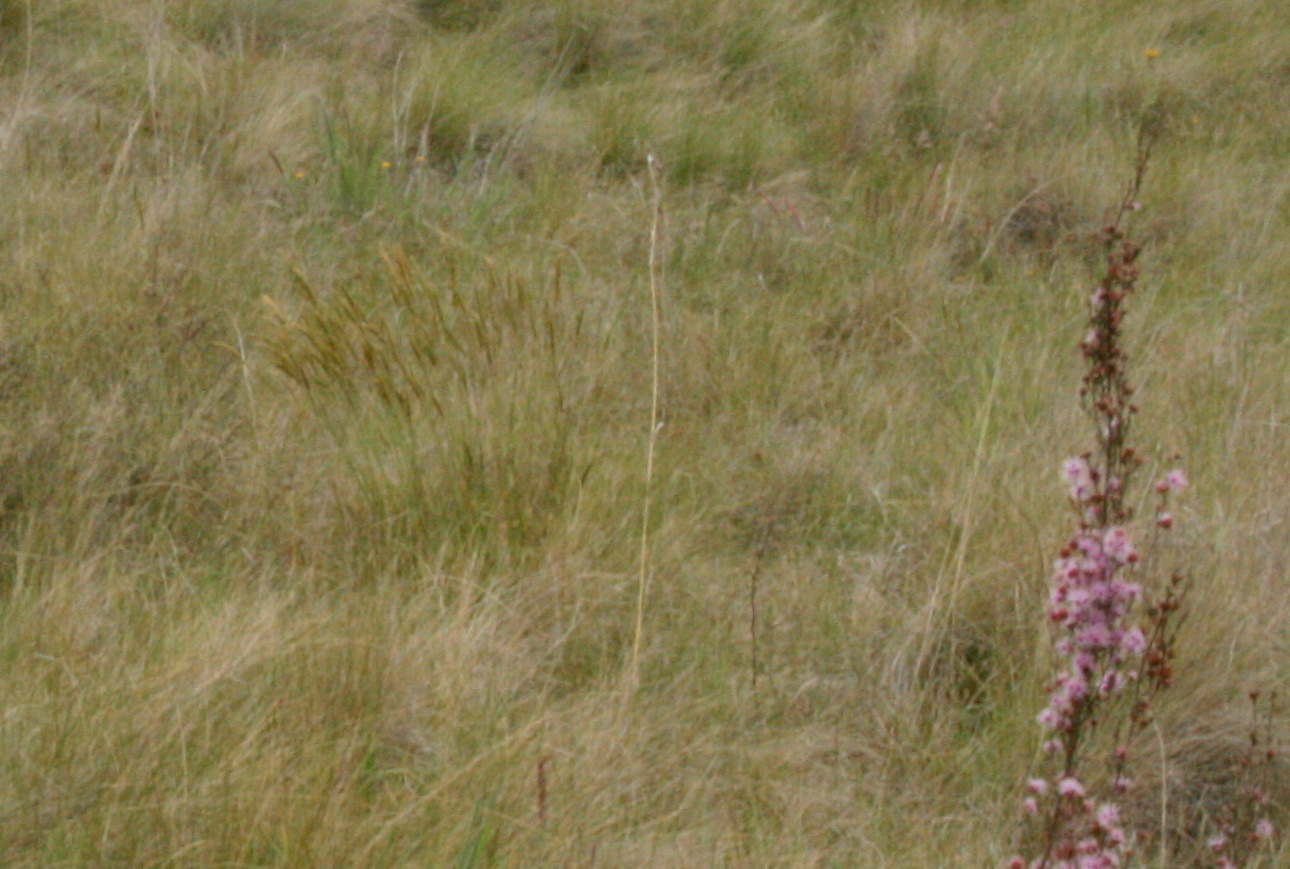 |
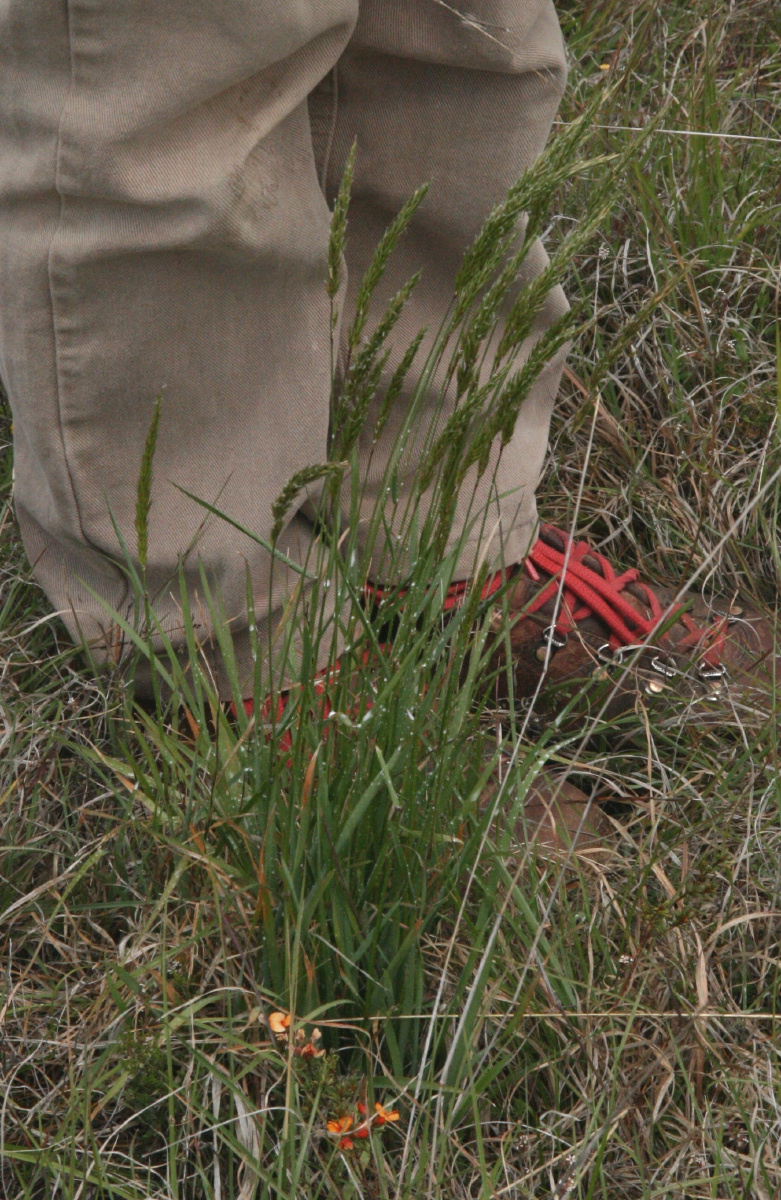 |
Looking up Gate Gully ... |
... the seedheads |
A close-up of a clump, after spraying |
 |
 |
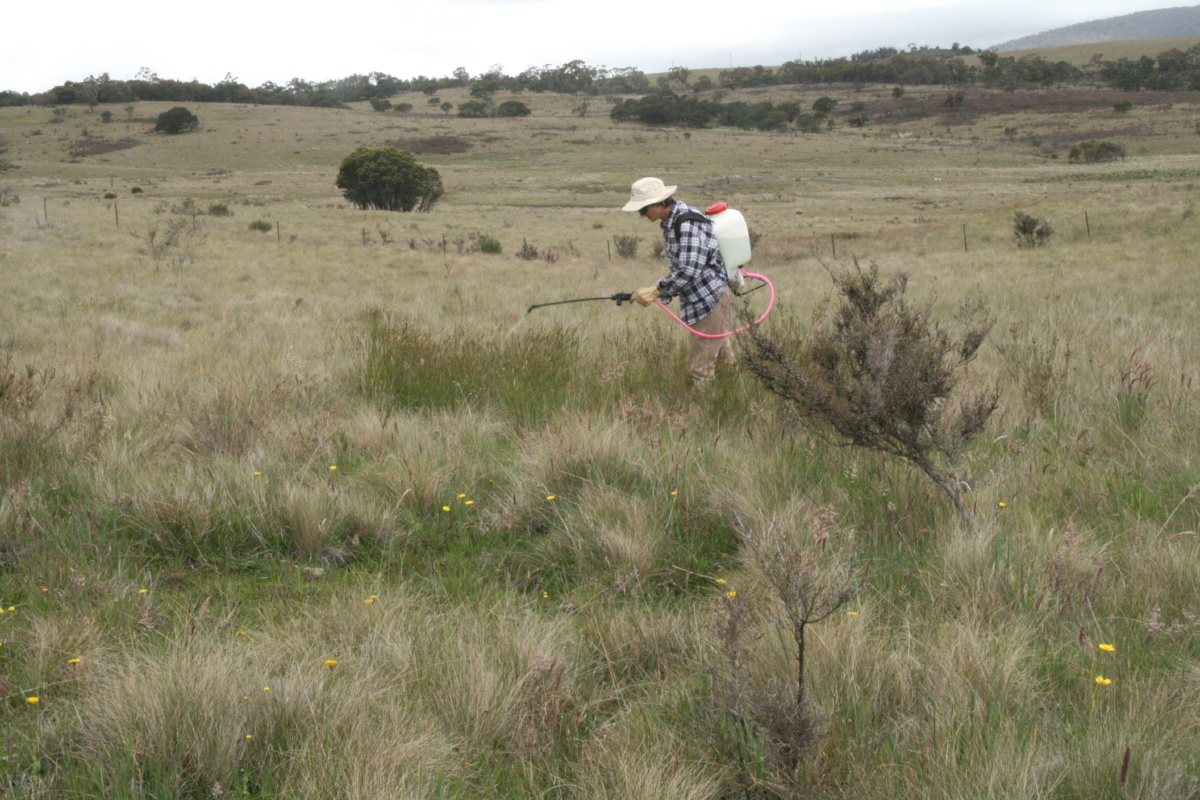 |
The location, looking SW |
The location, looking S |
The action, with recovering pig-damage in the foreground |
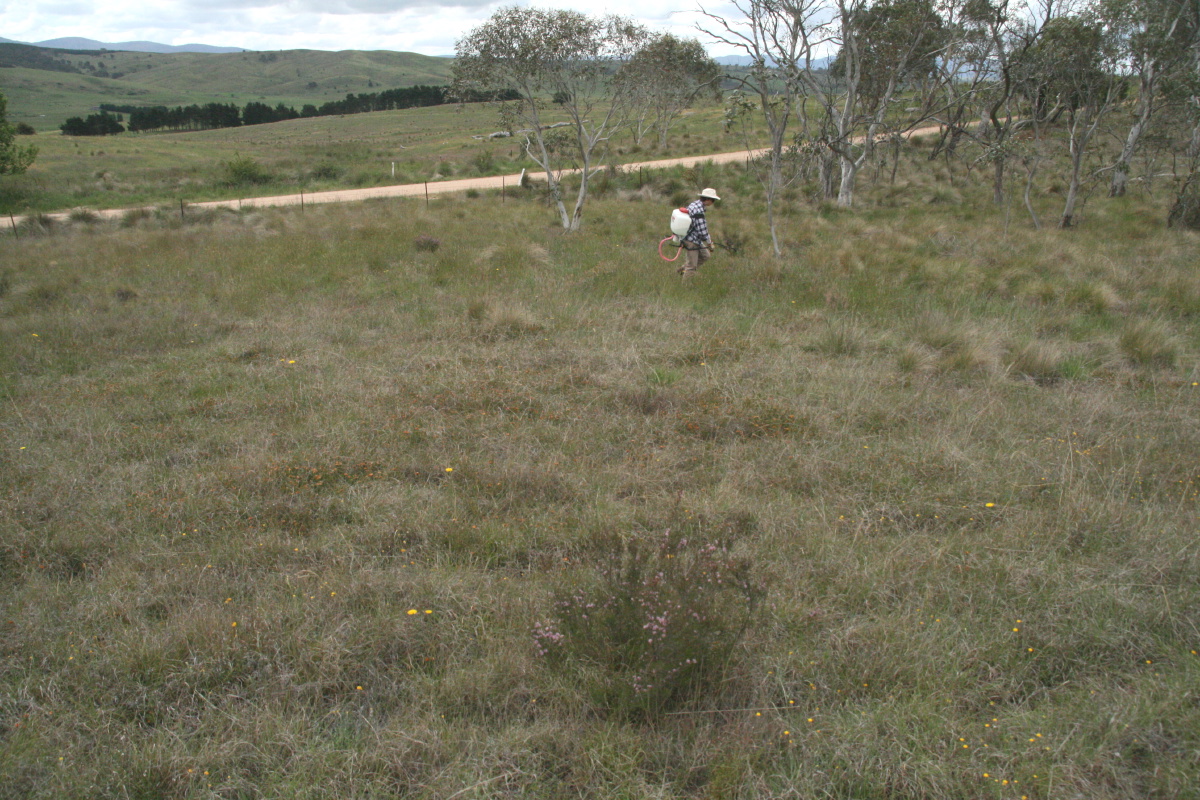 |
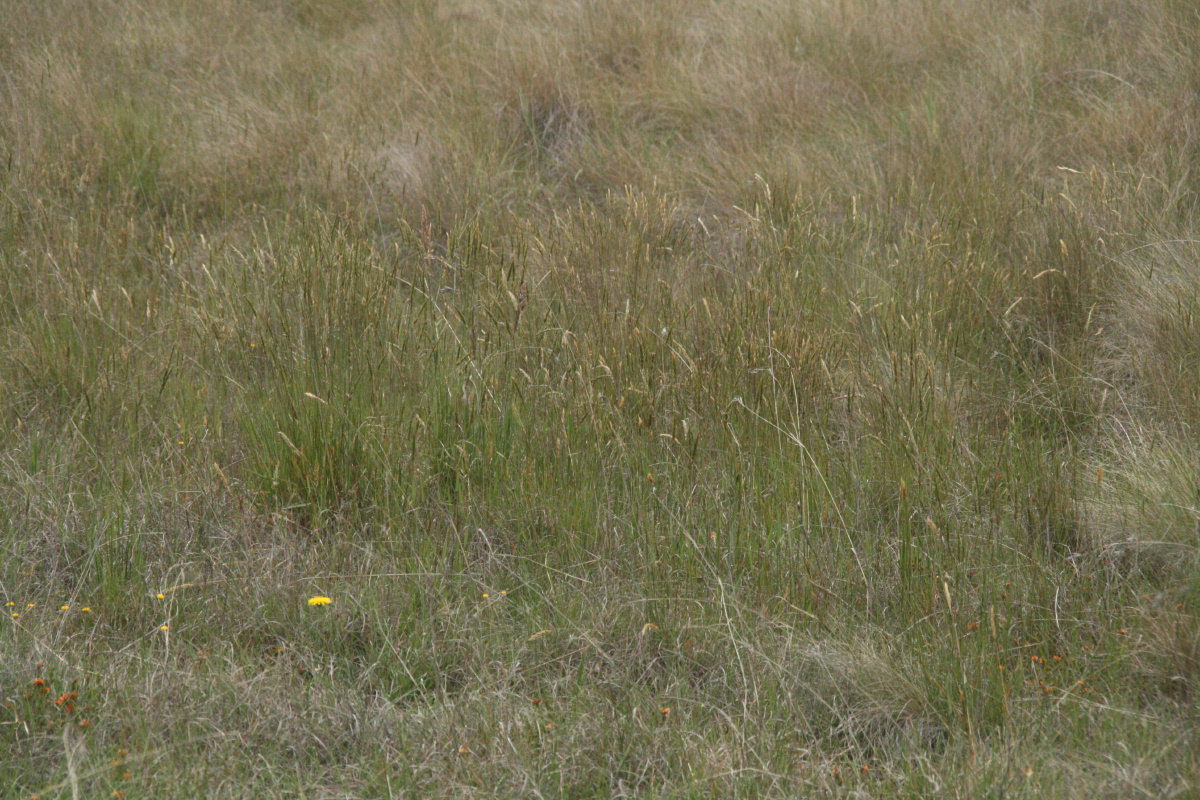 |
 |
In the midst of one thick section ... |
... closer ... |
... and the seedheads |
 |
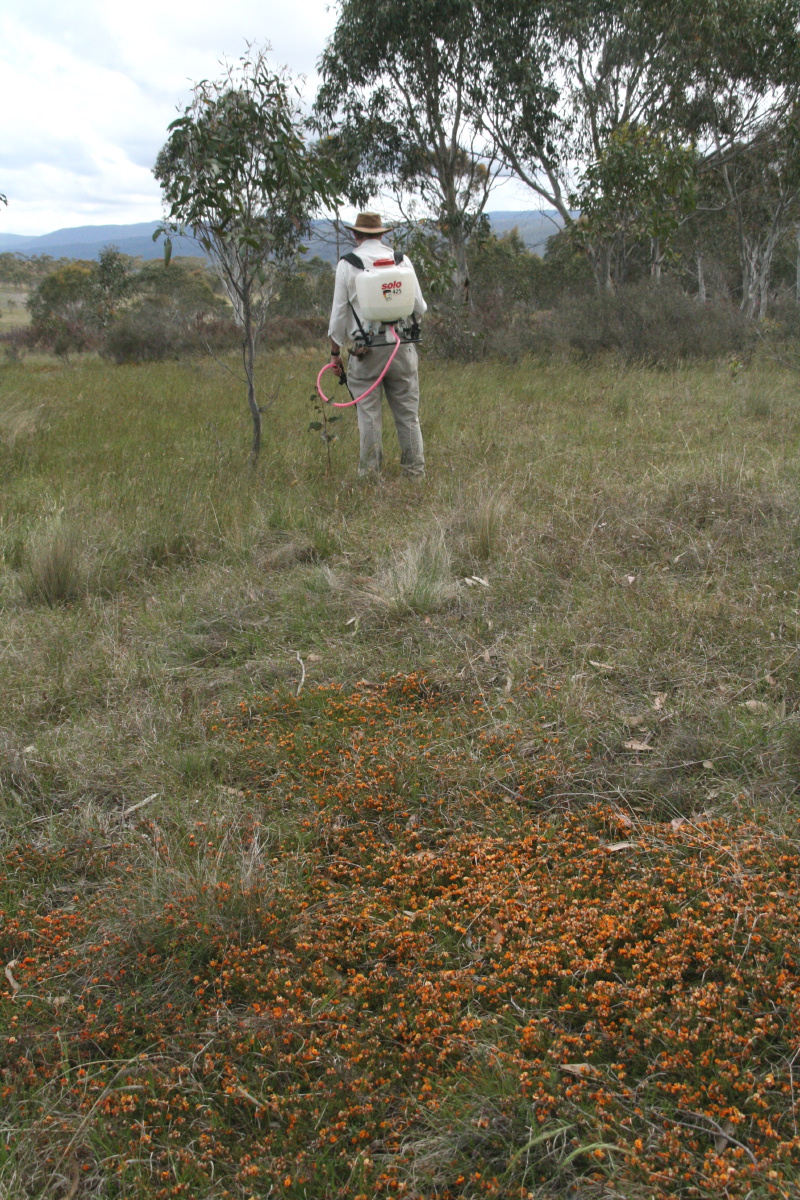 |
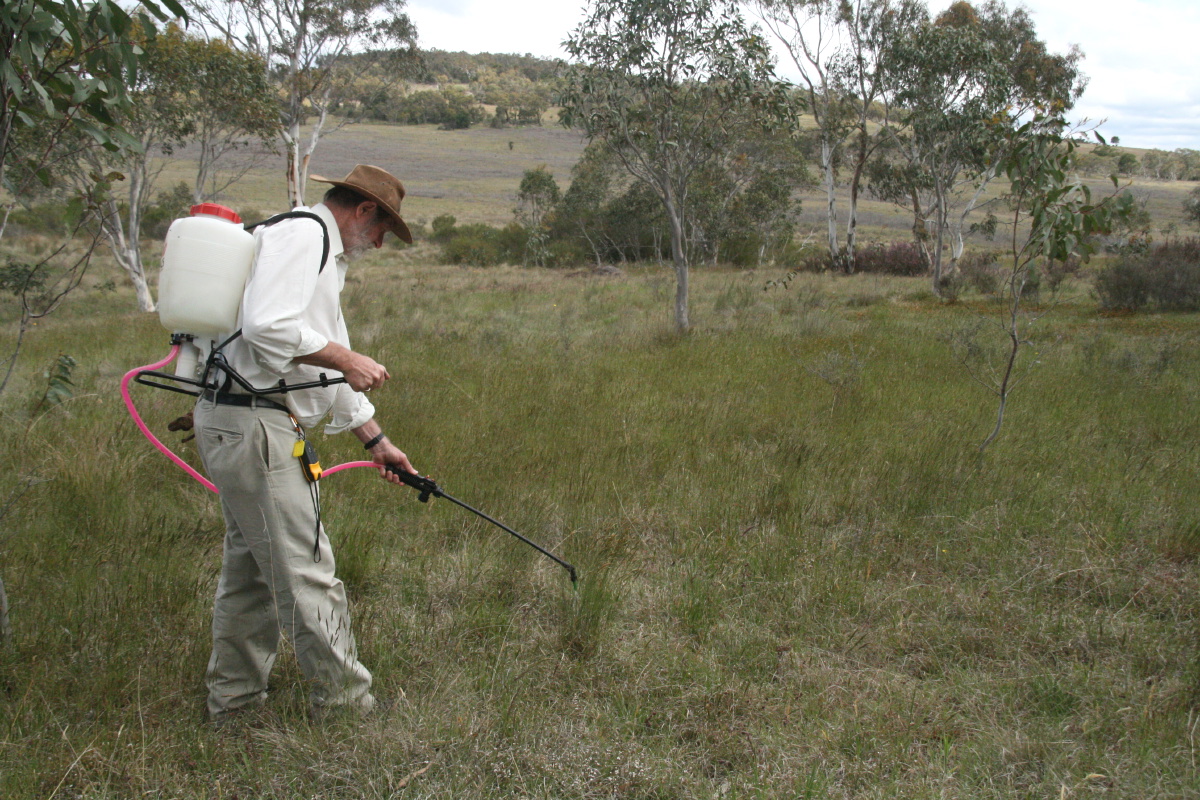 |
One end of the slope ... |
... further south, with Pultanea subspicata ... |
... and unfinished work, when the 24 litres ran out |
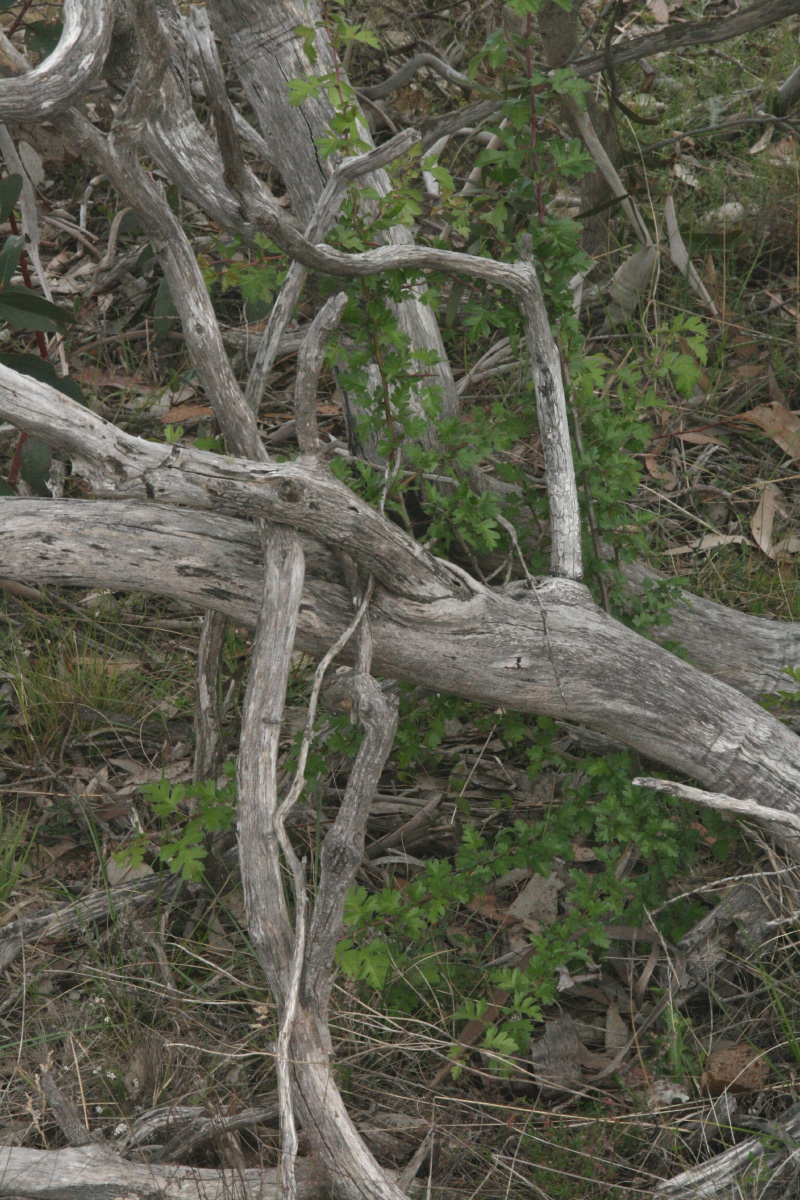
We found the first-ever Hawthorn on the property, a young one beneath a twisted
snow gum 40m SE of the gate. There was glyphosate in the back-pack, so Linda
tried out the effect of a short spray:
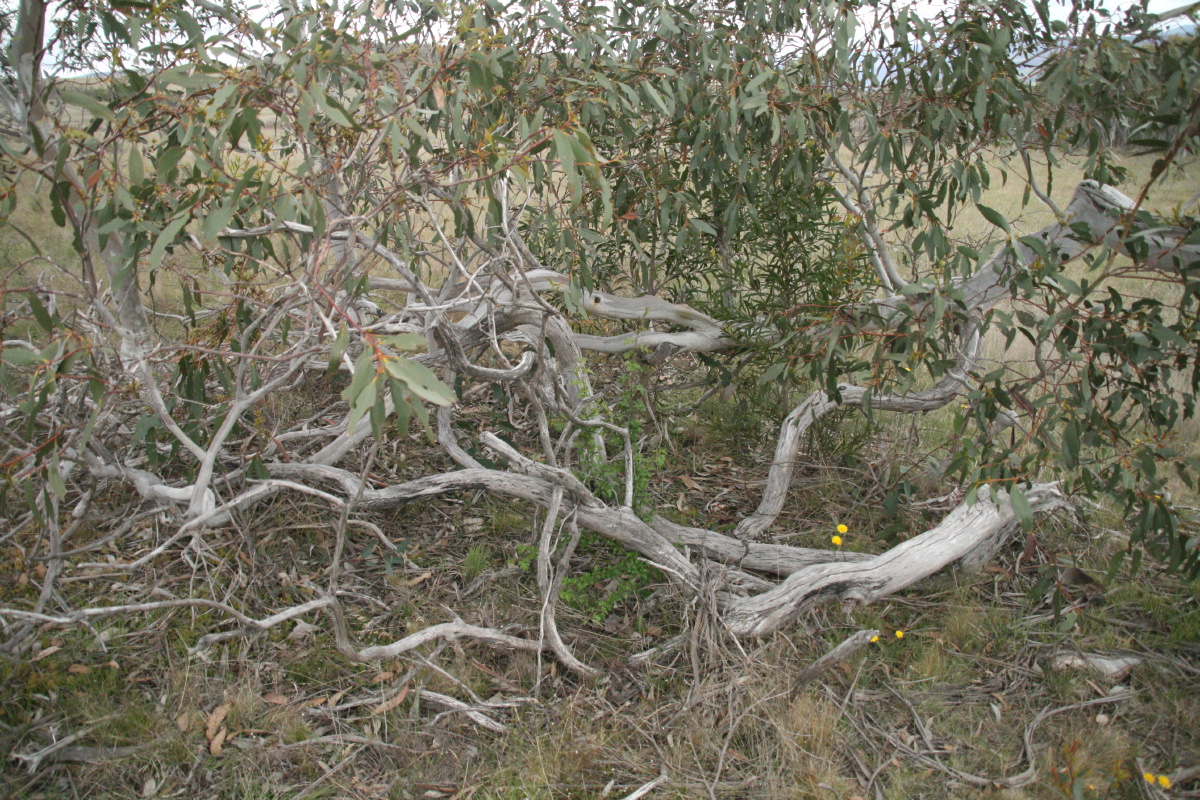 |
 |
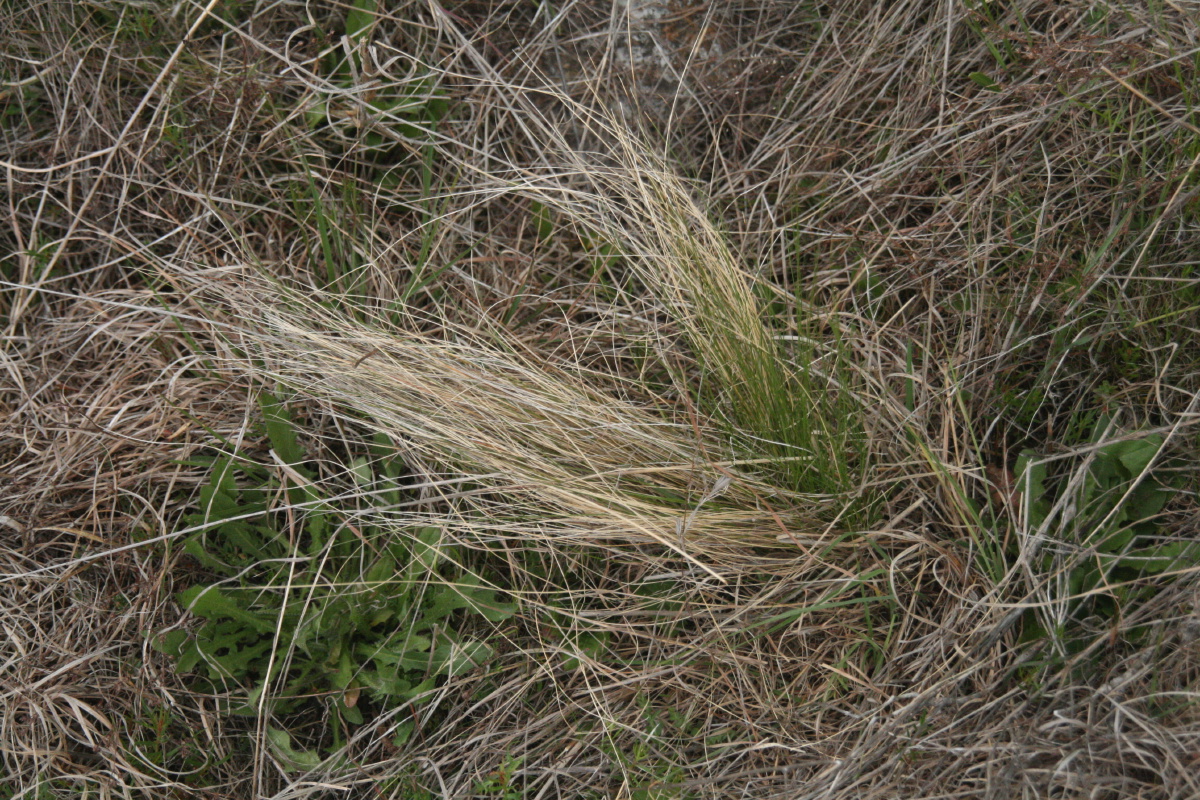
We saw a single suspect serrated tussock, little fleabane, and no thistles.
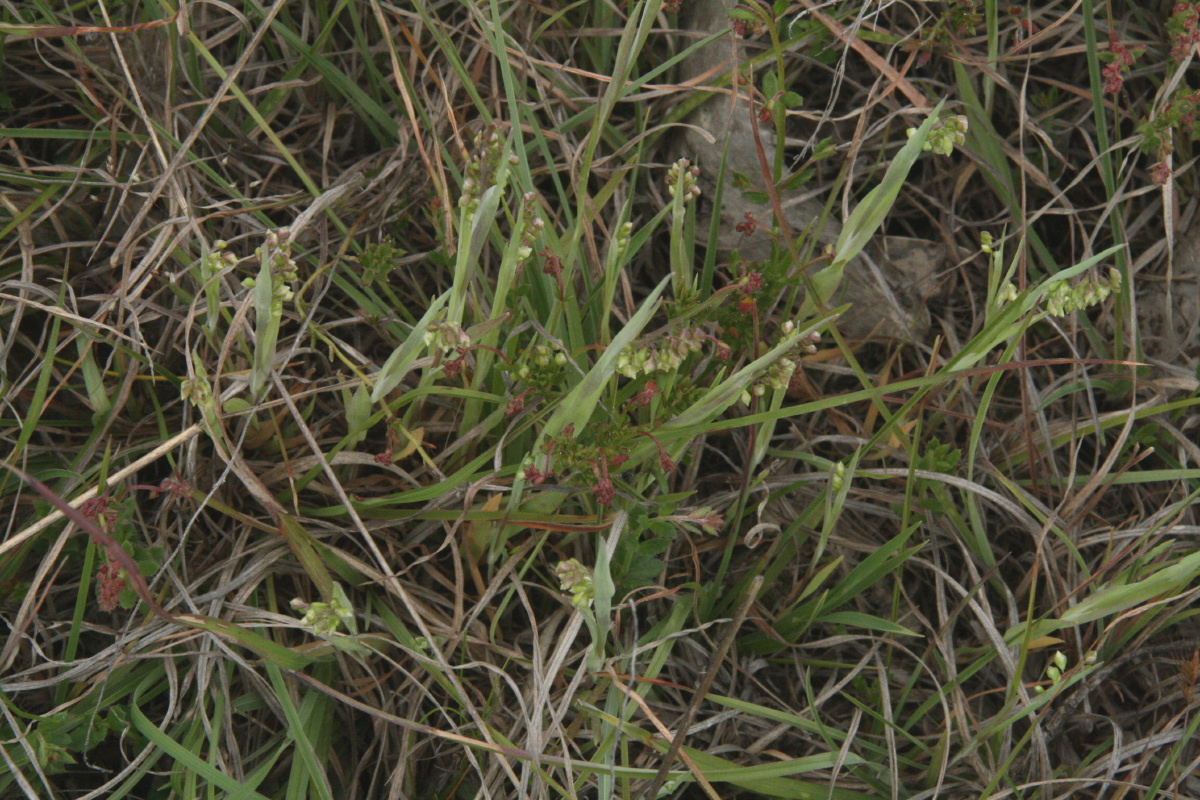
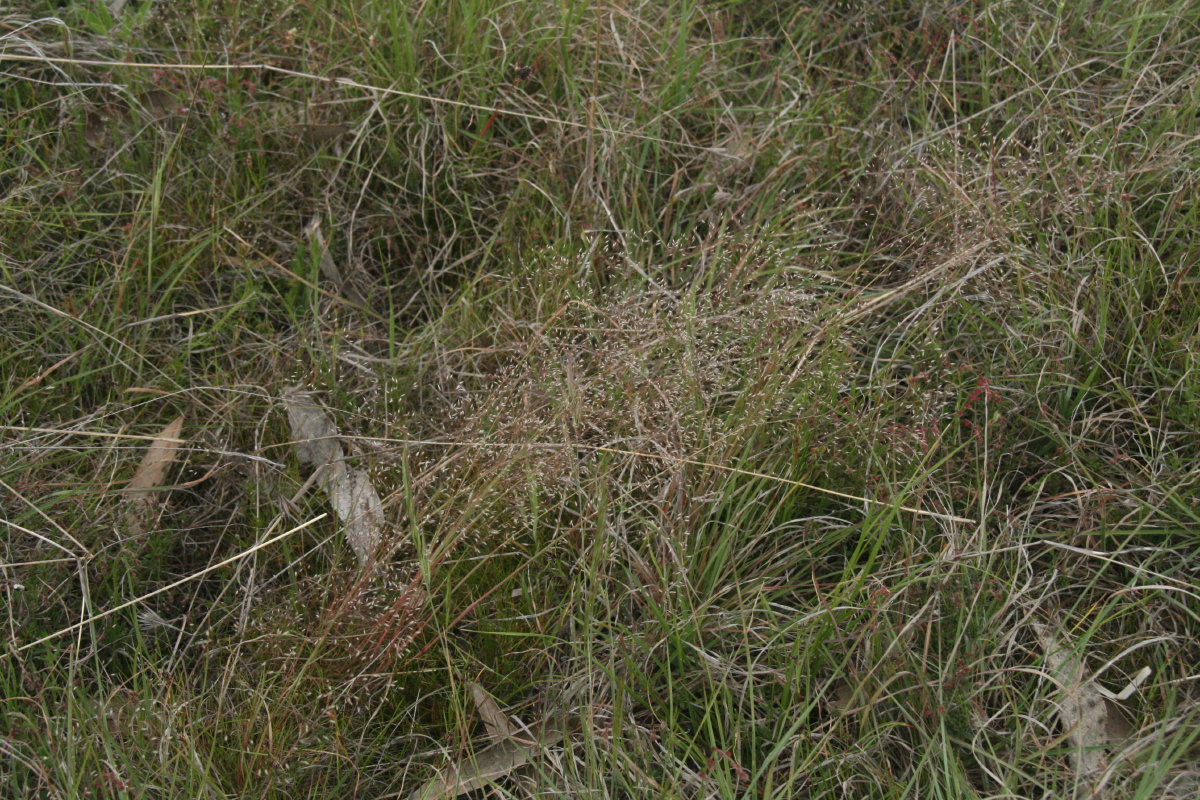
We took some shots of introduced grass species:
 |
 |
 |
Suspect Serrated Tussock ... |
... and in context (centred) |
Aira and Briza ... |
 |
 |
 |
Briza minor ... |
... close-up |
Aira, prob. elegantissima |
After a fair in Braidwood on Friday, and overnighting there, we worked 9-11:30 on a day when the temperature rose quickly, and we had English cousin Jake Sievwright and Tamara with us.
The previous spraying had made a noticeable difference to the plants that were hit, although some patches within each area had been missed, reminding us how much concentration is needed to ensure comprehensive back-pack spraying.
Linda finished spraying the Sweet Vernal Grass areas adjacent to the southern swampland, using 10ml glyphosate to 1 litre of water (same as last time), about 8 litres in all. The temperature climbed to the high 20's by late morning, by which stage the wind had become very gusty, preventing further spraying.
Roger walked the north block with the cousins, spying out the smaller number of smaller patches of SVG, and removing occasional small, young fleabane and a dozen thistles, mostly in Peppermint corner, plus a lone briar rose in the northernmost waterline. A couple of suspect Serrated Tussock need to be re-visited shortly.
The last six weeks had been somewhat dry, and summer had arrived, somewhat late, and not vicious, but fairly warm. We timed our visit well, however, and had a relatively cool day (24, cf. 29 in Canberra), with a cooling breeze coming up in the middle of the day.
Linda sprayed Sweet Vernal, and Roger walked the north and centre blocks pulling fleabane and thistle.
The BAD NEWS:
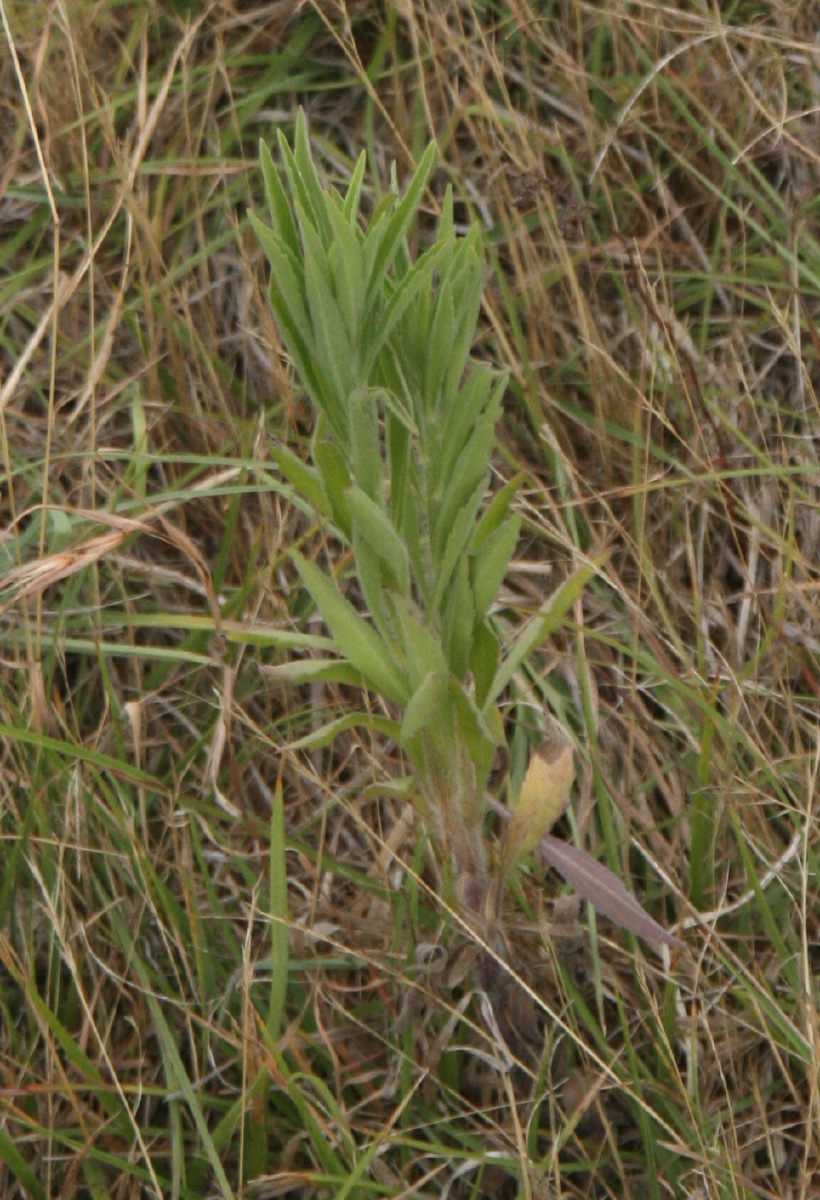 |
 |
 |
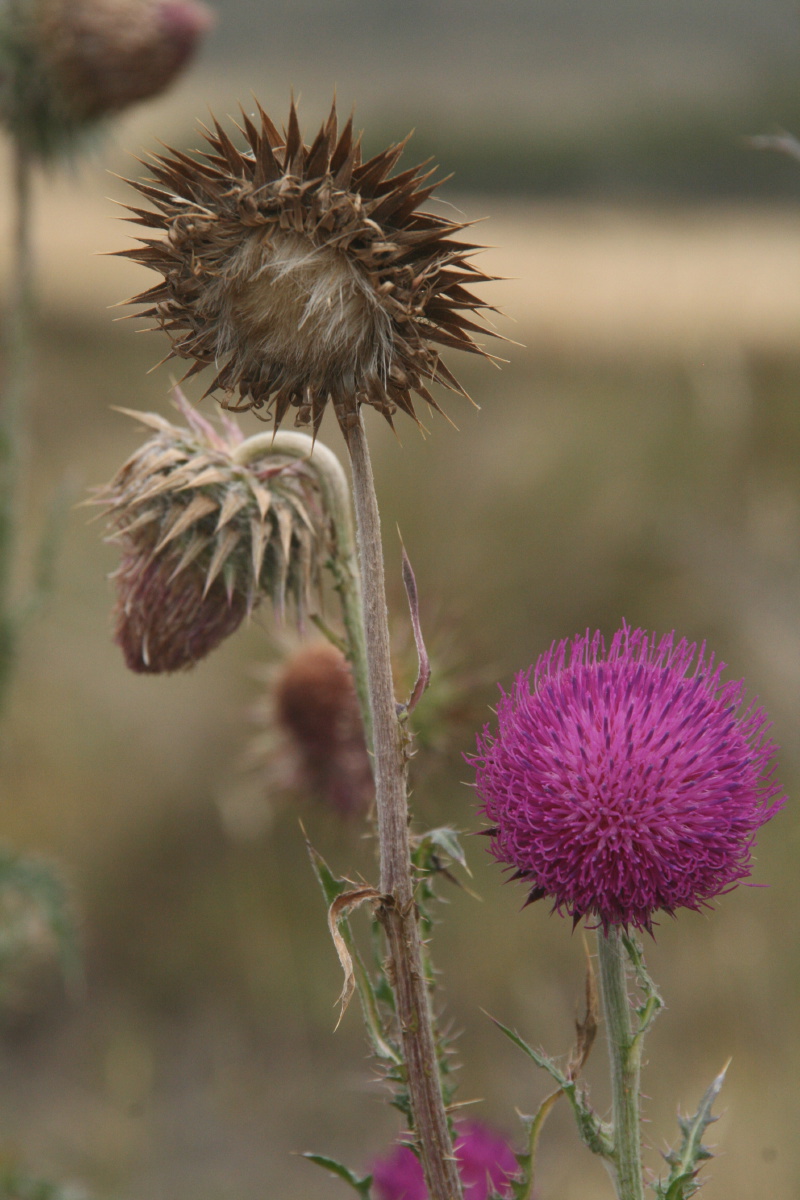 |
Fleabane, typical for the day |
Carduus nutans Nodding Thistle ... |
... one on Echidna Ridge ... |
... two N of the E end of the N waterline |
 |
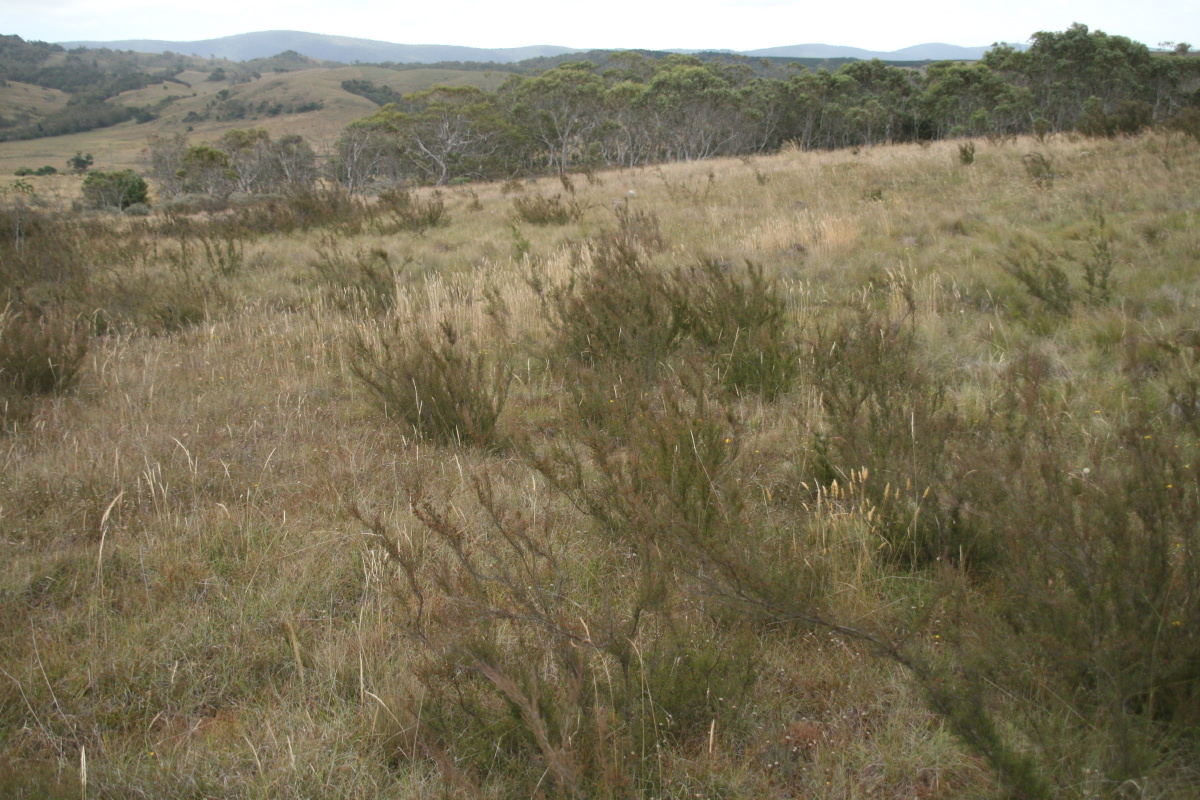 |
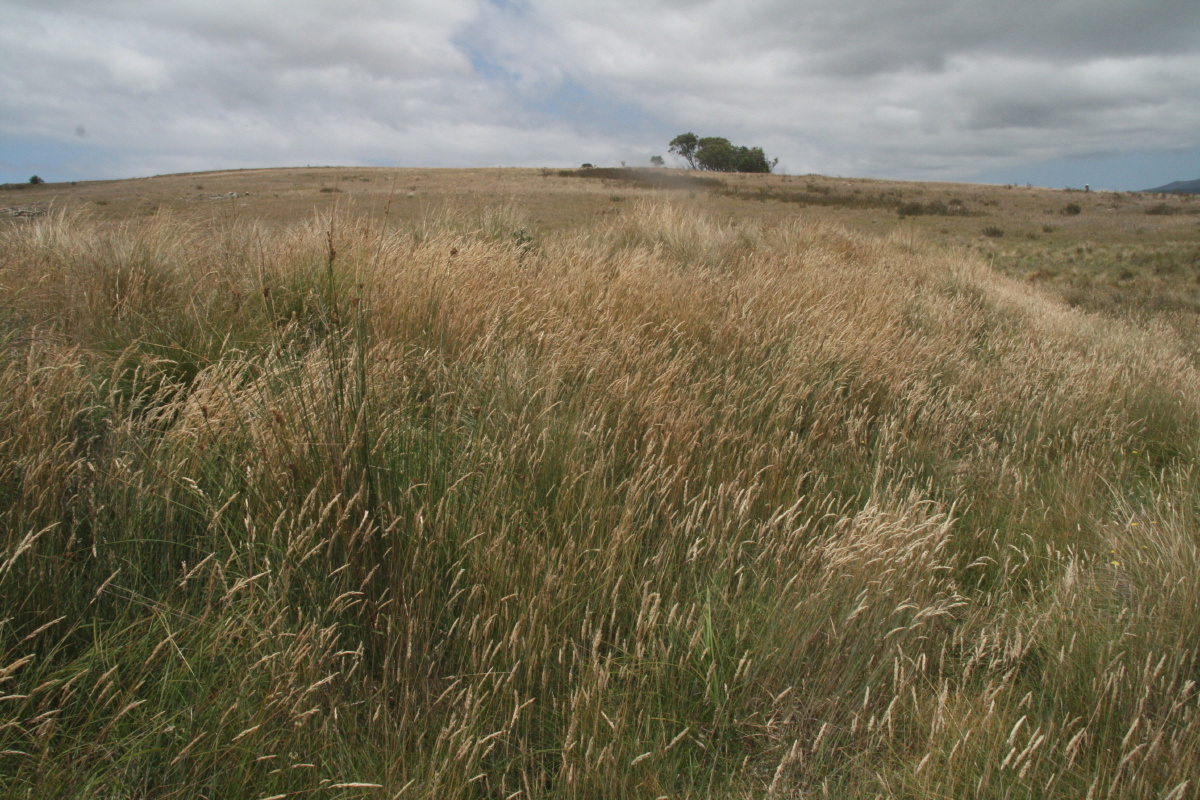 |
|
The golden-brown of mature Sweet Vernal ... |
... again, with Fog and Dichelachne |
The eternal challenge of the dam-wall, now Fog and some Vernal |
The GOOD NEWS:
The Sweet Vernal is still worth hitting, but we may need to do spring runs on it, and perhaps on the Fog as well.
We should do a controlled experiment of Blackberry cut-and-paint during summer. Roger is sceptical, but we should try it.
This was a rubucide / blackberry-attack day. The focus was on the southern swamp. The old bushes are in a state of disarray after several tears of serious assault. But of course some fightback from old rootballs remains – most muted but some aggressive – and new volunteers are forthcoming every year.
Roger cleared the excess foliage from two large infestations in the northern end of the swamp, and then from the re-growth in the original horror-area on the SW edge of the swamp and one patch further into the moist area itself. Linda started on isolated smaller bushes that could be cut-and-painted directly, plus the 20-30 young and virile briar rose in the area. She then switched to cut-and-paint of the two large infestations in the north, and after lunch cut-and-painted the c. 30 smaller bushes in the central area of the swamp. She switched from brush to dabber part-way through, mainly because the dogs knocked over the open jar; but dabbers use less glyphosate, and uncontrolled tests to date suggest that it may be as effective as using the brush.
Small numbers of fleabane and thistle were pulled, and in most cases their heads were bagged.
The next visit will involve cut-and-paint of the couple of areas that have been cut down, but not killed off yet – at least a half-day, but quite possibly a full day in the area.
We were joined by Helen, John and Jenny Austin.
We toured the northern and central blocks and finally down the middle of the southern waterline, attacking blackberries, as follows:
We cut-and-painted a dozen briar rose scattered around, mostly in the southern waterline.
There was very little fleabane (already seeded), very few thistles (seed already flown), no serrated tussock seen.
This was the last rubucide run for the year, in the southern swamp. Some vines were showing some rusty-red leaves, but there had been some growth since we did the pre-cut on 20 March, and it looks likely that the plants were only now drawing the juices back down to the root-balls, i.e. our timing was good.
(There was good rain in Jan-Feb, although March was pretty dry. Gilston 070261 was showing no April readings at the time we looked, but given there were a few puddles and moist waterlines, we suspect there has been April rain. Canberra, on the other hand, is 45% of the long-term average for Feb-Mar-Apr, with most of that in February and only 7.7mm since 2 March).
We took 2 hours each to clear the original horror-patch just to the west of the southern end of the swamp. Almost all plants were fairly small (in comparison with the monsters of 2009-10), and struggling a bit from previous attacks on their root-balls.
After lunch, we toured the southern end of the swamp, removing a dozen or more scattered plants, and completing the job. We also checked the forest corner near the road, removing a few small blackberries.
We also removed a few briar roses in the swamp, and a few scattered fleabane. The few thistles we found had almost all long since scattered their seed.
The purpose of the visit was to check that the place was really as quiescent
as we think it is at that time of year.
It was.
I walked up the track, along Echidna Ridge, and back down gateway gully.
Rainfall in
2012 was 18% above long-term average (LTA), and 2013 YTD has been 19% above LTA.
The big months
have been Feb-Mar 2012, Feb 2013 and Jun 2013 (the last, 130mm cf. 58mm LTA).
There was water in all waterlines, including a flooded wombat-hole high in
the gateway waterline (which we've never seen like that before), with a lot
of pig-markings all around it.
There was also a (new? very occasional?) spring 20m south of the waterline
and 50m from the gate.
The native grasses were very much in evidence and reasonably
erect, but generally
very dull – except the Stipas, which showed green stalks among the yellow. It
was worth taking some general shots of the grasses along the walk.
The Yorkshire Fog was pale and flattened down. The Sweet Vernal was very difficult
to
see.
There were almost no flowers in evidence yet, and the small amount of colour was red stalks. The exceptions were:
I was unable to locate Calotis #3 (on the house-block). Even with the markers in place, it was difficult to locate #2.
We walked from the gateway, up the track, along the ridge, below the copse
most of the way to the dam, and down gate gully.
Neither fleabane nor thistles were to be seen.
We found two previously-missed blackberries:
• only 30m up gate gully - a young, virile, multi-stalked infestation
over a 4x2m area
• 80m up gate gully, c. a dozen 1m canes. Linda did an experimental early-spring cut-and-paint
The purpose of the visit was to answer the question: is this a
good time of year to attack the Yorkshire Fog?
The provisional answer is: In some respects yes, but maybe a little *too* early?
As we'd envisaged, the Holcus lanatus was easily discernible from the native species.
Many plants (40%?) were showing enough green stalks to make hitting them seem well worthwhile.
Some were so deeply entangled in Poa or Stipa as to make them very difficult to attack. We left those.
Others were not yet showing any green stalks, so they need a visit in 1-3 weeks' time, in Early Spring.
But of course we won't be able to gauge the attack's effectiveness for a few months.
We parked on the ridge and worked all the way down gate gully.
We did 3 x 10l backpack-tankloads, each with 100ml Glyphosate.
We experimented with lone-working and team-working, and team-working easily won.
The key reason is that the backpack makes it too difficult for the carrier to bend and isolate plants:
• Linda went 2m ahead, and found and isolated plants (i.e. bending and kneeling work)
• Roger followed and sprayed them, hitting occasional, already-isolated plants along the way.
We plan to re-visit in 9 days' time and do the same area again, for the later-emerging plants.
 |
 |
 |
 |
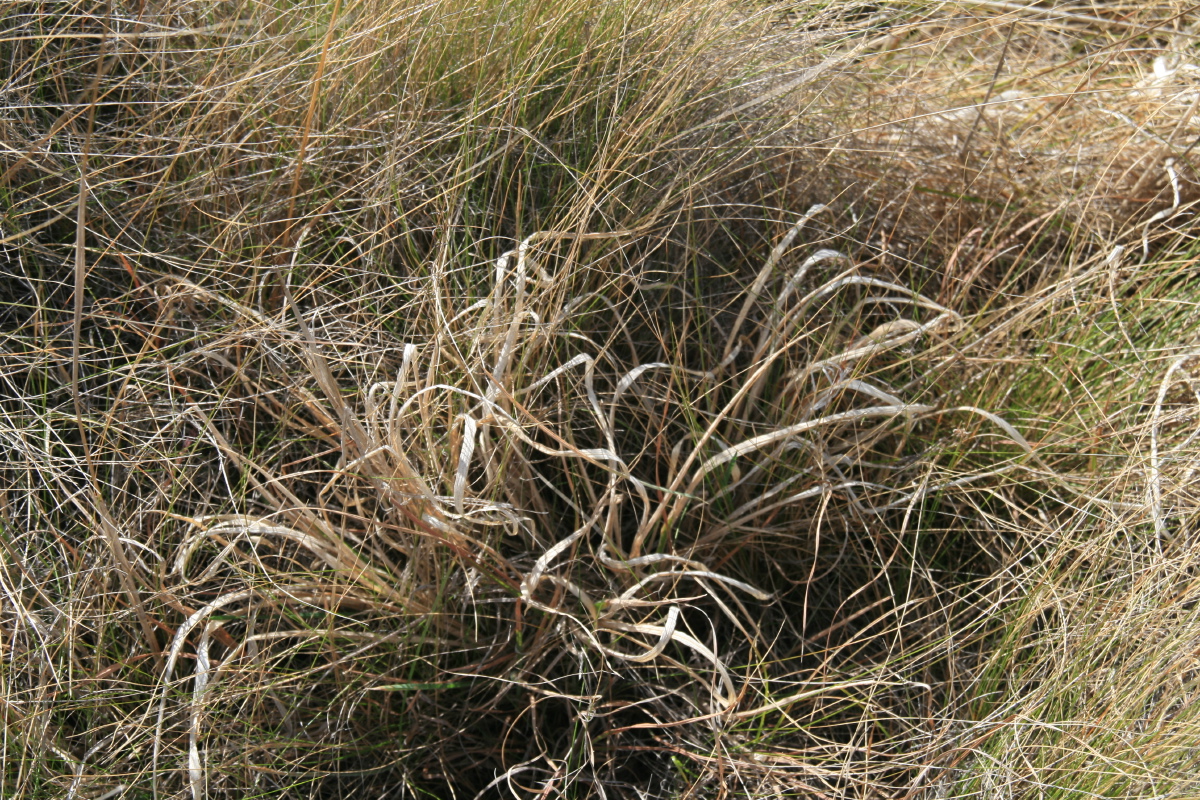
Typical appearance in very early spring – straggly pale ribbons and wide green streaks |
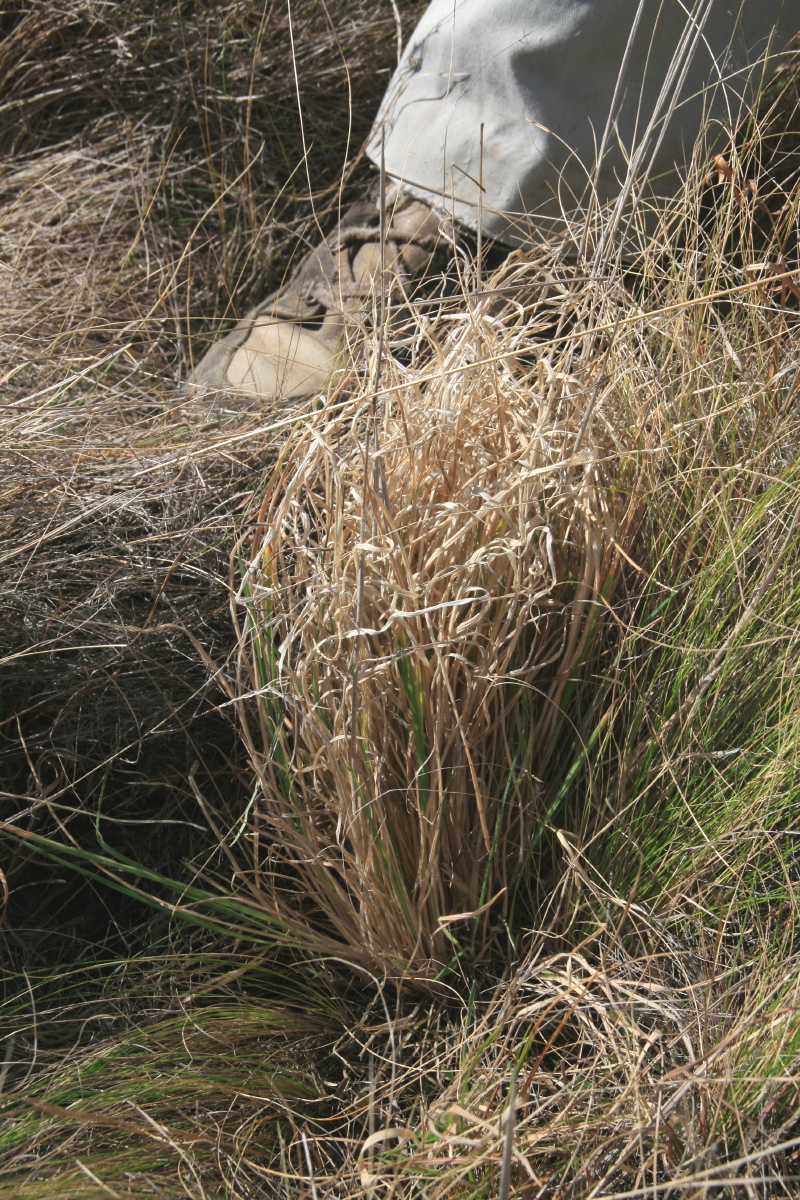
A plant not yet prepared for attack, hard to visually separate from the adjacent natives |
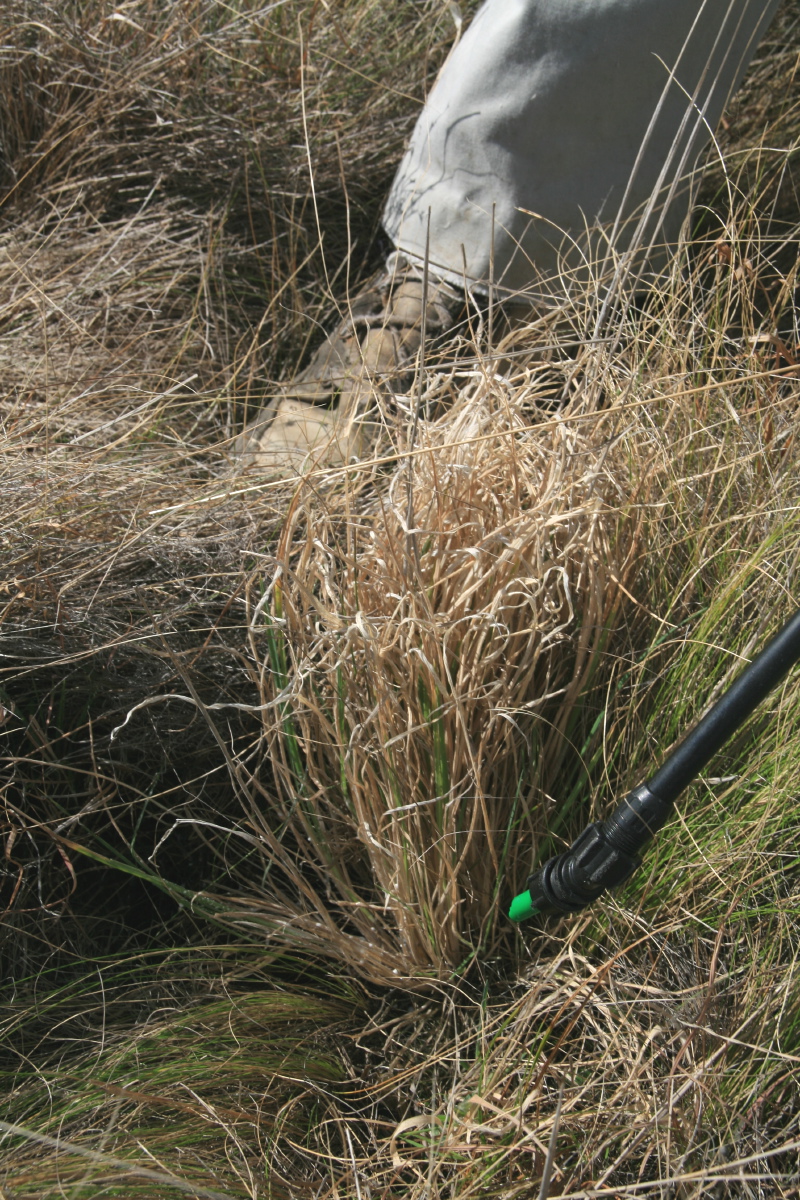
After separation partly by boot, but mainly by hand |
We then narrow-sprayed Water-and-Glyphosate on the green stalks |
This was intended to be Phase 2 of the experimental attack on the Holcus lanatus / Yorkshire Fog.
It failed, for several reasons, including that Linda was coming off the back of a bad and extended flu, Roger was now into a bout of it, and the wind picked up much earlier and much more strongly than had been forecast – 30km consistently, plus gusts, which is far too much for controlled spraying.
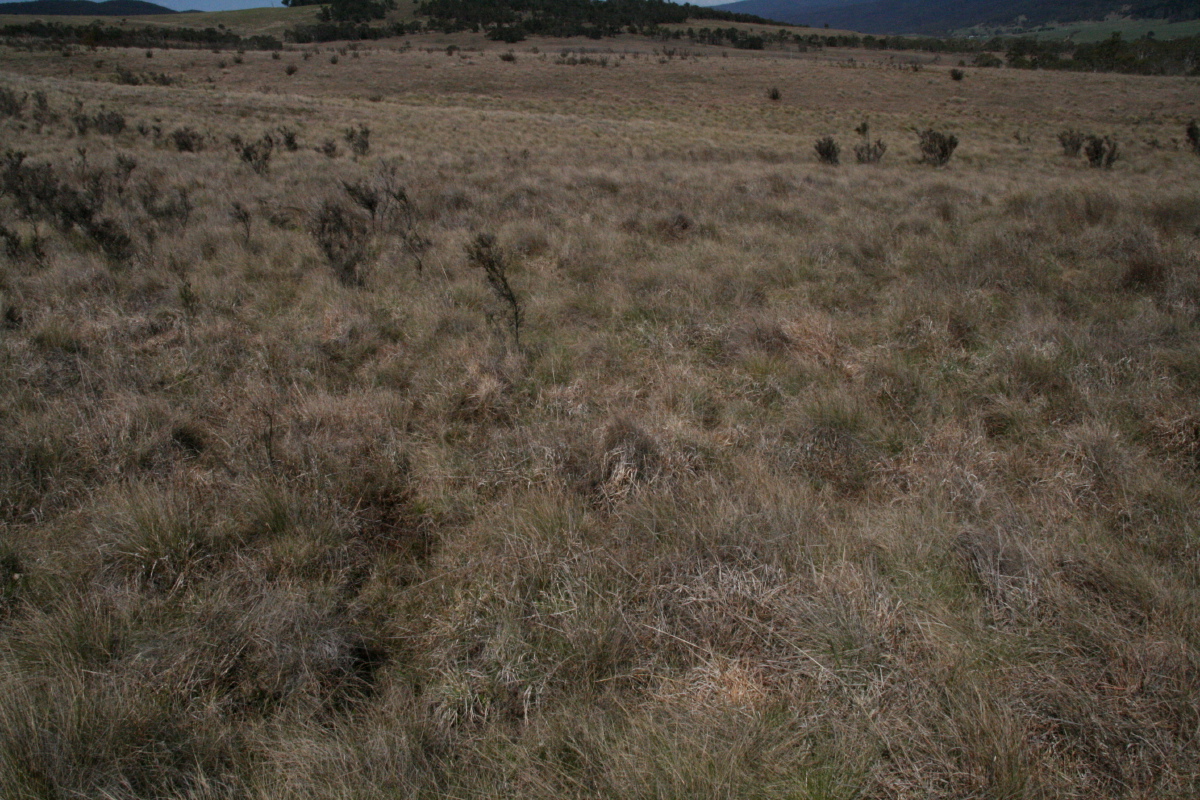
The results of the previous round of spraying seemed to be mixed. In some areas where we thought we'd sprayed, we could see little or no impact, whereas in other areas there seemed to be moderate numbers of plants looking very wan, or starting to green up a little but in a sickly manner. The jury remains out:
 |
 |
 |
Yorkshire Fog / Holcus lanatus ... |
... Sprayed 18 days earlier ... |
... now unhealthily pale |
One option had been to repeat the same path, this time spraying the plants that looked like they'd come out of their dormancy in the 2-1/2 weeks since we were last there. We decided against that, because, later in the year, we'd have been unable to tell if one or other of the two sessions had been effective (although we'd know if both have been, or neither has been).
The option we settled on, but deferred due to the wind and to some extent tiredness, was to work either up or down the southern arm of Gate Gully. Coming up from the gate, it diverts south-west from half-way up the main gully, then bends north up towards the end of Echidna Ridge. It's reasonably well depicted in the original site-sketch that we did 5 years ago.
This time we managed to actually perform Phase 2 of the experimental attack on the Holcus lanatus / Yorkshire Fog – hereafter YF. (Although Roger was still recovering from the month-long and rather debilitating flu, which slowed him down).
In the lower part of the main arm of Gate Gully, there were modest-to-moderate numbers of white YF clumps, suggesting modest-to-moderate success in the 7 Sep effort. But of course there were plenty of other YF clump that we hadn't attacked.
We worked up the southern arm of Gate Gully. Coming up from the gate, it diverts south-west from half-way up the main gully, then bends north up towards the end of Echidna Ridge. It's reasonably well depicted in the original site-sketch that we did 5 years ago.
The Yorkshire Fog was in patches pretty common, and in other patches almost non-existent. There were isolated clumps of Sweet Vernal Grass as well. We used 100ml Glyphosate per 10-litre tank. (It's a poor shoulder-harness, and filling it to 15 litres would make it both heavier and too unwieldy). We left the two refill containers at the gate, and did 3 trips across the 300m or so. During the first two passes, Linda located and separated clumps and Roger sprayed. Near the top of the gully the clumps were substantial and obvious, so Roger did the third pass alone. On the third pass, the nozzle was spraying wildly – which Linda later diagnosed as some grit in the filter inside the nozzle.
We've now decided (partly based on our own monitoring and judgement, and partly on discussions with Geoff Robertson, Margaret Ning and ANBG botanist Joe Mc – whose property east of Nerriga we'd visited the previous day) that the Kunzea is altogether too virulent and spreading rapidly, and that it would continue to do so without intervention, and that clumps of Kunzea are something of a mono-culture and therefore particularly harmful to the diversity objective.
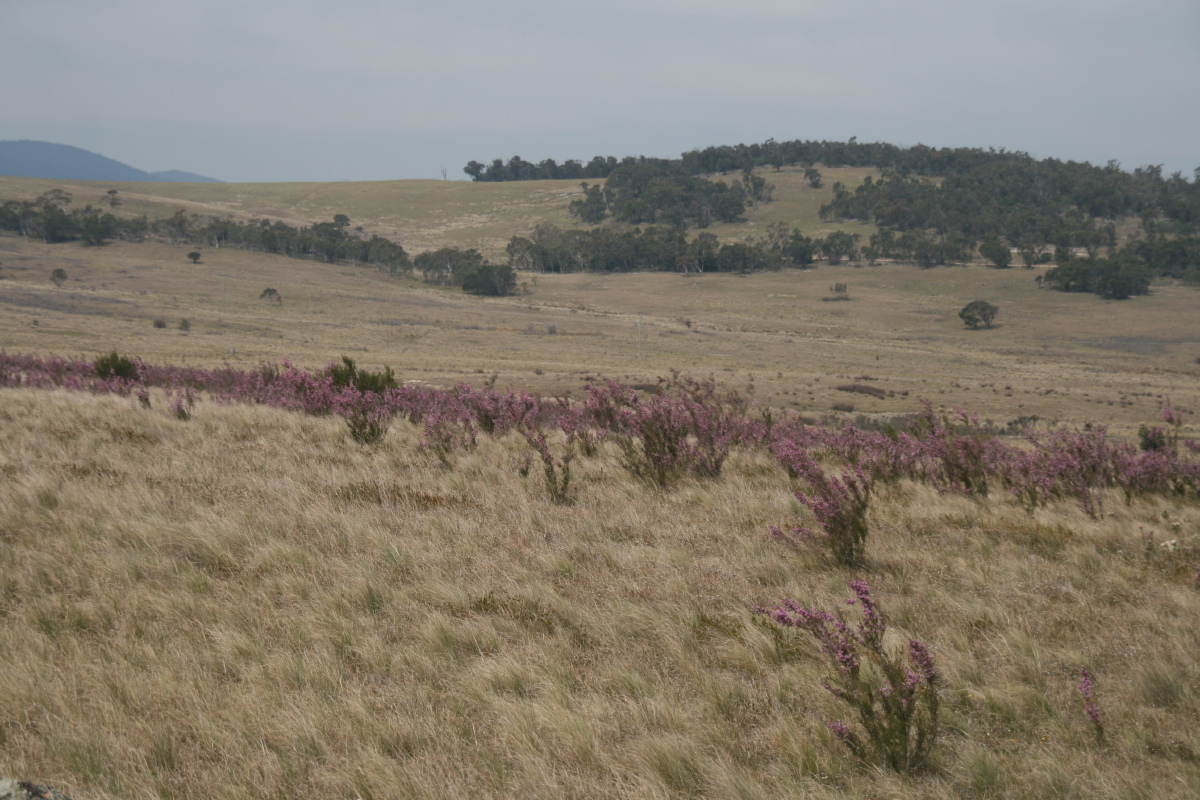
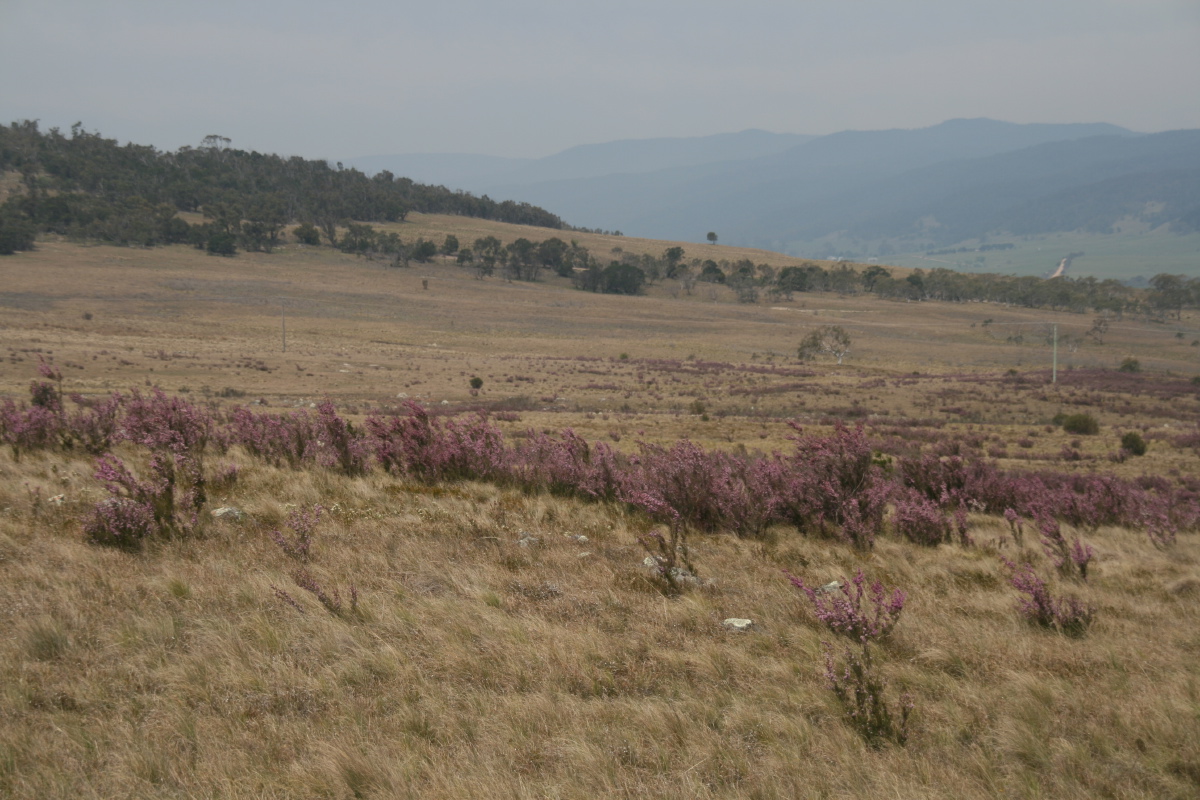
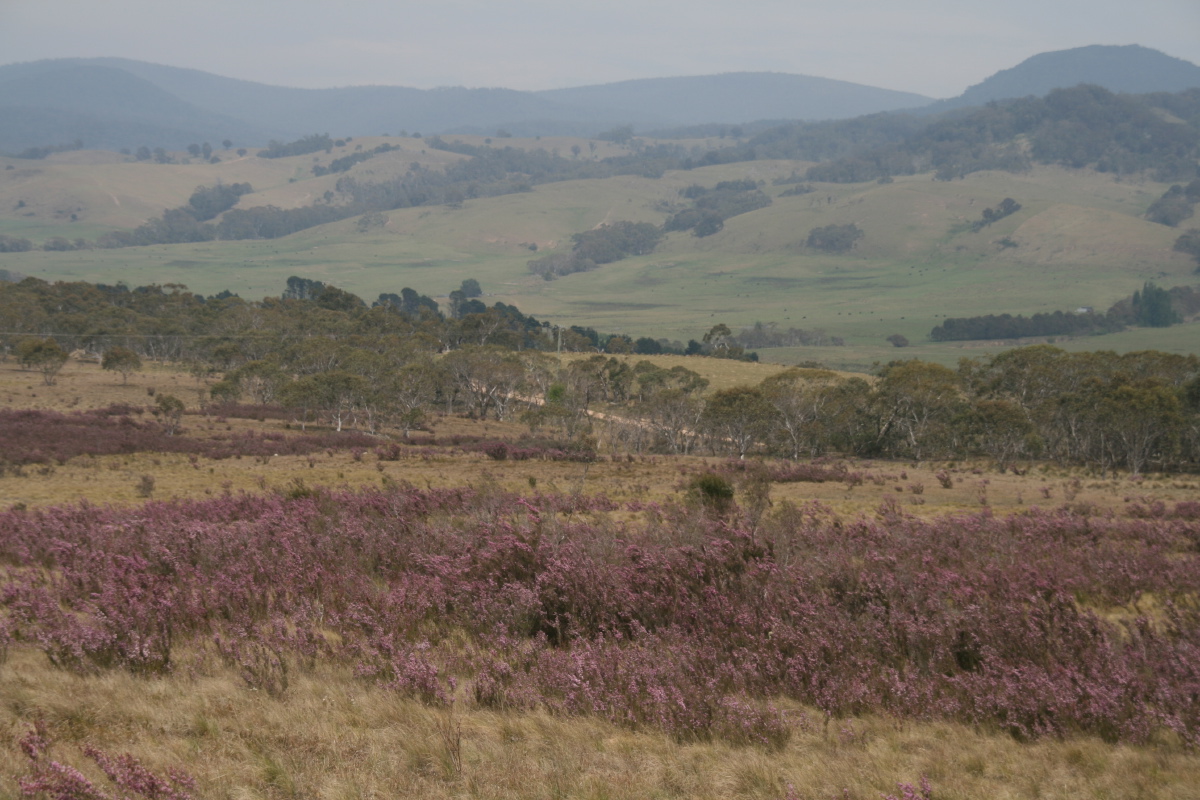
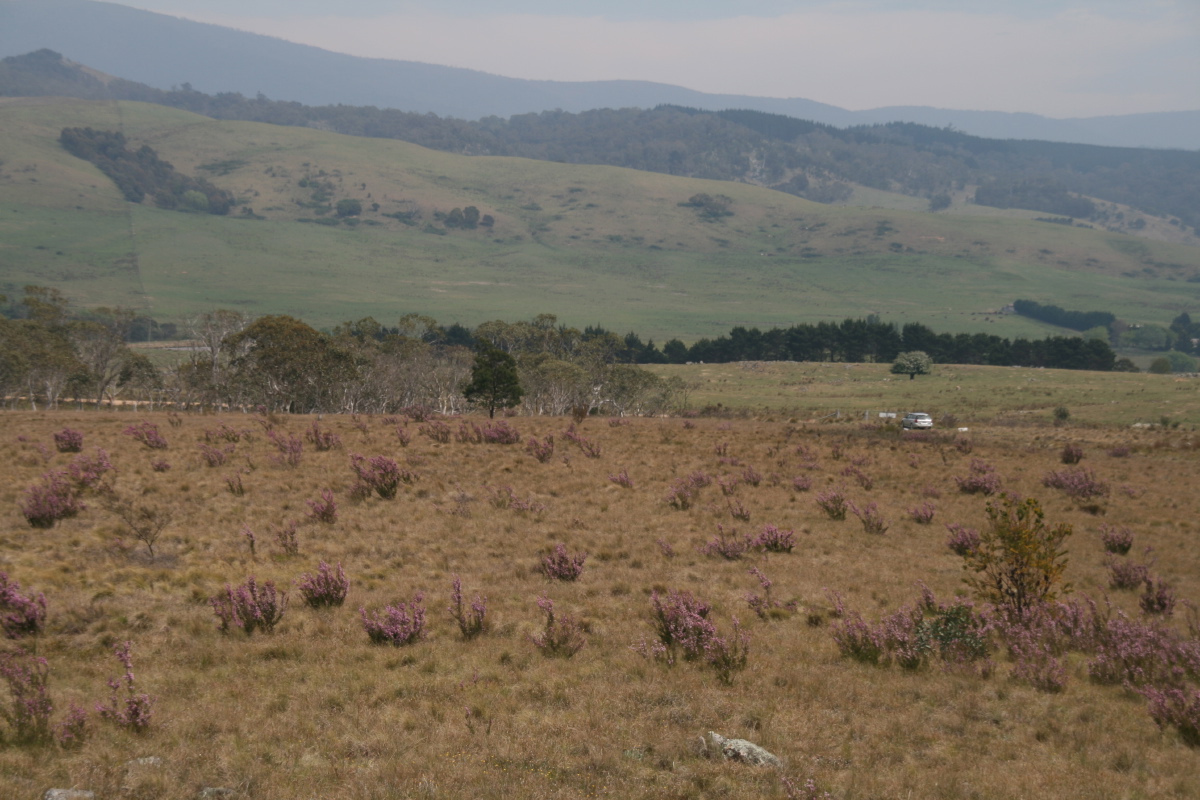
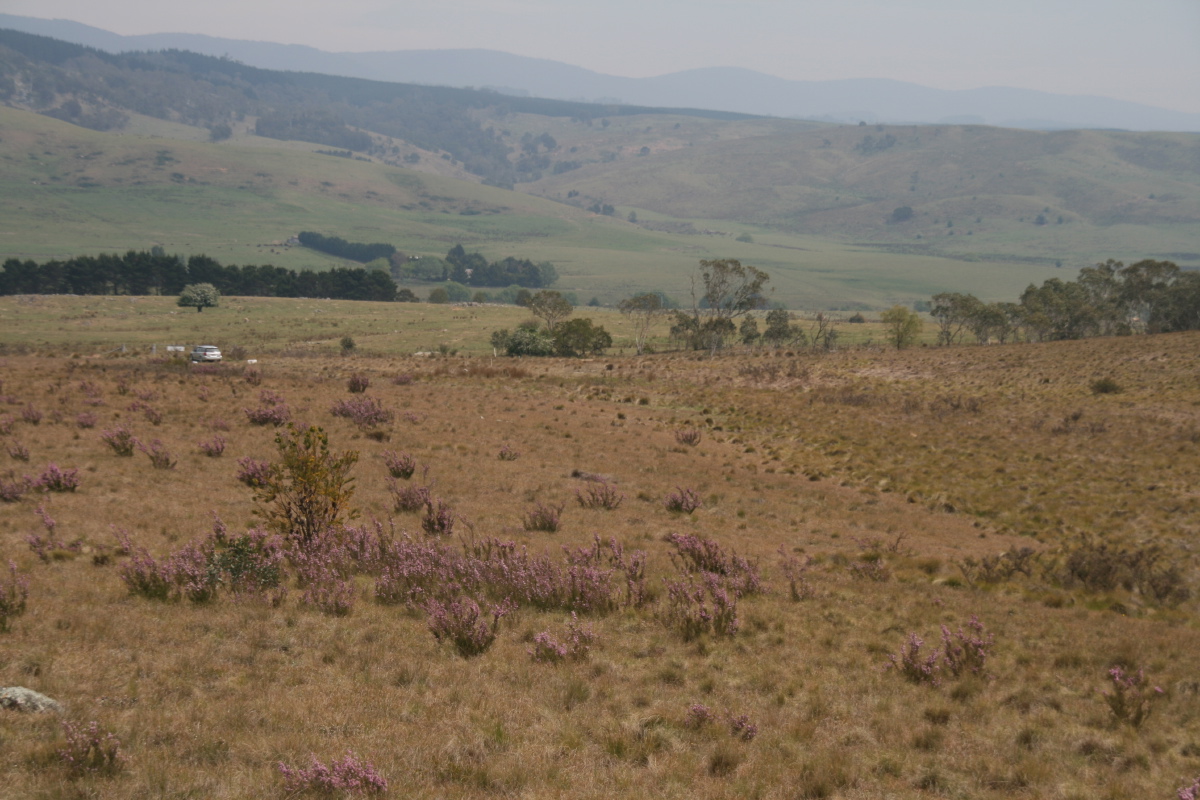
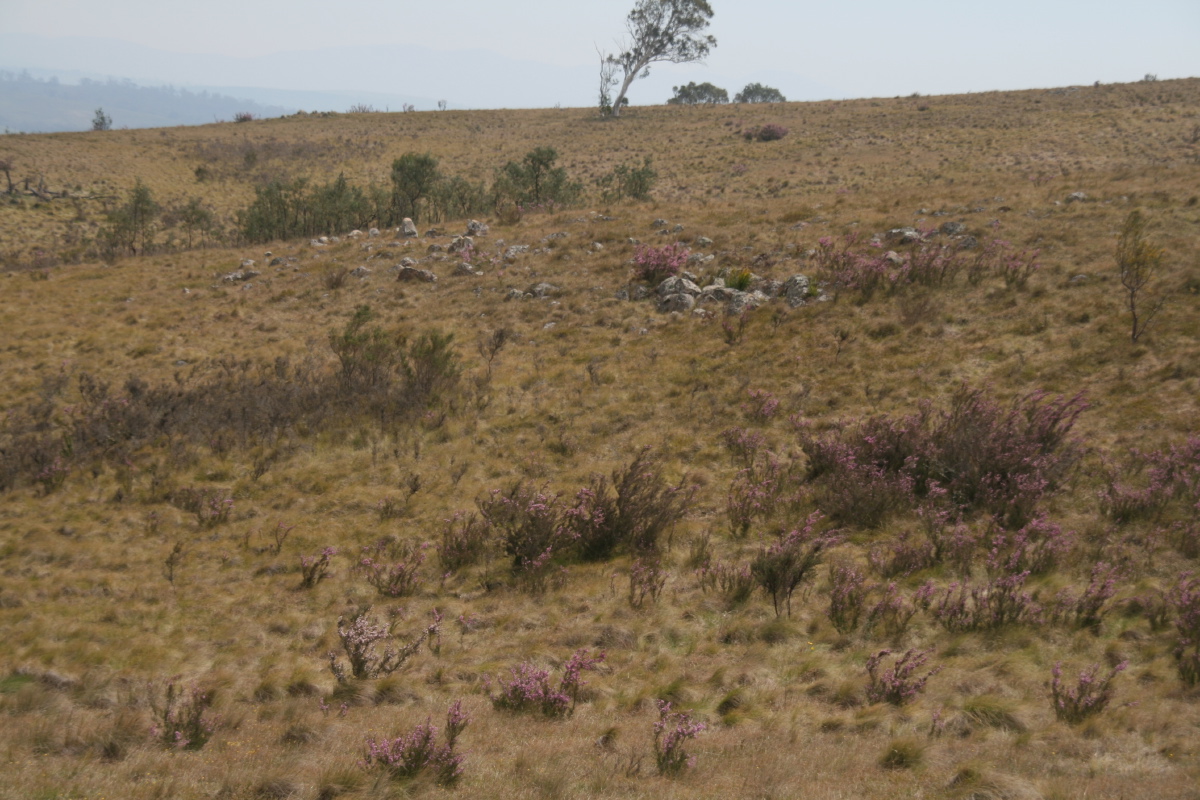
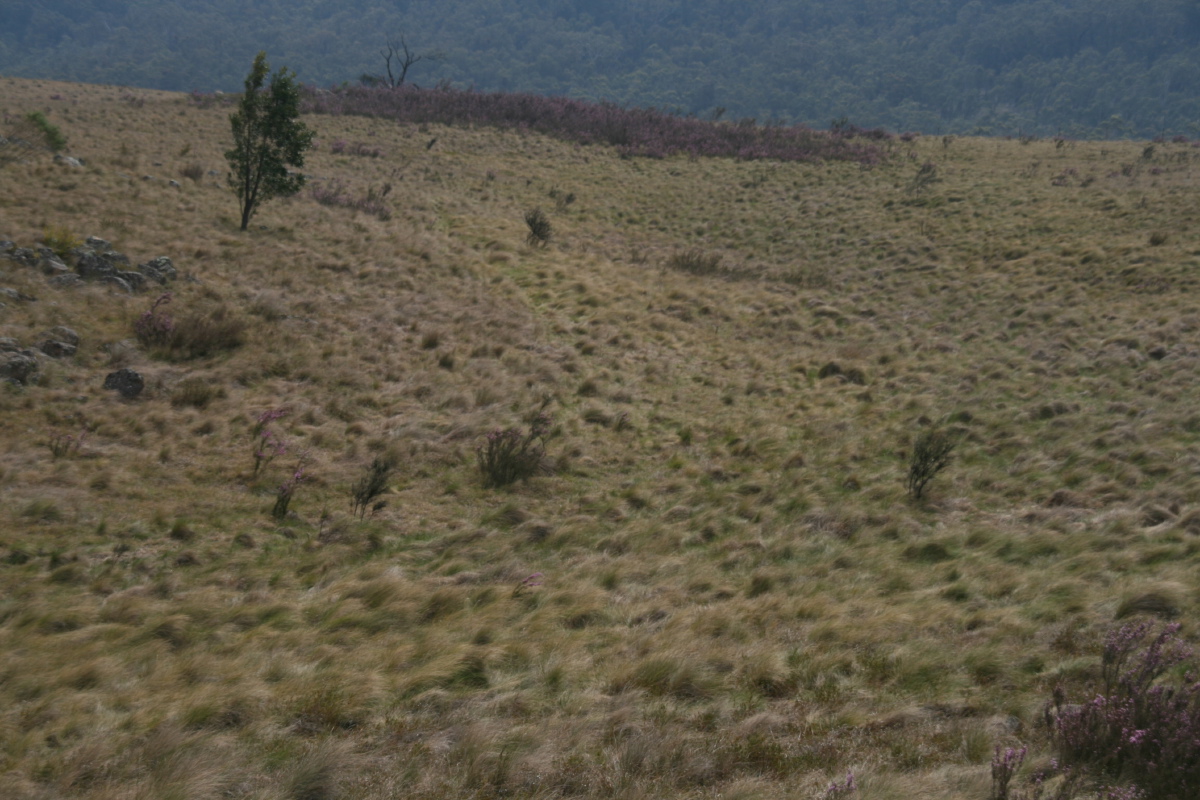
The following photos are a 360-degree panorama from 'Kunzea Outlook', high
up in the SE of the centre-block.
The day was hazy, due to smoke from a bushfire
in the Ulladulla area (NE).
They were taken using a 28-60mm focal lengths, c. 1 / 1,000th at c. f = 4.5,
just after 11am UT+11 on 20 Oct 2013.
They start facing Eastwards, turning c. 25 degrees each exposure, clockwise,
i.e. South, then West, then North, then East.
The angles to North provided in the table are necessarily somewhat arbitrary
(because there are 14 shots across 16 hexarcs).
The two angles omitted (based on 'best guess') are either side
of East – ESE and ENE.
The following shots can be compared with a year later.
Memo to Us: Use c. 30mm focal length at the 8 angles (E, SE, S, SW, W, etc.),
and they will have enough
detail but also overlap.
 |
 |
 |
 |
 |
Eastwards |
SE |
SSE |
S |
SSW |
 |
 |
 |
 |
 |
SW |
WSW |
W |
WNW |
NW |
 |
 |
 |
 |
 |
NNW |
N |
NNE |
NE |
Eastwards |
So we now need to decide how to contain it. Our preliminary thoughts on the options are:
A very retarded, or maybe suppressed, early summer, following a couple of months of high, wind-driven evaporation. The grass was very dry, with almost no water visible in any waterlines. The flowers were the poorest November crop of any year 2008-13. Even the Pultenea subspicata, normally prolific at this time of year, was burnt off.
[Gilston showed J 96 F 145 M 34 A 63 M 20 J 130 J 31 A 15 S 124 O 10 = 670mm in 10 mths cf. 625mm long-term average (LTA). Jul-Oct total of 180mm cf. 208mm LTA. The average maximum for Oct was 20.5 cf. 19.3, and for the 8 days of Nov 25.3 cf. 21.7. That suggests that the wind must have been quite something recently.]
Roger focused on the gateway, dumping 3 loads of 10 l water / 100ml glyphosate on (mostly) Yorkshire Fog, a moderate amount of Sweet Vernal Grass and some Phalaris, and such Plantago lanceolata as presented itself. The track was done up to c. 20m from the gate, and out to the road. The areas 10m either side of the track were also spot-sprayed. Previous spraying had been effective on individual Fog plants, so we hope to achieve the same effect again.
The time was close to perfect for Fog (i.e. easily distinguished, but with
little viable seed yet).
Sweet Vernal could mostly be distinguished, but we fear that the golden-brown
heads already contained viable seed.
We weren't sure whether the smaller sumbers of smaller, greener heads were
Sweet Vernal, Vulpia, or something else.
Linda toured Gateway Gully and Echidna Ridge, and worked on Fog in the area North of the small dam.
We saw no Serrated Tussock at all, even when Linda inspected the Stipa setacea beside the copse.
No Conyza at all was seen (which was astonishing after the last two years).
No thistle spears were seen, and very small numbers of thistle rosettes.
A modest number of young briar roses were seen. (Linda despatched a bunch across
the road from the gate).
A small number of young blackberries were spotted.
Remarkably, the southern waterline
seemed almost blackberry-free at this stage, with just a few small rosettes
on the site of the original, large bush.
Still retarded and/or suppressed, even after a solid rainfall event, and with water back in the ponds.
Roger sprayed Yorkshire Fog and Sweet Vernal, using 100ml of glyphosate to 10 litres of water:
Linda checked the upper end of the southern waterline and found a patch of
too-healthy blackberries.
They are to be cut-and-painted before May 2014.
She also found three Serrated Tussock 40m east of the gateway, and chopped
them out.
Patrolled the northern half. Both dams were down but not low yet. There was only one pond left in the northern waterline. The Araluen peach man (Wisbey's?) said that the peaches were 2 weeks early this year, which may hold for summer at Bunhybee too. We:
We took these, in order to help with distinguishing among similar species at seed-head time of year:
 |
 |
 |
 |
Left: Serrated Tussock Right: Poa (prob. sieb) |
Same, plus the S'd Tussock Plant |
Close-up of the Serr'd Tussock |
Not Serr'd Tussock; prob. Stipa setacea |
 |
 |
 |
 |
Patch near copse incl. Serr'd Tussock and Stipa setacea |
A nearby Poa, looking like Serr'd Tussock |
Same plant from distance |
And again |
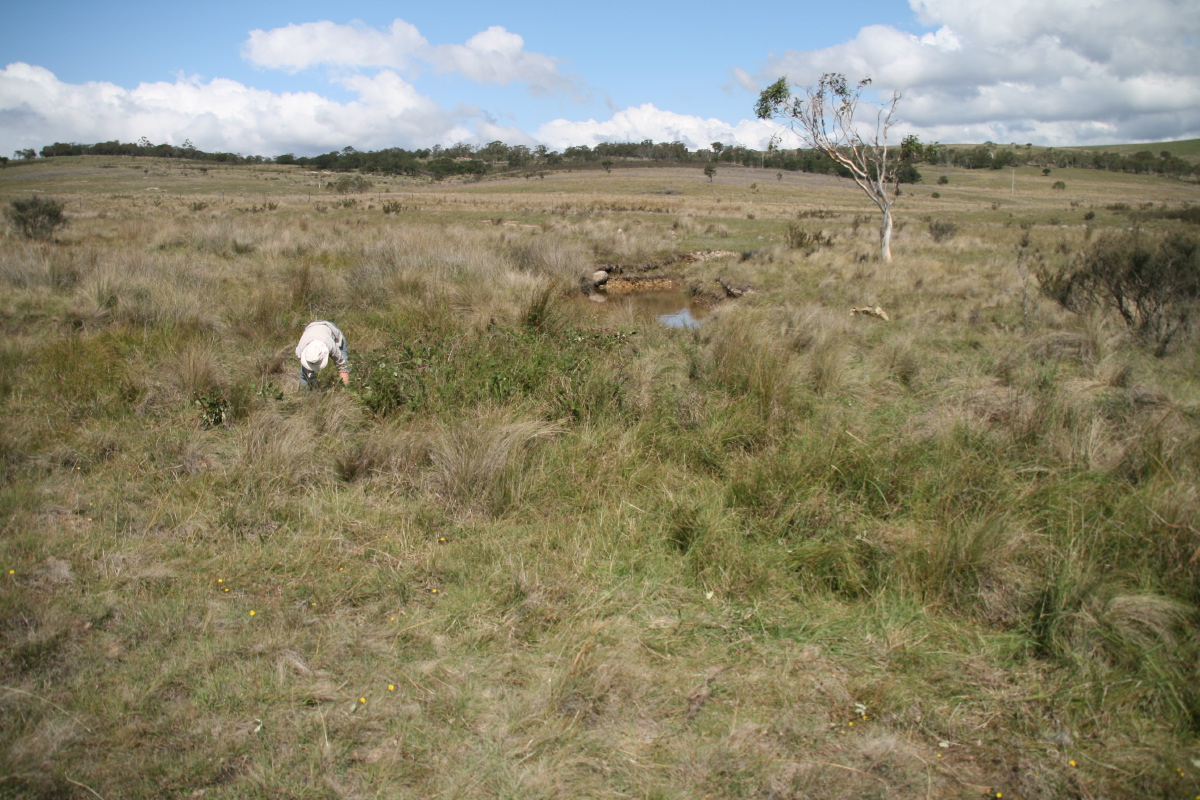
This was Blackberry Attack '14, Day 1. The first target was a large patch at the top of the southern waterline. It turned out to be far healthier than we'd anticipated – about 5 metres square, dense and reasonably virile – although nothing like the major infestation at the bottom of the waterline that we'd had to attack in the first couple of years after we took over Bunhybee. It doesn't appear that we've ever done anything in this location before, because we saw no signs of old cut canes.
We adopted the well-established technique of Roger clearing it and Linda doing cut-and-paint on the exposed stems using glyphosate with a splash of water in it to slow down the thickening and lengthen the time it can be absorbed. We stacked the big volume of cuttings on rocks nearby. That took 4 hours.
 |
 |
 |
 |
Prior to the Attack |
Trimmed, and 80% cut-and-painted |
After clearing |
Cuttings piled on rocks |
We also worked the whole of the upper waterline, from the eastern fence to the bend. It was in good shape. We looked carefully at areas where we'd worked previously – which we recognised visually, but also from the previous briar rose cuttings – many of which were stone-dead. The things we removed were:
Finally, we inspected the lower waterline. We have a full day ahead of us down there:
This was Day 2 of the Blackberry Attack for 2014. It was a fine autumn day, c. 26 degrees, remarkably with virtually no wind.
There had been appreciable rain in the intervening weeks, all ground was moist, all the minor waterways had water in them, and the ponds at the low-point in the SW corner were brimming. (It then rained a bit for the next couple of days).
We did the following in the 'southern swamp':
Linda cut-and-painted a dozen scattered and small bushes in the snow-gums south of the parking area.
Roger spent half-an-hour doing a 70-cut pre-cut and 50-cut cut-and-paint on a bush low in Gate Gully.
We removed about a dozen thistles, with flowers plus near-ready heads, mostly between the gateway and the small dam. The heads were lush enough to part-fill a garbage bag, and were taken home for some quiet sun-baking.
A small number of very small fleabane were pulled. The Pinks were anything
but Proliferous.
The Yorkshire Fog was all-too-evident in many (not all) moist areas.
This was the third and last day of the Blackberry Attack for 2014. It was a dull autumn day, c. 20 degrees, again with virtually no wind. There had been plenty of rain in the previous few weeks, keeping the whole property wet, with water seeping over the surface in a variety of places, the dam and the chain of ponds both full, and the main waterline trickling consistently.
We parked on Echidna Ridge, and worked the west-central and northern blocks. We cut-and-painted with glyphosate, with only a splash of water, as follows:
We also:
We lunched on top of Mt Bunhybee, a 40 minute / 170m climb from Picnic Corner. It was Roger's first time up there, and only Linda's second. The forest is almost entirely weed-free.
This was just a check of the centre and centre-north, after winter, and as
it turned out just after 100mm in a couple of days.
Key things found were:
The ground was moist, with water still lying in the pool in the Gate Gully creekline, 20m in from the entrance gate. The native plants were becoming floriferous, with more than a dozen species seen in flower.
A few blackberries were noted in Gate Gully, on the northern side of the junction of the two arms.
Small numbers of several species of thistle were becoming enthusiastic in lower Gate Gully, the northern waterline, and Picnic Corner.
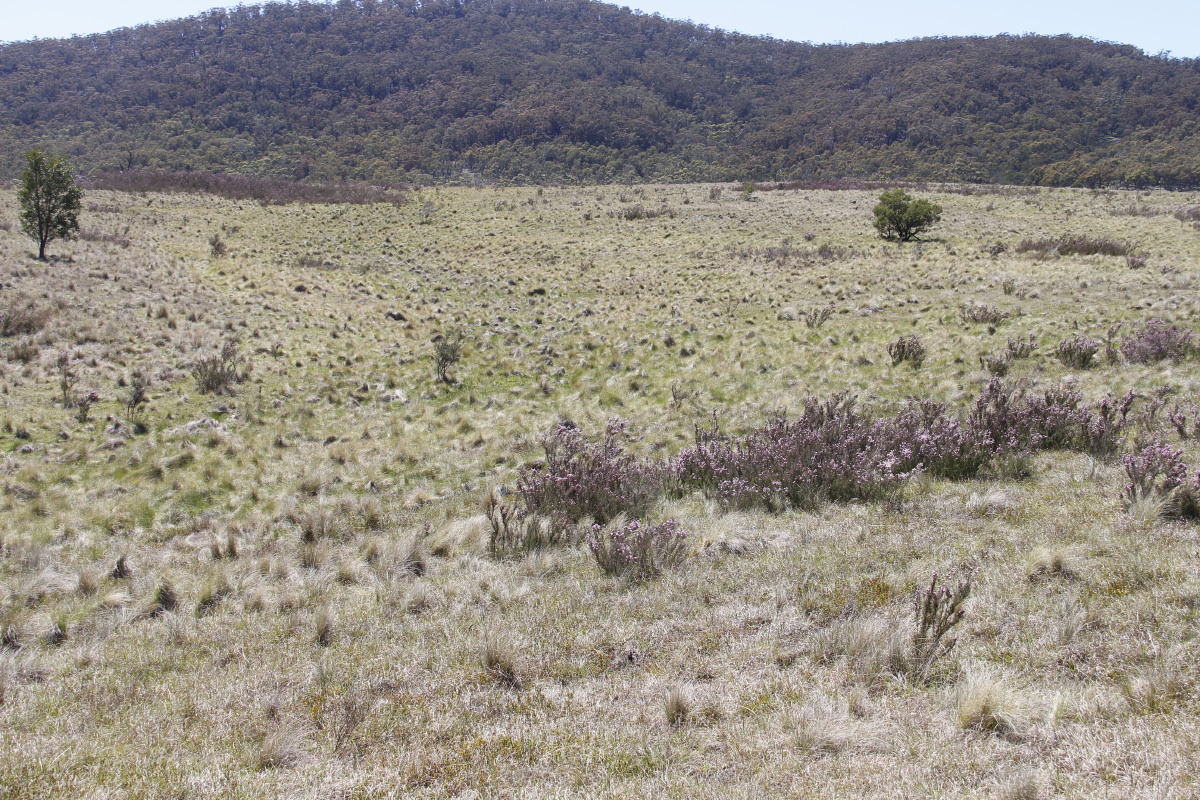
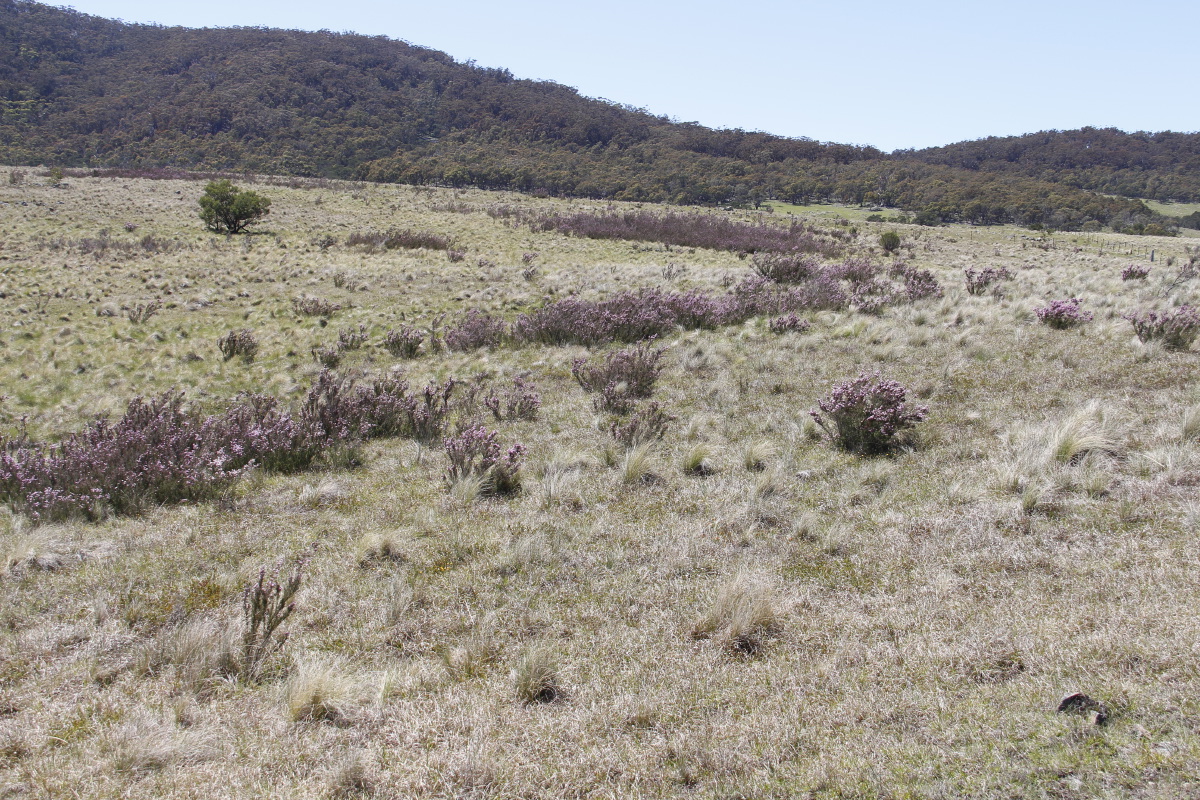
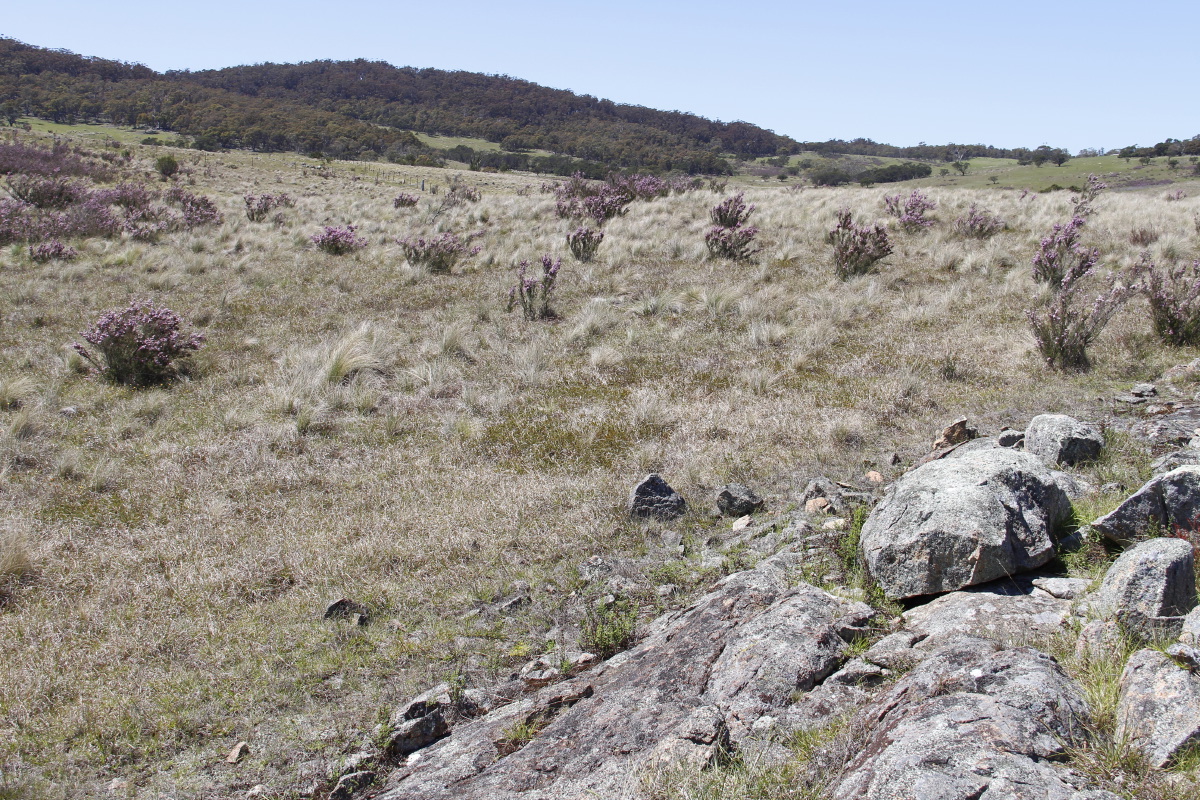
It's now very clear that the Kunzea is expanding its cover,
becoming denser, and proliferating into new locations.
We need to halt the advance, thin the areas where species diversity is being
lost, and prevent outliers becoming colonies.
The following shots can be compared with a year earlier.
Memo to Us: Use c. 30mm
focal length at the 8 angles (E, SE, S, SW, W, etc.), and they will have enough
detail but also overlap.
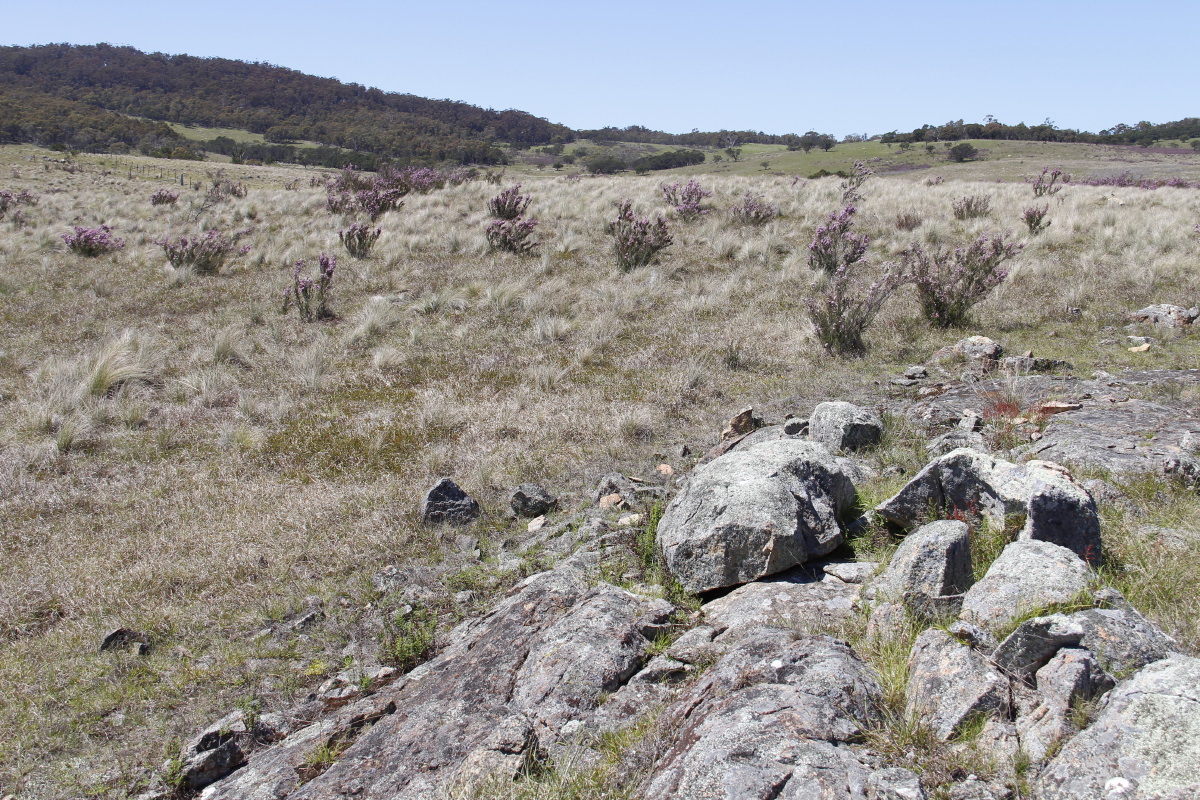 |
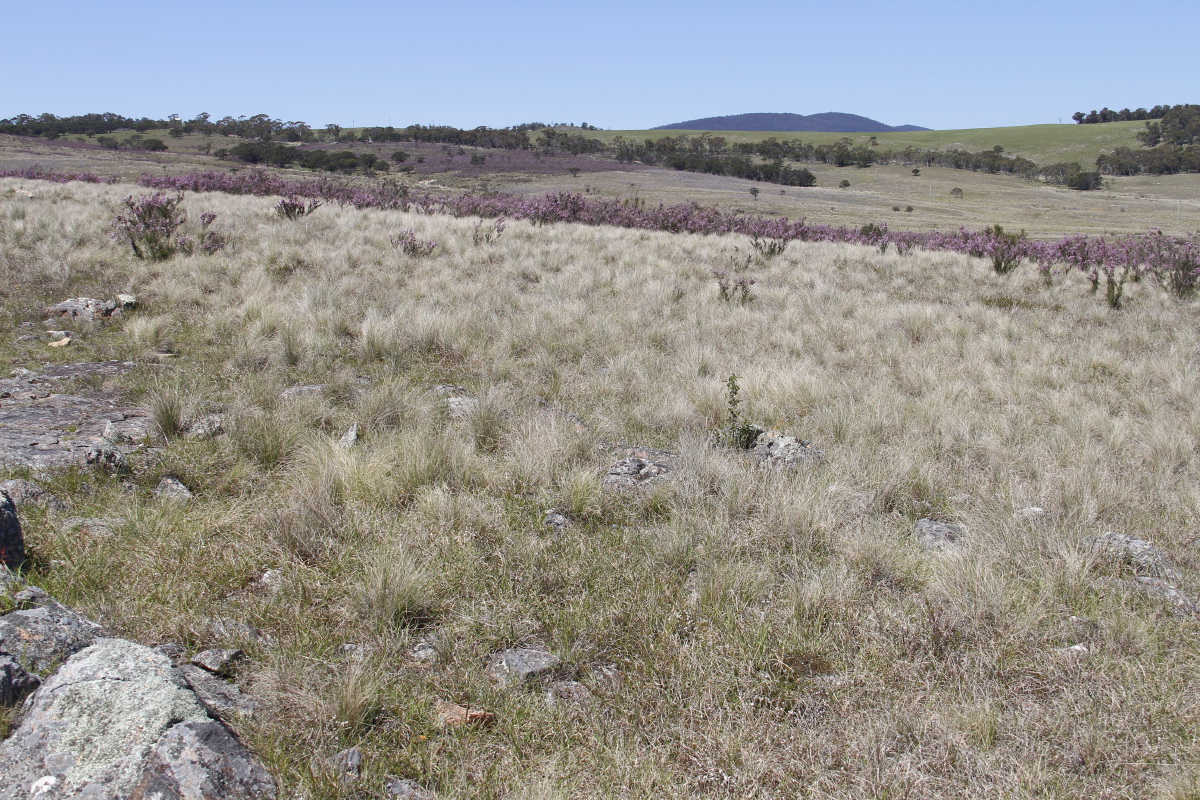 |
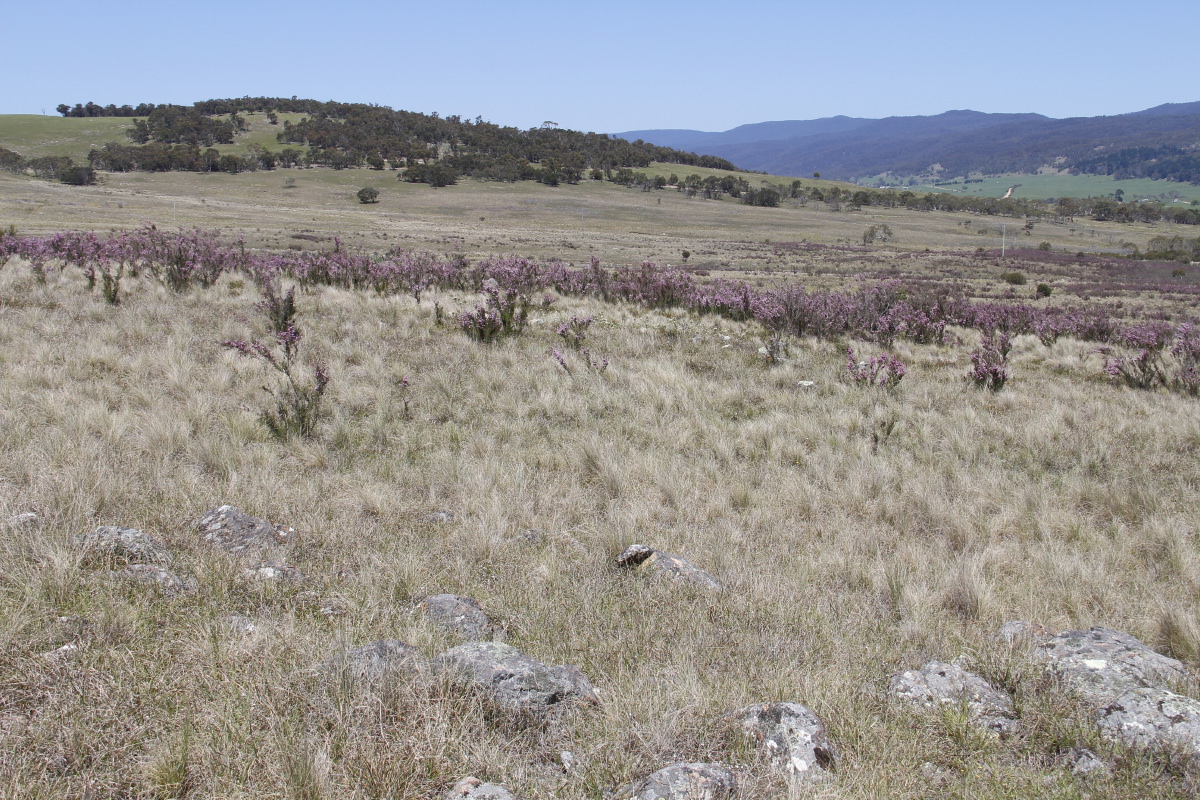 |
||
Eastwards |
ESE |
South |
||
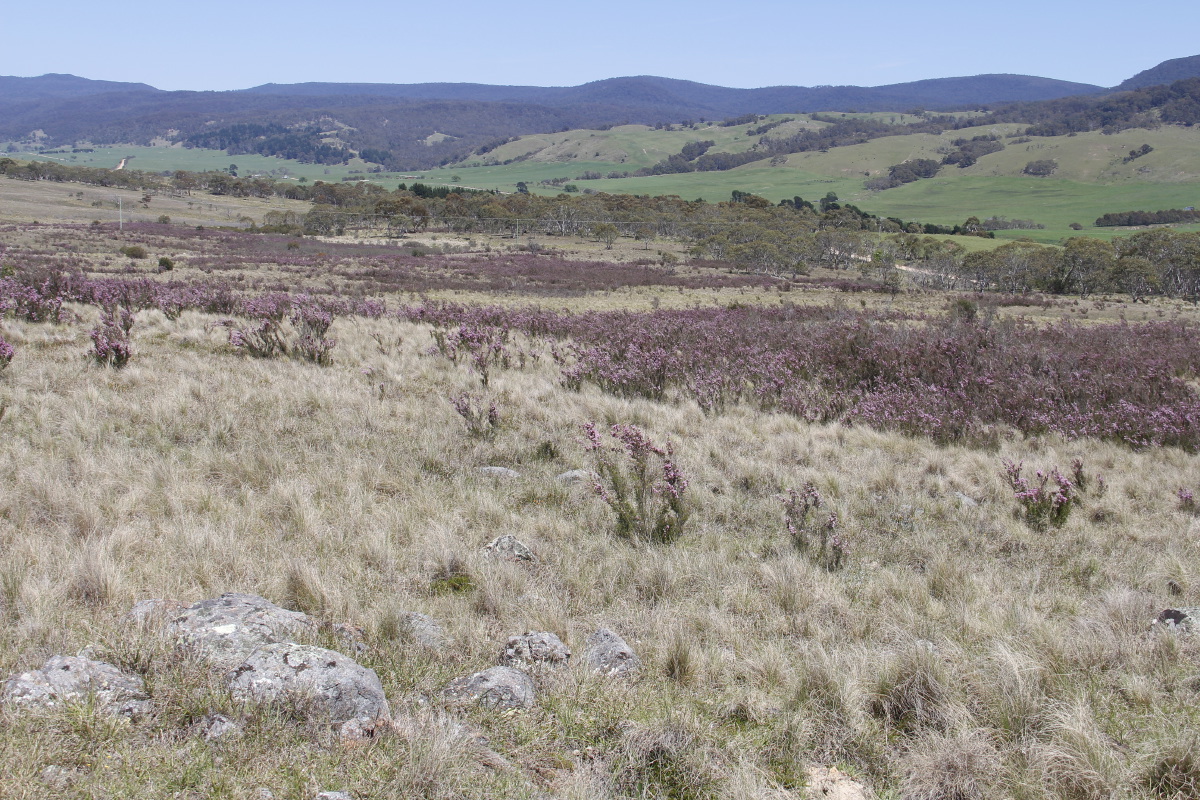 |
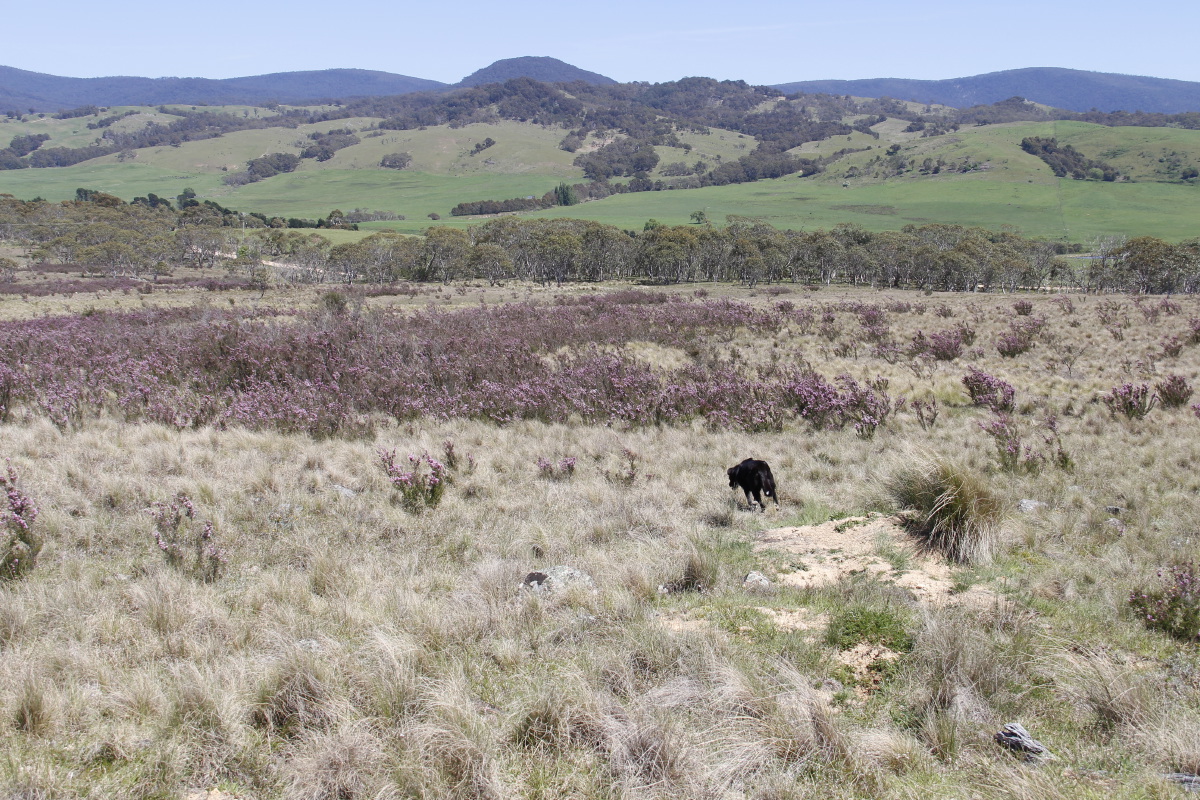 |
 |
 |
|
SW |
WSW |
West |
NW |
|
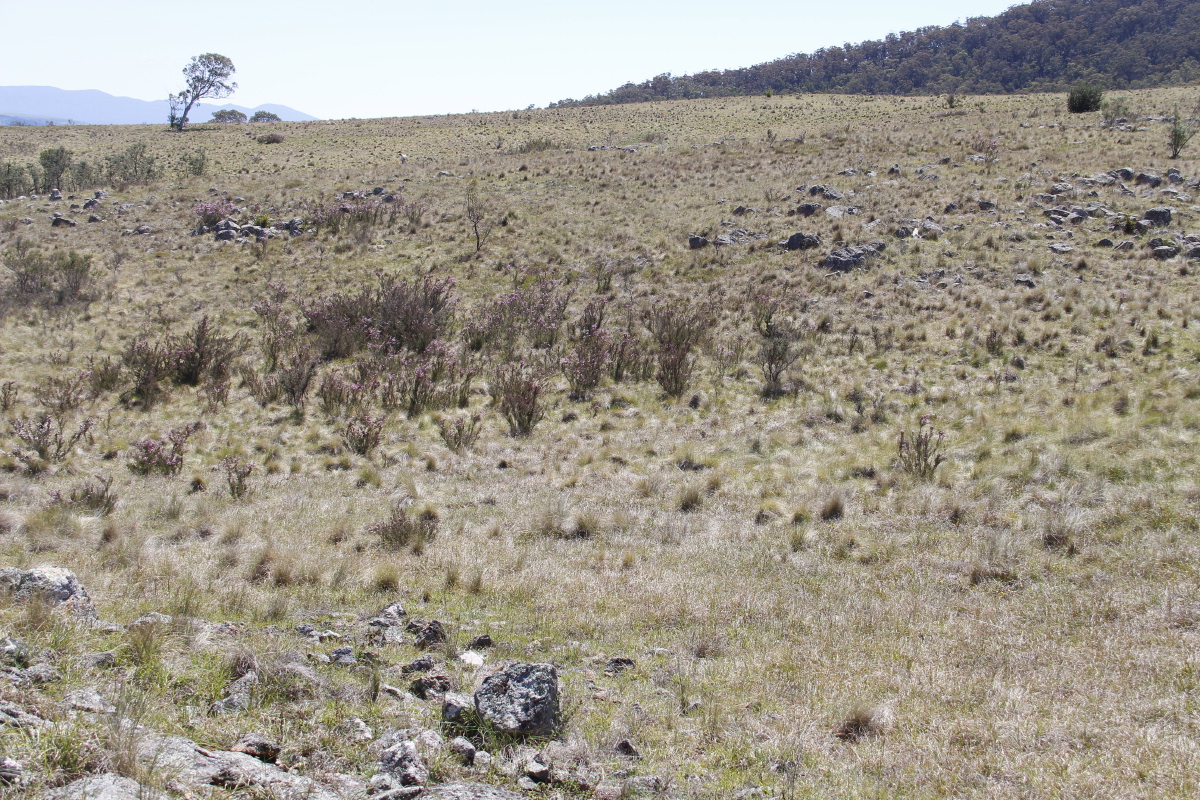 |
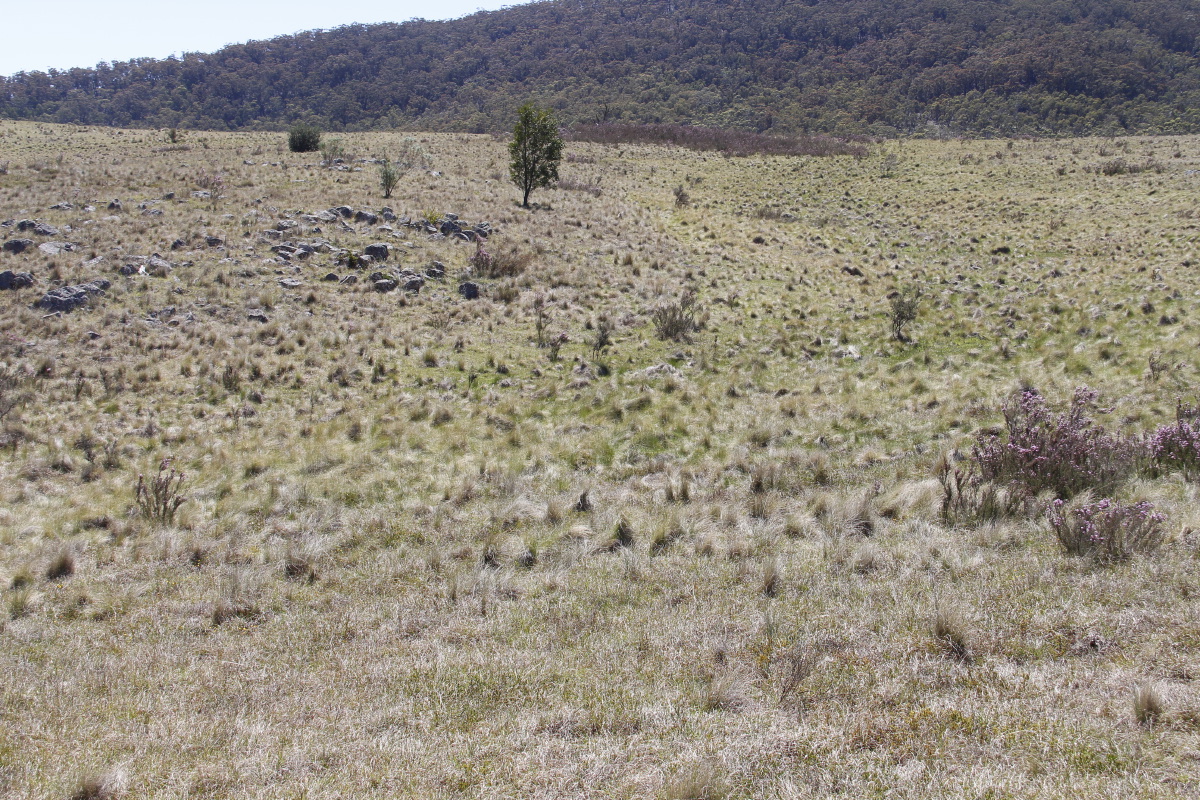 |
 |
 |
 |
NNW |
North |
NNE |
NE |
Eastwards |
Out conclusion is that the 1 year's growth was not problematical, but the dense areas are reducing diversity and need work:
 |
 |
Taken Westwards from 30m S of middle shot above |
Taken WNW from another 30m S |
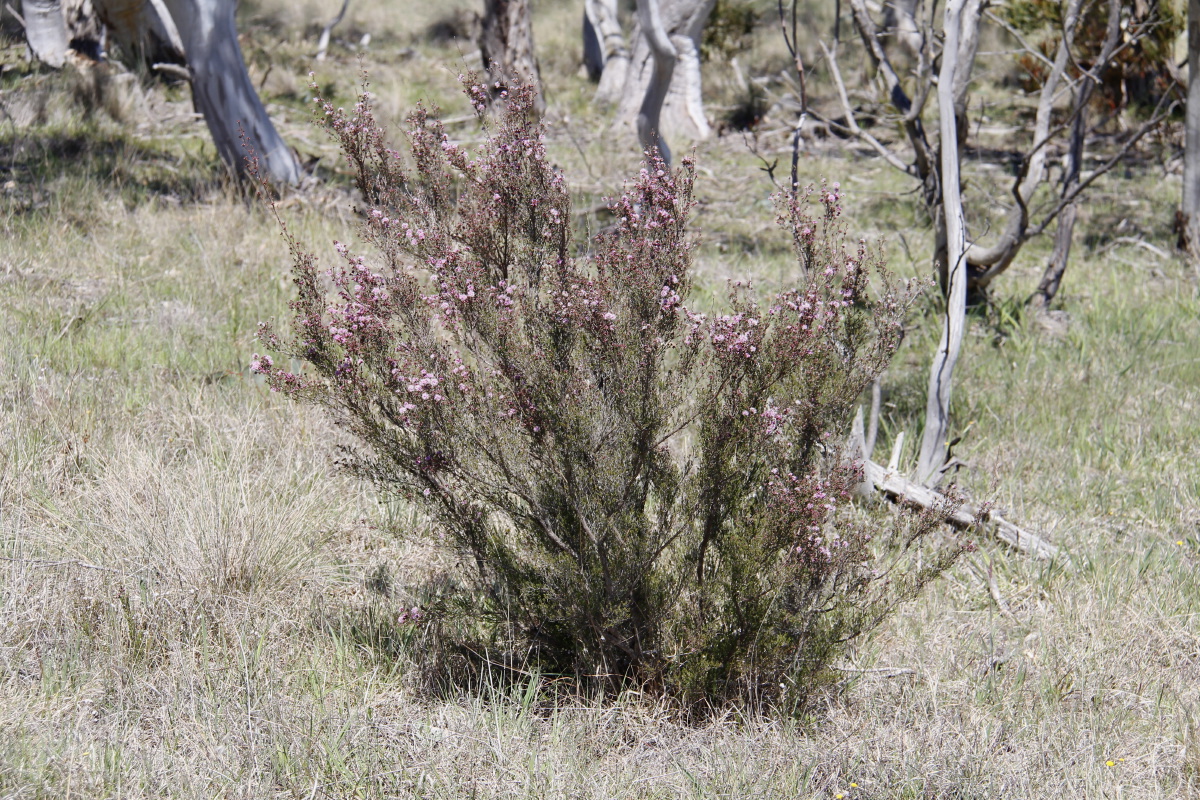
An experiment was performed on a mature plant, conveniently located 10m south of the parking spot inside the gate.
All (c. 8) stalks were cut with a secateur (two thick ones needed some tearing),
and painted with neat Glyphosate.
We need to know whether a bulk attack is practical, using shears to cut the main stalks, and a brush to paint.
If not, we'll have to resort to spraying with Starane, which brings with it significant risk of collateral damage.
 |
 |
 |
 |
 |
 |
The main business of the day was to attack the Yorkshire Fog in
Gate Gully.
Roger sprayed, using 100ml of Glyphosate to 10 litres of
water, starting at the top of northern arm, down to the junction.
He then switched to the top of the southern arm, reaching the bend, and using
15 litres of the same mix.
The Fog was easily distinguishable from other grasses, because it was much further
developed.
It was harder to distinguish it quickly from young Trigger
Plants and Rumex brownii, and to cope with entwining.
It was mostly not too difficult to limit the collateral damage.
The good news was that considerable prior damage was evident to many plants. Those that had been attacked previously were retarded in their development compared with the apparently freshly-grown ones. The fresh ones had at least reached the stage of having the main leaves folding around ready to flower, and perhaps 10-15% already had seed-heads. The previously attacked ones had only reached the stage of having thin leaves, in some cases few leaves (mostly where they were fighting through either other grasses or dead Fog), and in others many leaves (mostly where the plant was fairly free-growing).
This was the annual Serrated Tussock scan, conducted a little later than it should have been. The glumes were all mature, mauve rather than black, and quite a few had flown or dried.
The dam was full, and there was water in the line-of-ponds / northern waterline, but it wasn't running
We walked almost all of the northern half of the block. (We've yet to see a single serrated tussock south of Echidna Ridge). We removed perhaps 40, first drawing the glumes and bagging them (and taking them home to bake to death in the sun). We then chipped the plants out, mostly by loosening the roots with a miner's hammer, or for a couple of large clumps a mattock, then drawing them out, and shaking the dirt and other vegetable matter back into the hole. We left them roots-up, which as far as we can tell has always been effective in avoiding re-growth.
Maybe 25 were found along the upper-northern side of Echidna Ridge, in three clumps, close to the copse, half-way along, and towards the eastern end. About 15 were scattered along 75m of the tongue of land south of the old Peppermint, starting 50m from the eastern fence and working down westwards. All were in dry grassland areas that are among the less densely grassed on the property. We've yet to see them in a moist area.
We removed a dozen Thistles from the dam wall, but otherwise hardly saw a thistle, and hardly a fleabane in sight. We pulled a small number of Hawkweed. We pulled a few of the Proliferous Pink, but mostly tried to ignore it, as we do the dandelions.
We patrolled the northern half, concerned that we might find rampant fleabane and maybe thistles. The streams were all running, even very occasional ones such as Rubida Creek. The dam was overflowing at both ends. The Araluen peach man (Wisbey's?) was in Braidwood with close to the last of this year's crop. Ted and Suzi Jarvis joined us for coffee and then on the patrol and weeding.
We pulled out:
The Dandelions were having far too good a year, as was Proliferous Pink.
This was Day 1 of the annual rubucide attack.
The summer had browned off the grasses and few forbs remained in flower (Chrys apic, Brach rigid, some Utricularia, a few Hibbertia). The yellow-tails were particularly active and noisy. A couple of flocks of migrating young wattlebirds went over, and one mature bird noisily defended his patch. No sign of yellow honeyeaters passing through at this early stage.
The southern waterline was empty, although not parched; and some nearby areas to the north of Bunhybee still had water lying in some occasional pools. There was considerable water on the grass from overnight dew and/or showers, which soaked our boots and the bottom 9 inches of our trousers. It was effectively the first day of Autumn, with heavy cloud, and temperatures having suddenly dropped from 10-25 to 6-12.
We worked on the south-western waterline and the strip from the gate down to it.
We beheaded and bagged a few dozen fleabane, a very few of the small numbers of thistle that still had unburst seed-pods, and moderate numbers of rose-hips from the considerable number of Rosa rubi. that were around.
We spent 30-60 minutes clearing blackberry from each of several areas of the creekline. A few plants were young and virile, but many were pretty sickly, apparently from root-balls that we've previously caused a great deal of grief. The southern area beside the pool, which had once hosted the largest bush-complex on the property, was for the first time a relatively easy job, and the area is now overgrown mostly with natives plus of course some Paspalum.
The 5 hours (less lunch) sufficed to finish the SW corner for the year, plus clear the small amount of mature fleabane along the edge of the snow gums, and scattered blackberry inside it.
Day 2 of the annual rubucide attack.
There had been considerable rain during the week, and the central and southern waterlines were gently murmuring.
We worked on the southern waterline, from the south-eastern swamp area up to the eastern fence. The majority of it was pleasingly clean, but the extensive infestation at the top of the line has got away from us. We spent most of the short day on it. We completed the two-thirds that were on relatively dry ground, but ran out of time, and have to hope that it will be drier next time we're there and hence easier to get into.
Our technique has been to mount attacks only in the autumn, when the withdrawal of moisture down into the root-ball maximises the impact of cut-and-paint. With a large infestation, perhaps we should do a pruning run at some earlier stage in the growth-cycle.
Alternatively, Linda would like to do an experiment with pruning to a visible but manageable size in winter, and then doing a cut-and-paint in spring/summer; but Roger doubts that cut-and-paint would be anywhere near as effective at that time.
We came back along the eastern side and removed the re-growth from the large infestation low in Gate Gully.
We headed and bagged Rosa rubi. and Fleabane where we found them, cut-and-painted the Rosa and pulled the Fleabane.
Day 3 of the annual rubucide attack, the last we could fit in this year.
The target was the remainder of the infestation at the top end of the southern waterline
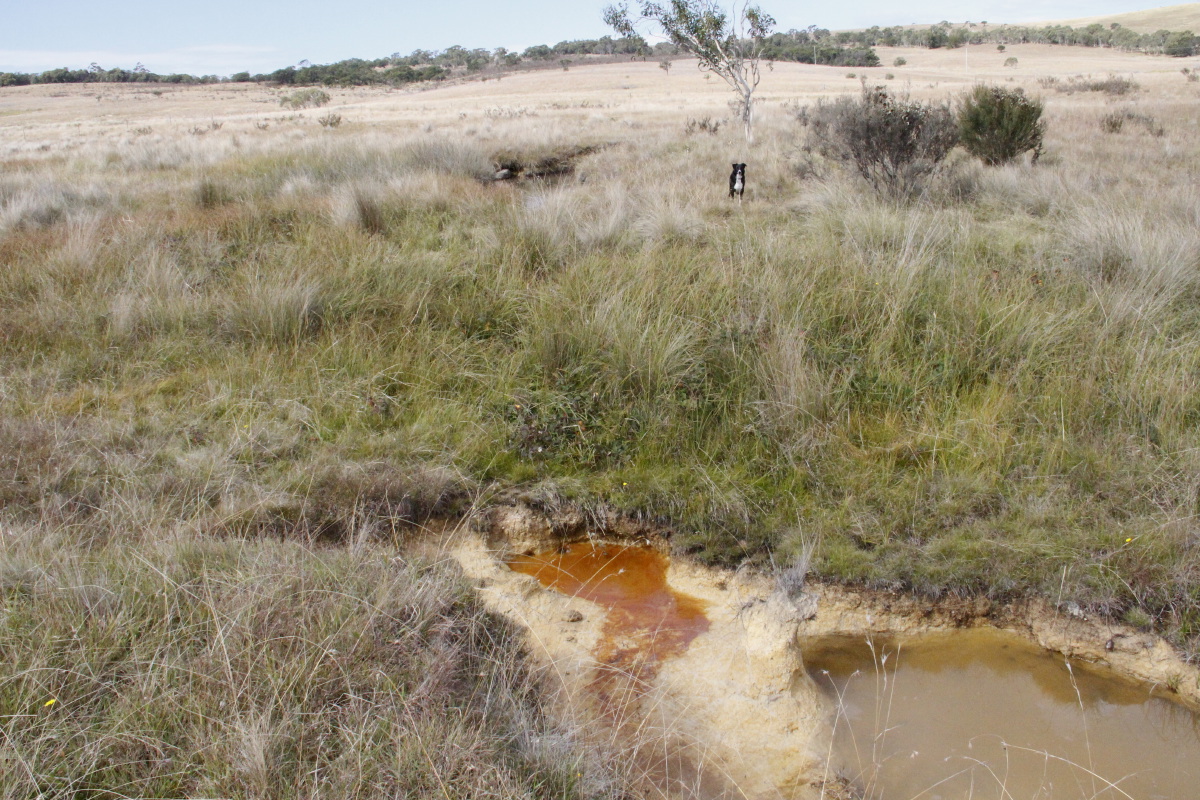 |
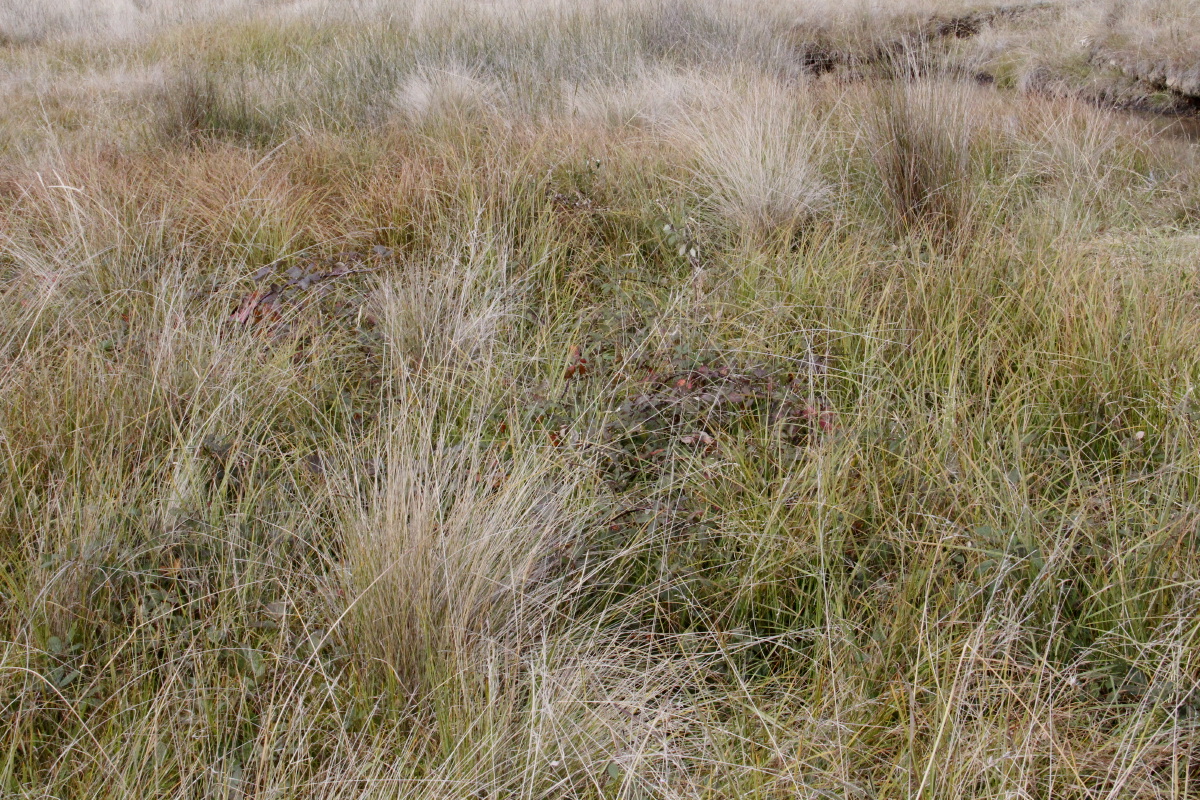 |
 |
 |
5 hours' work ahead |
Medium and small bushes |
Hiding in the grass |
And 5 hours later |
On the way back, we found a previously unknown and vigorous outbreak around the centre of the boundary between the southern and central blocks. That turned out to be a hard 40-minute grind at the end of a tiring day.
We didn't get to the eastern end of Gate Gully, or the waterline above the small dam, or the main dam wall, but we know from previous visits that those areas don't need a big effort right now.
An inspection day, with friends, and introducing 2yo Misha to the property. She met an echidna on Echidna Ridge, and kangaroos bounced towards us while we ate at Picnic Corner, stopped warily, and bounced away again. And, as a bonus, Di Izzard was crotching lambs across the road, so Misha patted lambs and saw more sheep than she knew existed in the world.
There was almost no evidence of spring growth yet. Rainfall for the 4 months May-Aug was almost right on long-term average, although over-weight in August. The dam was full and the waterways dribbling, but the mornings have been cold and the days not yet all that warm.
The Yorkshire Fog was not yet showing sufficiently to attack it, but no doubt will be shortly.
Only a few young blackberries were noted, at the track-crossing and above the dam.
There were very few thistles evident, although inevitably some on the dam walls.
The Yorkshire Fog was still not yet showing sufficiently to be worth attacking.
This was to be the primary Yorkshire Fog attack day.
It was indeed the right time, with the Fog still readily distinguishable, well ahead of other grasses.
And only a small percentage were showing viable-looking seed-heads.
We had the feeling that the prior attacks in Gate Gully had had a pretty decent impact, and slowed it down.
We again used 1% Glyphosate in a narrow-spray.
Linda did 12 litres using the back-pack, which did Gate Gully main arm (plus 3 litres near the gate).
Roger did 2 x 7 litres using the hand-pack, which did 3/4 of Gate Gully hidden arm.
It was also Kunzea monitoring time, for comparison with 20 Oct 2013 and 22 Oct 2014:
 |
 |
 |
|
From near the copse, the view south ... |
and north ... |
... and closer up |
|
 |
 |
 |
 |
From the control-point, SE of Central block, looking East |
looking SE |
looking S |
looking SW |
 |
 |
 |
 |
looking W |
looking WNW |
looking NNW |
looking N |
 |
 |
 |
|
looking NNE |
looking ENE |
Artistic interpretation, Kunzea looming threateningly above Pimelia glauca |
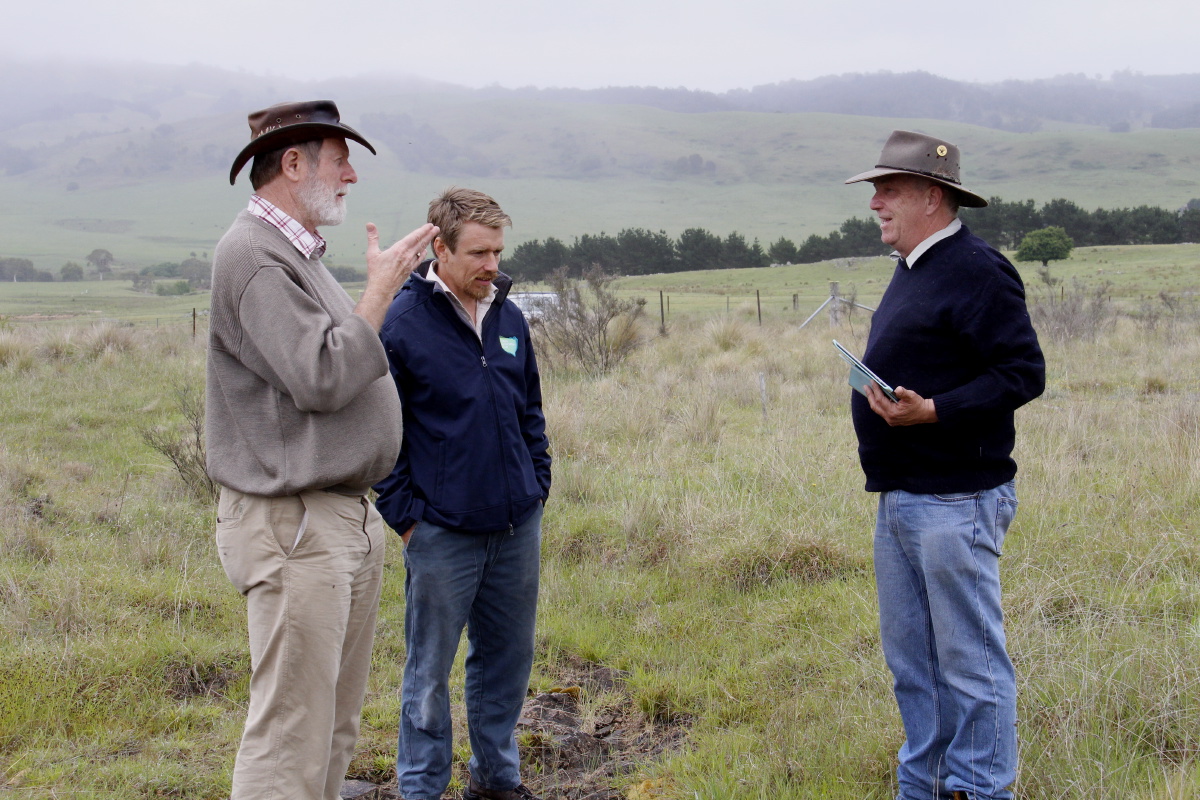
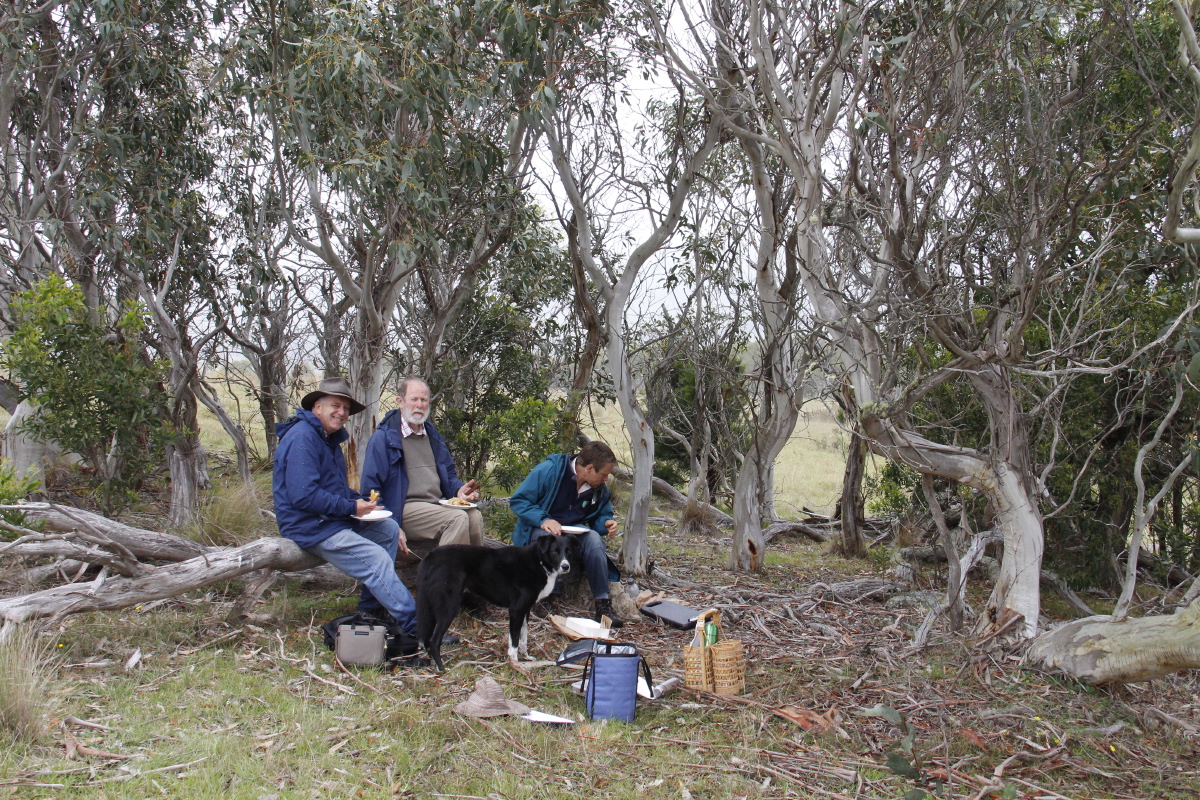
NCT's Nigel Jones came to inspect, and Rainer Rehwinkel joined us. It was a misty day, with light rain setting in after lunch. We also diverted into the forest, across lower Lot 120, and onto Parlour.
We spent most of our time looking at and discussing native species, so see FP, T&S and G.
However, we also discussed Kunzea parvifolia management, and the use of cool burning on Themeda.
Rainer had taken us to Turallo Reserve just S of Braidwood on the way, so that we could see both heavily matted
Themeda (which not only squeezes out forbs but also kills itself), and the positive effects of cool burning.
It would have already been too late to attack Yorkshire Fog, because Themeda and other grasses were now developing, recognition was harder, and a lot of the Fog was already seeding.
 |
 |
 |
 |
On arrival – Roger, Nigel, Rainer |
Lunch several hours later, at the copse |
At the gate, a replay of 31 May 2009 |
Gamochaeta americana, taken on Parlour, but a good, clear shot |
The primary purpose was to conduct experimental treatments of the rampant Kunzea. Currently, our overall intentions are:
We acquired a moderately-used brushcutter recently (thanks Georgie and Margie!), specifically for this purpose. We planned trials of two alternative approaches to Priority 1, and a third trial of a single approach to Priority 2.
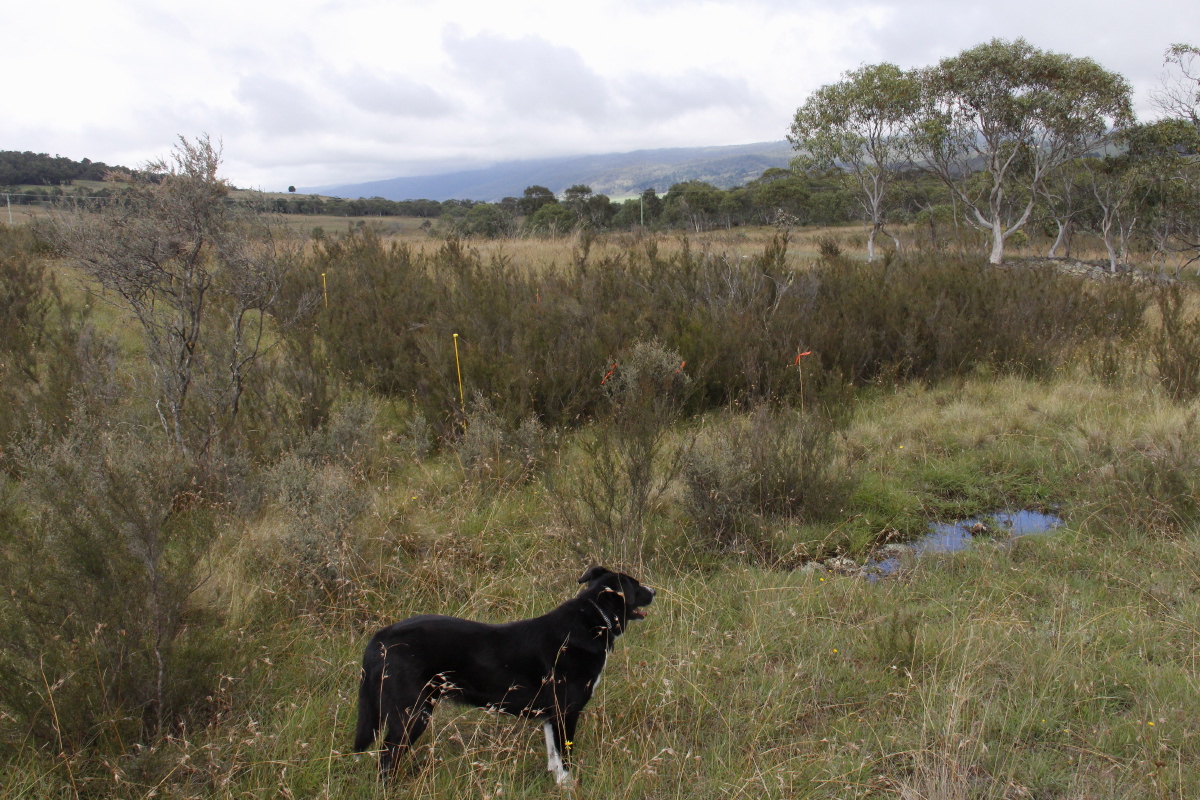
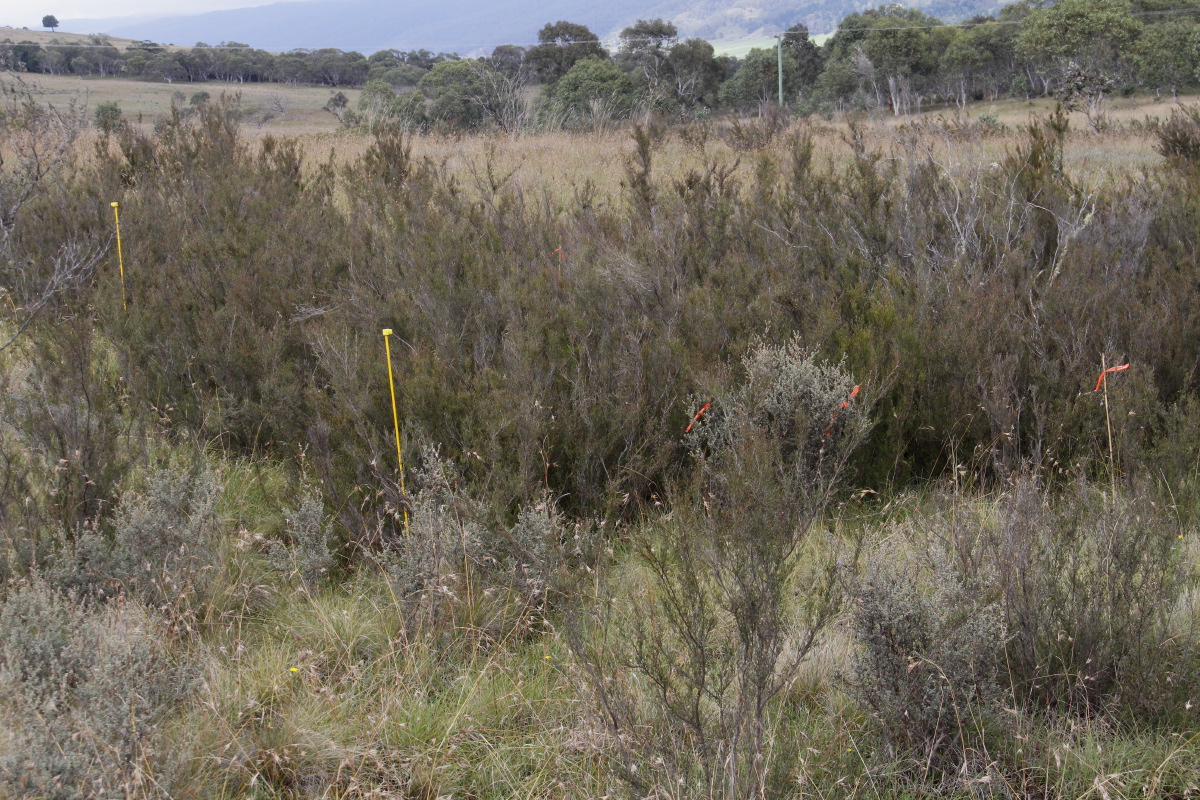
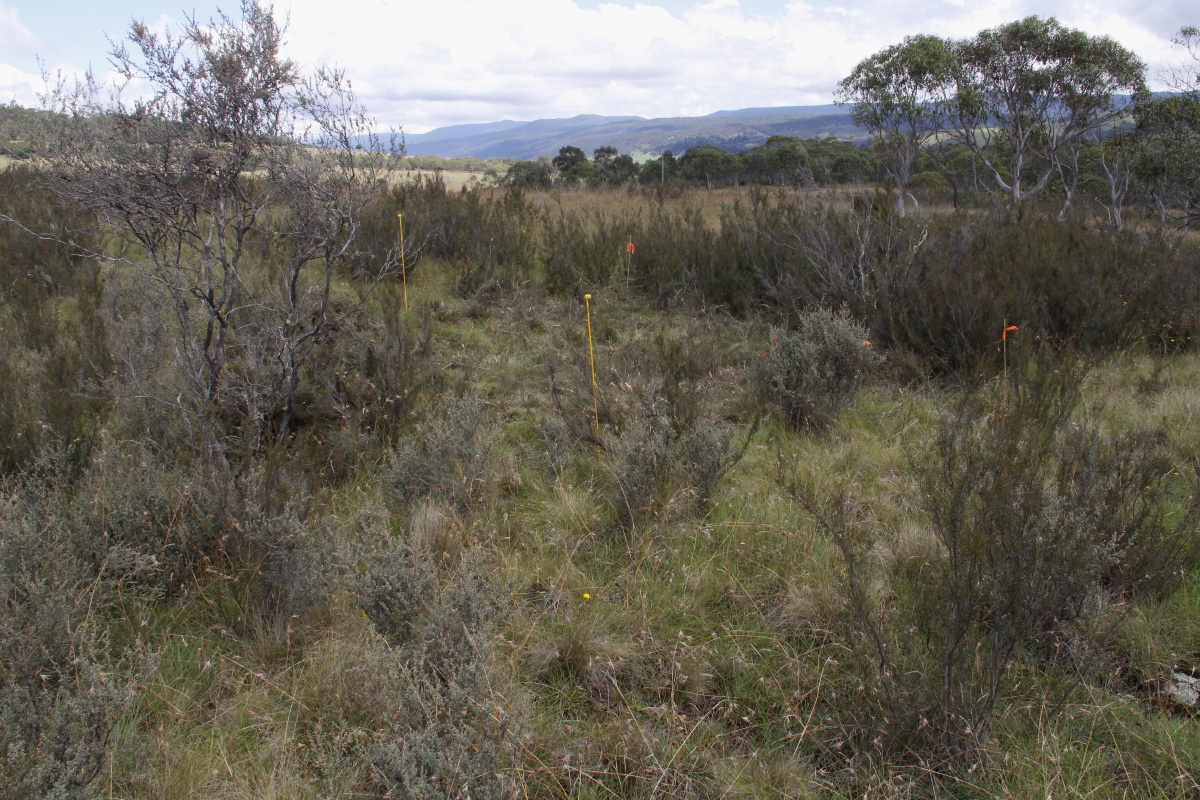
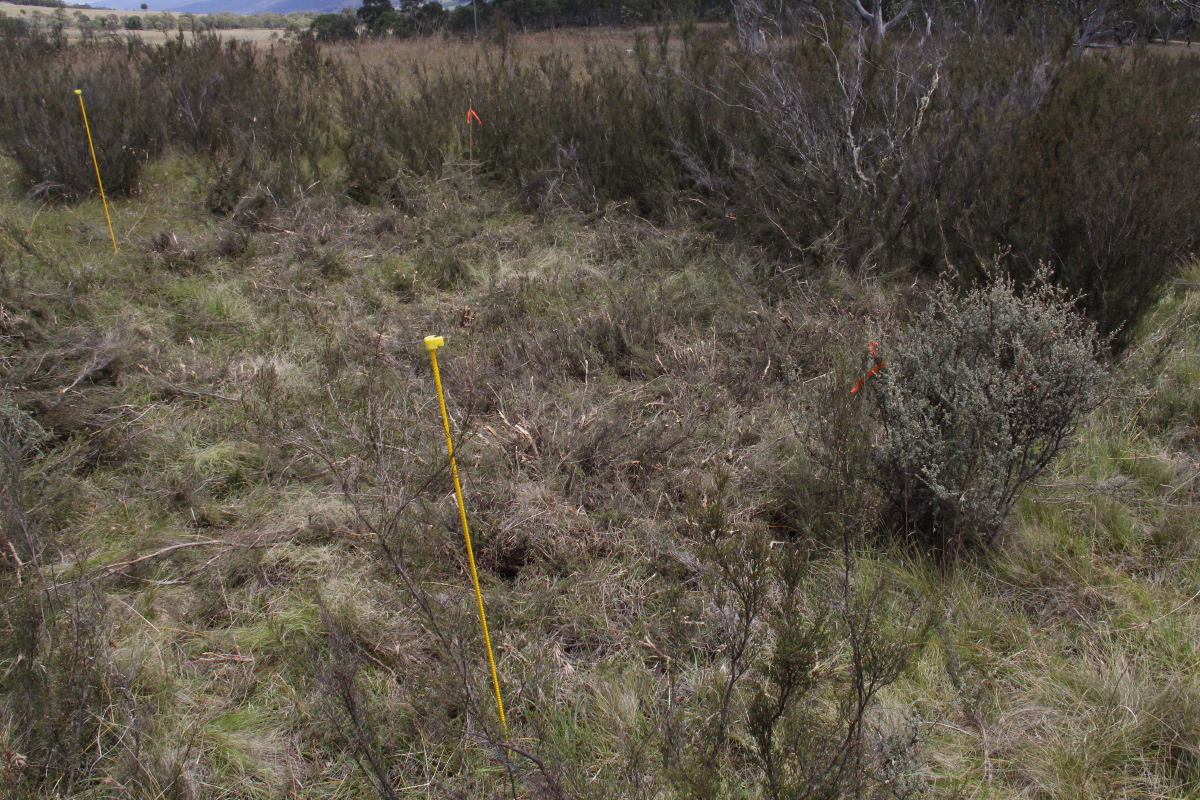
We selected three sites on the northern edge of the biggest area of Kunzea. They're 175m due south of the parking-spot inside the gate, probably just inside the southern block and still to the north of the southern waterline, perhaps 60m from the road.
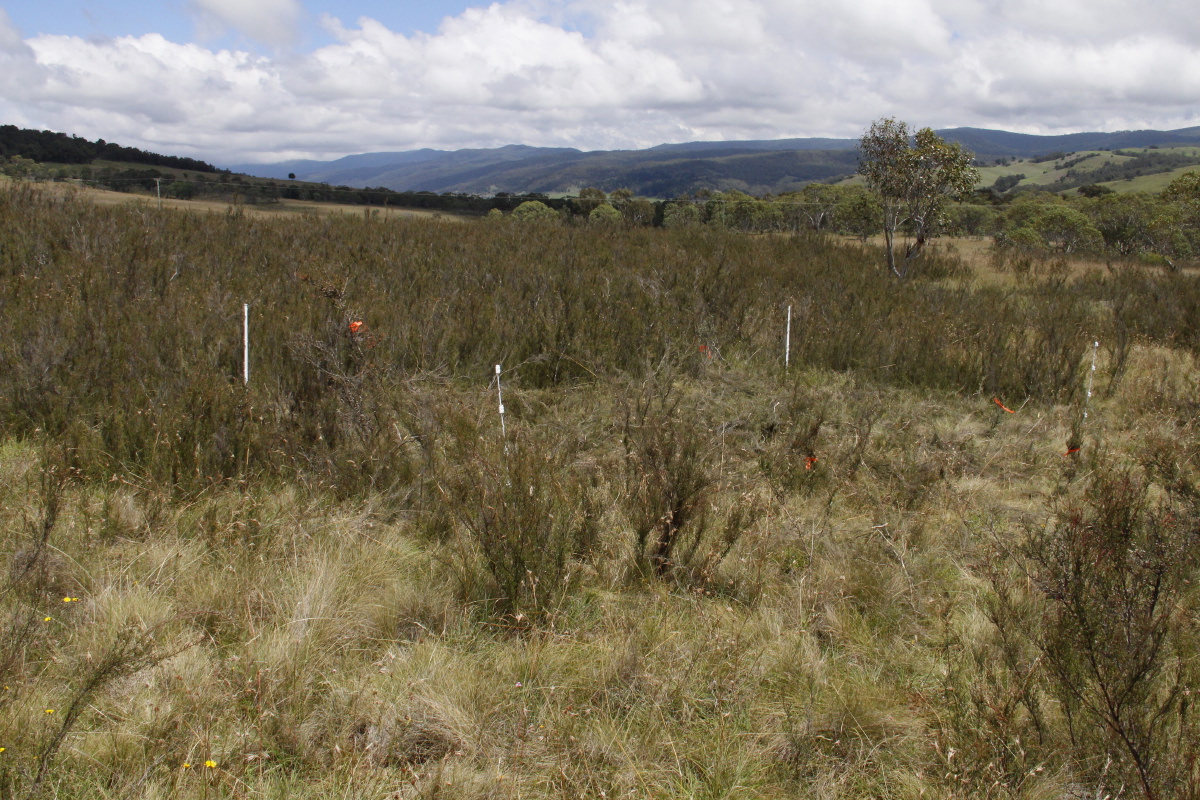
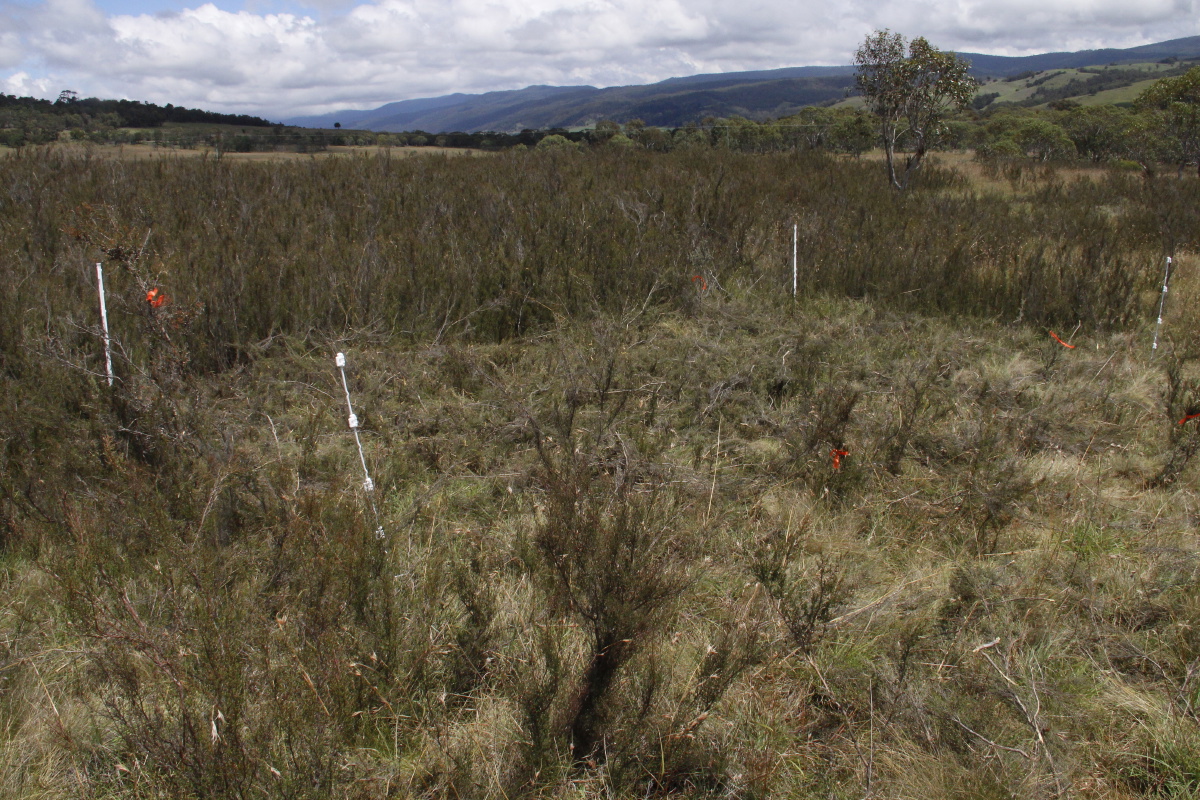
We performed the following trials, with each area marked by corner-posts and photographed pre- and post-, with location and orientation cues in some of the photos:
 |
 |
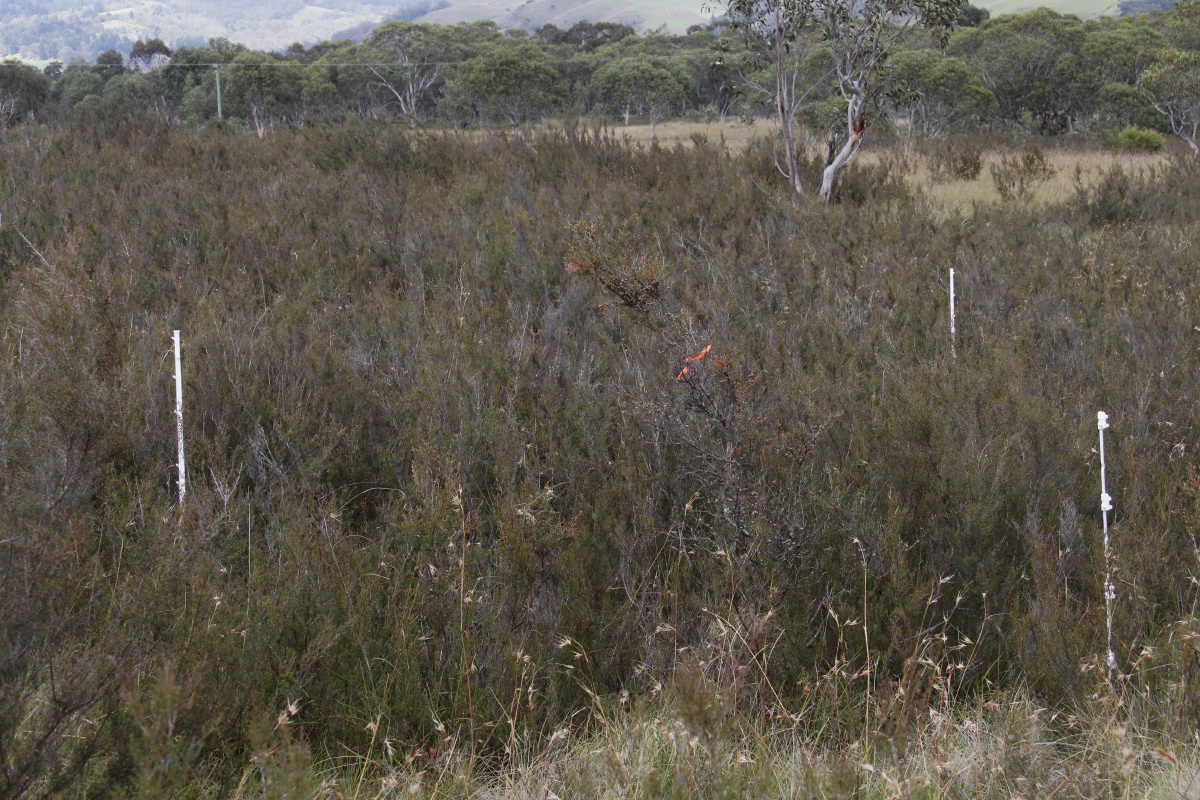 |
Pre: Location Looking SSW |
Pre: Location Looking WSW |
Pre: Condition |
 |
 |
 |
Post: Cleared Looking SW |
Post: Closer up |
Post: Cut (large bush) |
 |
 |
 |
Pre: Looking SW 3m wide, 6.5m deep |
Pre: Looking SSW |
Pre: Closer up |
 |
 |
 |
Post: Looking SSW |
Post: Closer |
Post: Closest |
 |
 |
 |
Pre: Looking SE (Far corner centre-left) |
Pre: Looking SSW (All corners visible) |
Post: Right-side posts in line - confusing! |
Interim Conclusions: If 2. Brushcutting-Only has a substantial impact with an initial cut, plus a second a year later, that's likely to be easily the most practicable of the approaches. We need to re-inspect all three areas in Autumn, Spring and Summer, take photographs and compare them, an re-cut Area 2 (when? Autumn or Spring?).
After lunch, we patrolled the northern half, because we'd failed to do the annual early-mid-summer visit to find and eliminate Serrated Tussock, and we concerned that we might find rampant fleabane and moderate numbers of thistles. The streams were all running. The dam was overflowing at both ends.
Linda re-visited the North Gate Gully blackberry that she'd attacked on 21 Oct 2015, as a trial of a Spring cut-and-paste. There was somewhat restrained re-growth, suggesting that Spring attacks are less effective than Autumn, but not useless. She cut-and-painted the re-growth. A few new and regrown blackberries were noted around the dam, north of the dam, and in the waterline above the small dam.
Linda chopped out a couple of Serrated Tussock – although this is probably the hardest time of year to differentiate them from Stipas.
We removed a total of perhaps 60 fleabane from the whole of the northern 50 acres – a very good result given it was a potentially very good year for the pests. None had reached the stage of having any seed.
| We removed about 25 thistles from Picnic
corner. The bad news was that (1) seeding was already well under way, and
(2) there's a massive, new thistle crop on the dam wall, which we didn't
have the time
or energy to attack. We stayed with Ted and Suzi Jarvis that evening. |
 |
It was 30 degrees, but perhaps even wetter under foot than a week earlier. Easy pulling at least.
We did the following:
 |
 |
 |
 |
North Block ... |
... before |
?Carduus nutans ... |
... and leaves |
 |
 |
 |
 |
And ... |
... after |
Southern Swamp ... |
... Rosa, thistles, but also J. usitatus |
The wet and warm summer has stimulated a lot of blackberry, so we need to find time in a busy autumn to get around the whole property and cut-and-paint.
It was 18 degrees, in moist cloud, with very wet grass but dry ground beneath and waterlines dried up.
It was rubucide time, in the southern swamp. This involved
We also removed a couple of blackberry bushes from the snow gum woodland just south of the gate. There are a few more scattered through there which need to be addressed yet.
None were large enough to make it worth working in tandem (cut-back-and-carry, cut-and-paint). So we worked separately, on each of the segments in succession.
We saw occasional fleabane during the walk to and from, but no 2nd-year thistles. In both cases, it was too late to prevent seed-dispersal.
It was 25 degrees, dry and sunny, with very dry grass, ground and waterlines. The summer had been long, and after a wet start was warm-to-hot and dry.
It was the second rubucide visit for 2016. We did the following:
 |
 |
 |
 |
Western half,
part-done |
The plants' condition,
strangely, no sign at all of fruit |
The dry gully
|
At the end,
western half done, eastern half 14-done |
There was a solitary rose in the upper line, and a couple of small blackberries were dispatched during the walks to and from the site. Linda also did the several remaining blackberries in the snow gum woodland south of the gate.
Linda also sprayed 2 x 8litres of Glyphosate in the entrance driveway and nearby. It appeared to be less infested with introduced grasses than in the past. That's partly due to the season (Yorkshire Fog is early to rise and early to die back). But it does appear to be partly due to the attacks we've put in on it.
We pulled occasional Fleabane and a very few thistles, all long after seeding.
It was 23 degrees, dry and sunny, with very dry grass, ground and waterlines.
We completed the other half of the dense blackberry in the upper southern waterline. That took the anticipated 3 hrs of both of us, this time cutting-and-removing, then cutting-and-painting with a Glyphosate / Water / some Grazon mix. (We'd considered spraying with Grazon, to reduce the deep bending involved; but it's a waterline, and hence the inevitable collateral damage wouldn't be sufficiently localised).
 |
 |
The area before |
The area after 3 hrs |
We also found and removed a tangle of re-growth 100m north of the main target-area, requiring 20 minutes of both of us. We needed to be away early for Mother's Day dinner, so we didn't tour the remainder of the southern and central blocks as hoped.
The winter had hung around for a long time, bringing with it a great deal of rain to the west of the Divide over the previous 14 days, but less to Bunhybee. The rainfall pattern for the year has been strange – well below average in some months, but 222mm in Jan and 263mm in Jun, both of which are 97th %ile measures. So the annual average of 760mm had probably fallen by the end of September. In the 7 years since the drought of 2000-09, only one year has been below average – 2015 at 90%. The other 6 have been in the range 5-10% above average.
The day was cool (11 degrees), and the low cloud had a shimmer of English drizzle beneath it until after lunch. As usual when the waterlines are full, there was one high-pitched frog-voice, and one lower-pitched.
We had three plans:
(1) The inspection of the central and southern blocks delivered few nasty surprises, primarily a couple of sickly blackberries in need of attention next autumn, and a few suspect serrated tussock. But then the spring growth hadn't started, so more problems may be apparent in 3-4 weeks' time (fleabane, thistles, ...).
(2) The secondary plan was to spray the expected Yorkshire Fog in the upper waterlines. We abandoned that on arrival, partly because the moisture in the grass and in the air were far too high for any kind of spraying to be effective, but also because the season was so late that the Yorkshire Fog still hadn't grown sufficiently for its blue-green to stand out from the rest.
(3) The main plan was to conduct a trial of the brushcutter as a solution to the outlier Kunzea.
We'd decided that the stands of Kunzea were fine – native anyway, and in principle good for small birds – but that the rapid expansion wasn't.
Rather than 'the nuclear option' that the airport used on Parlour Grasslands nextdoor (presumably Grazon or other triclopyr), we would first trial two variants:
The brush-cutter declined to start the first time. 1-1/2 hours and persistence later, and it ran beautifully, burning 3/4 of a tank in 1-1/2 hours. We then did two patches c. 20m x 10m, on the southern edge of A on this map of the day. The patches were on the northern edge of a fairly dense zone of Kunzea.
We then shifted 100m north to Area A, SE of the gateway, in which Roger brush-cut the outlier Kunzea, and Linda cut-and-dabbed the low stems which had been missed by the brush-cutter, and the very small Kunzea plants that Roger missed. She also dabbed some of the brush-cut stems, although way outside the 30 second requirement.
The map also provides a rough indication of the dense infestations. These are mainly in the centre-south, but also the north). And here are photos of the area that we cleared in this first pass:
|
|
 |
Looking NW |
Looking W |
Looking SW |
The photos are from 2013, when we were first becoming concerned about the rapid spread. With 3 years' additional growth, the heavily bushed area on the left was thicker, and the outliers were bigger and a little more numerous. The area cleared is primarily that in the middle photo, plus some outliers visible in the other two
The season had finally got moving, a mere week later. The dams and waterlines were still full, but barely running, the various springs were easing off, and the ground in the lesser waterlines was moist rather than wet.
The primary purpose of the visit was to do the Photo-Points.
But we did over an hour on clearing Kunzea outliers, in the northern block, below the copse, mostly on the western side of the large (40m x 10m) Kunzea area aka 'Misha's jungle'.
This used a further development of the 9 October technique:
Roger used the brush-cutter until it ran out of fuel (55 mins), and Linda cut-and-painted. That did a lot but nowhere near all of the outliers up to 20m west of the infestation. I thought there was another hour's work to get the lower western slopes done, and then work down the sparser eastern side. (But – see immediately below – it actually took over 3 hours).
We continued the work of 15 October, and finished clearing outlier Kunzea from Area B on the map. That's on the northern block, downhill from the copse, on either side of the dense Kunzea area ('Misha's Jungle') and below it down to the waterline. As previously, Roger brush-cuttered (over 3 hours' worth, cutting down scores of outliers), and Linda cut-and-painted. We didn't get to the scores of bushes that have emerged in the last 20m to the western boundary.
Linda cut-and-painted the scatter of outliers in Area B*, on the north-eastern face of Echida Ridge, from north of the house-block and down to the creek-line. (We added Area B* to the map some time later).
Strangely, on Di Izzard's side of the fence, right up to our fence-line and even a little on our side, almost all of the bushes were dead. And Di says she hasn't done any poisoning, partly because a neighbour has horses in there at the moment.
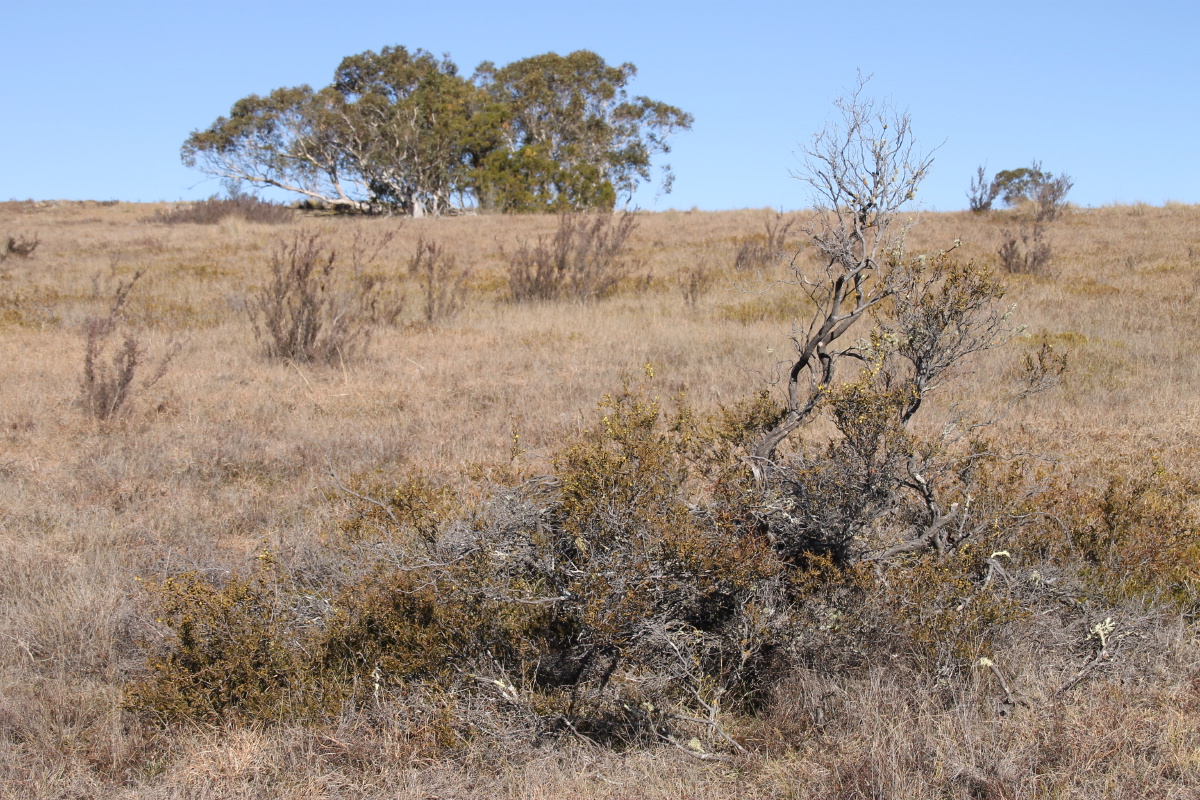
Here are some earlier shots of the area, indicating a lot of growth since the drought:
 |
 |
 |
 |
Eastern half lower patch small 23 Aug 2008 |
Western half, bare of Kunzea 6 Sep 2009 |
Bottom, NW corner, bare of Kunzea 2 May 2010 |
Top, NW corner, Acacias and Kunzea 20 Aug 2014 |
We didn't take any 'just before' shots, but here are the 'nearly finished' shots taken late that afternoon:
 |
 |
 |
 |
Area B, north of the copse, to within 20m of the Western boundary (right), plus 30m out of sight to the left (east) |
Centre of Area B, from further away, with a dozen outliers left to do (above Roger); plus untreated foreground |
Swinging right, looking SW |
And right some more, towards the West |
This was day 3 of the Kunzea attack, clearing outlier Kunzea in Area C on the map.
We cleared the outliers from the 1-1/2 acres on the northern side of the northern
creek-line.
The Kunzea was in full bloom, so distinguishing species was even easier than on other days.
Breaking up the roots of the larger bushes took a toll on the brush-cutter and it needed repairs.
Linda did the area closest to the creek using cut-and-paint.
Linda also sprayed a thicket about 40m east of the dam, using glyphosate, not Grazon.
This is a test to see if that's a tenable treatment for thickets.
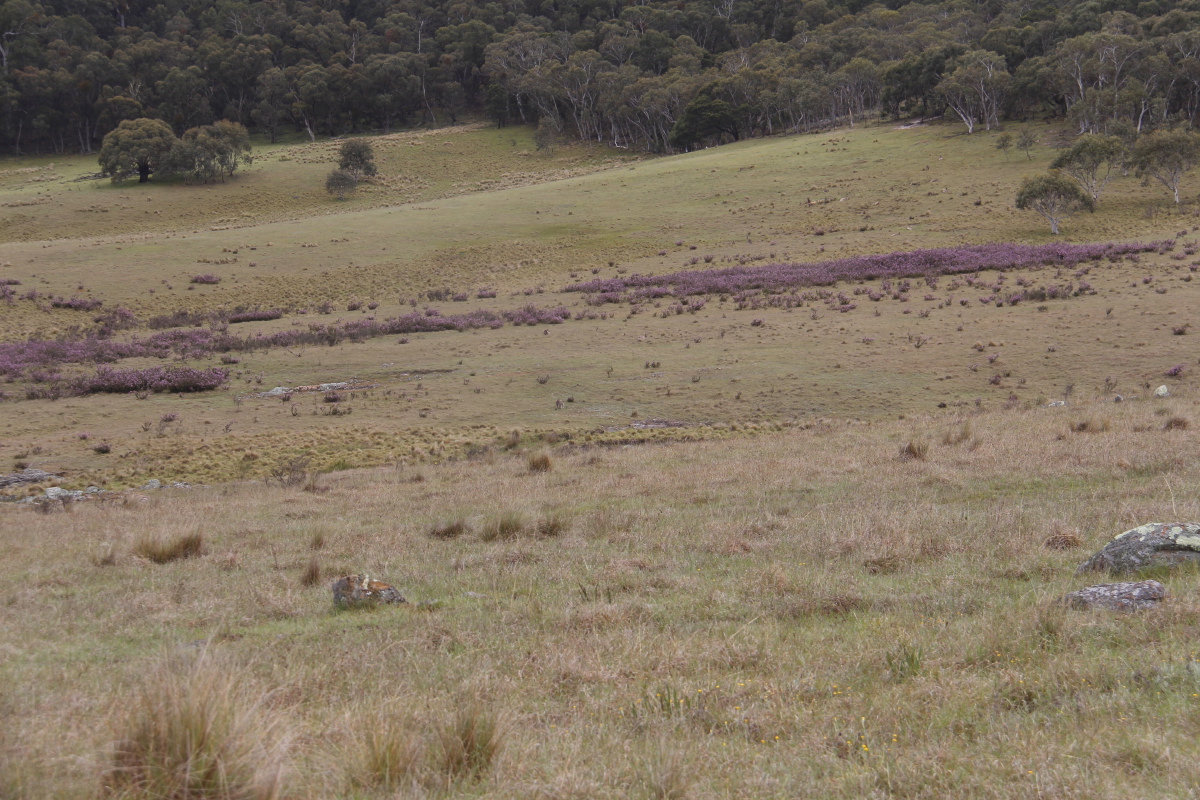
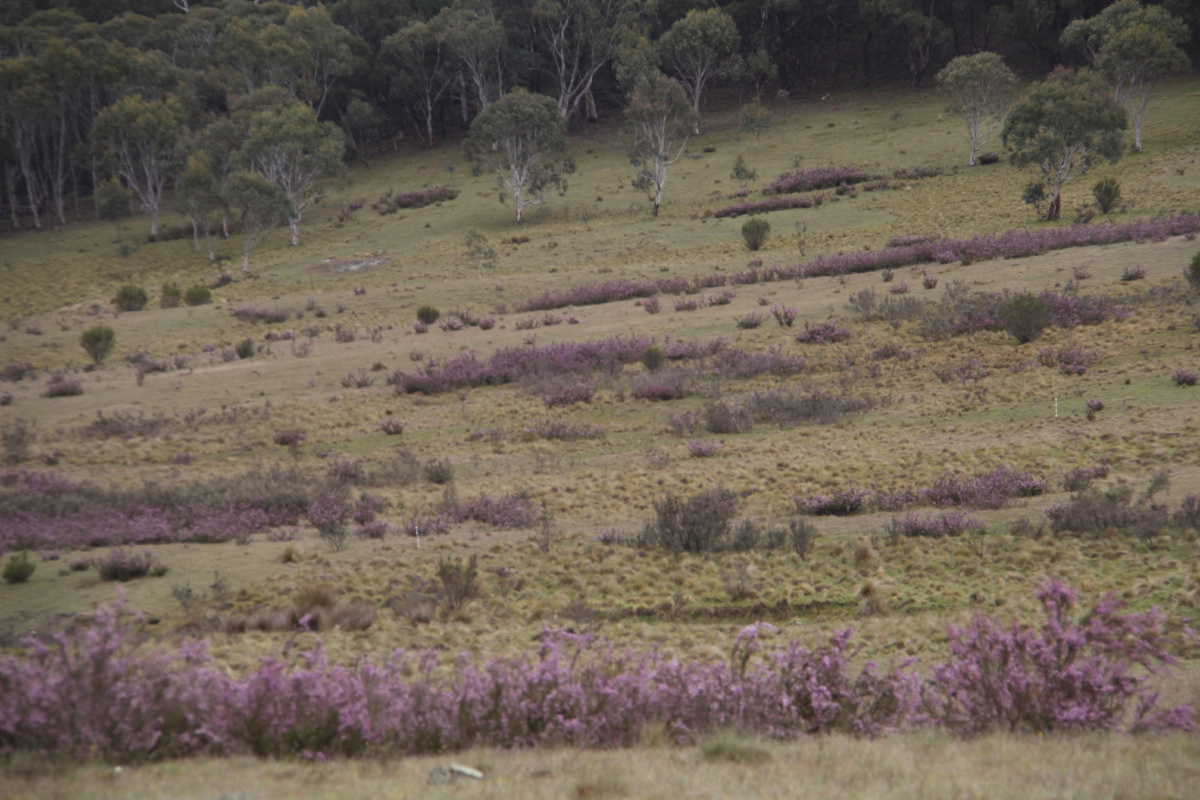
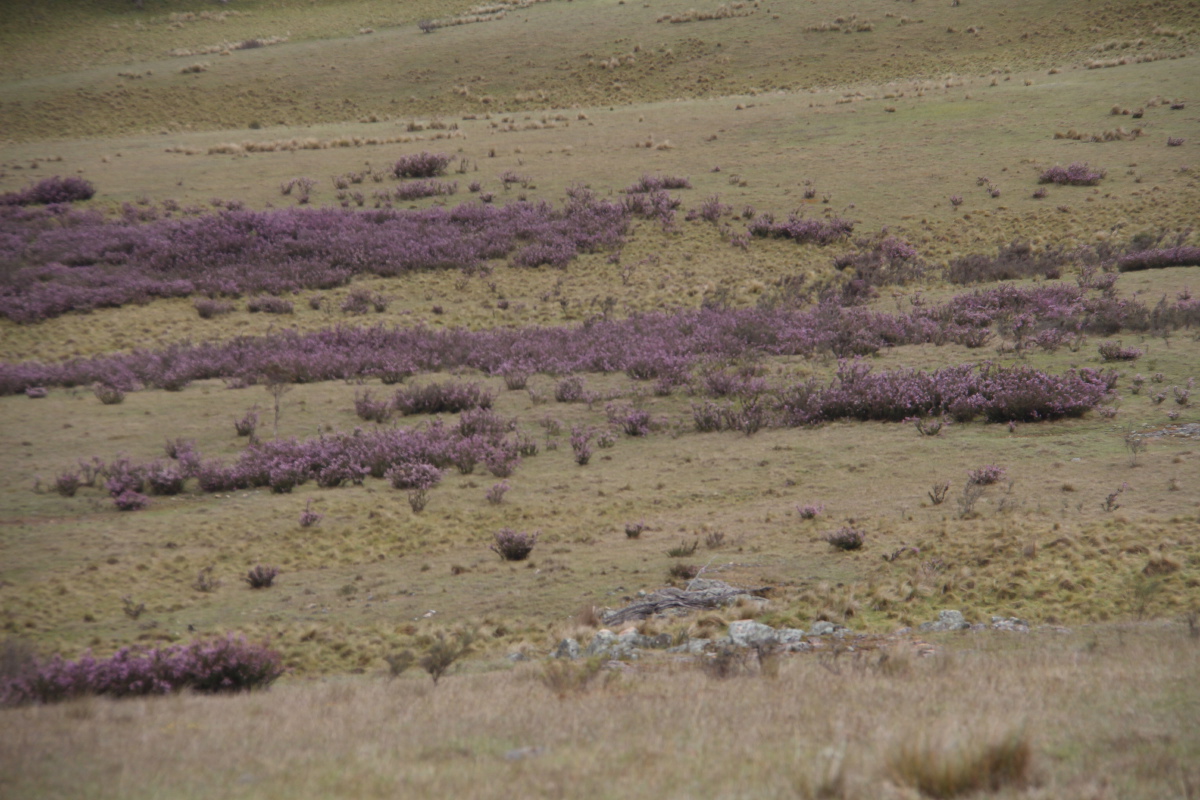
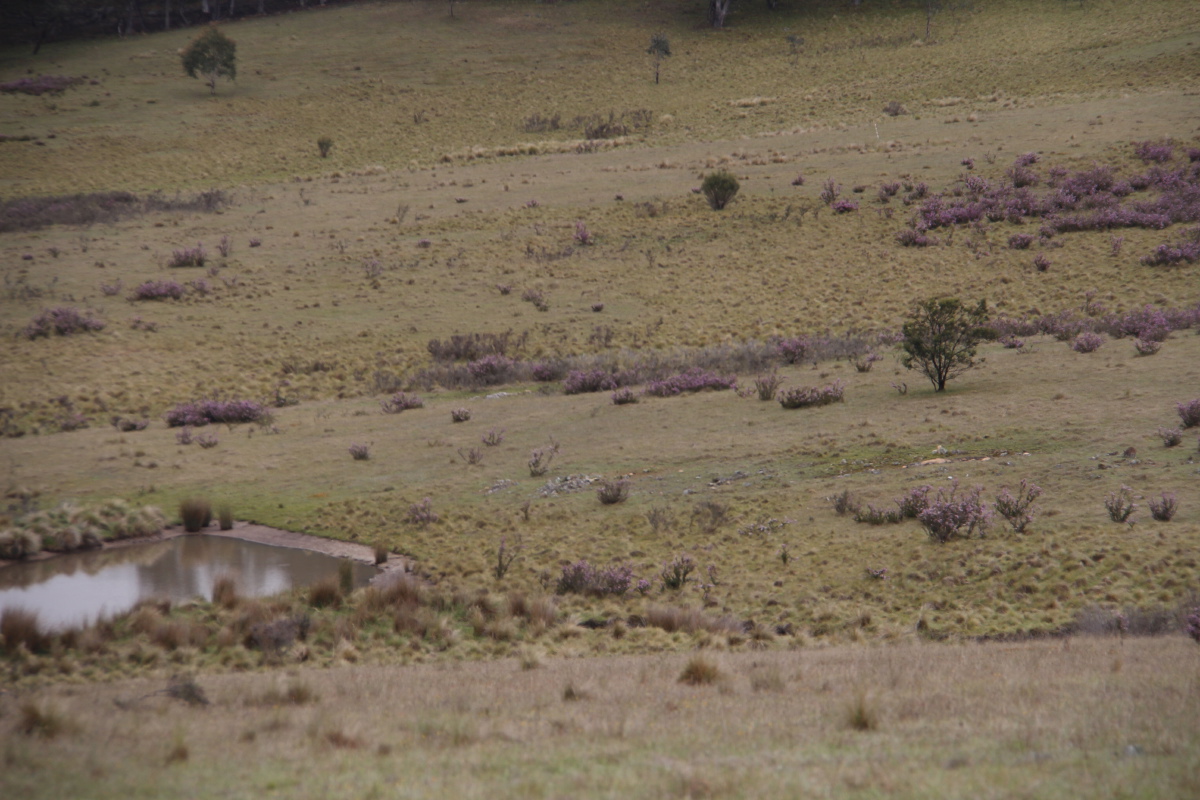
These are reference shots of the northern block, taken from 20m East of the copse, from NNW to NE:
 |
 |
 |
 |
. |
. |
. |
. |
 |
 |
||
NNW, distant and closer |
N, distant and closer |
NNE |
NE |
These three paired shots taken at the beginning and end of the day don't show as clearly as we'd hoped that some scores of outliers have been laid low:
 |
 |
 |
. |
. |
. |
 |
 |
 |
NNW, pre and post, most left for birds, some sprayed |
North, pre and post, outliers cut out |
NE, pre and post, outliers cut out |
En route to Carole's and then NNSW, we stopped off for 2-3 hours' belated work on Serrated Tussock.
Most of the glumes had already flown of course; but we dug out the two dozen we found.
This was an earlier-than-usual start to the autumn rubucide (and thistle and fleabane) visitations. We did the following:
Linda also did an inspection of the Kunzea attacks of 2015-16:
We stayed Friday night with Ted & Suzi, and worked Friday and Saturday.
We did the blackberries on almost all of the south-central and southern blocks. We also did briar roses along the waterlines and particularly in the swamp, and some fleabane and occasional, not-yet-finished thistles.
 |
 |
 |
 |
Three shots before ... |
... East, Detail, ... |
... and West |
And one afterwards |
The two roadside infestations will need checking next season, and possibly a Grazon spray.
The purpose was specifically to select, mark, and do a preliminary assessment of a couple of areas where we intend trialling low-temperature burns during a cold time of year.
We picked out 2 x (10m x 10m)burn-squares, and placed markers in each corner:
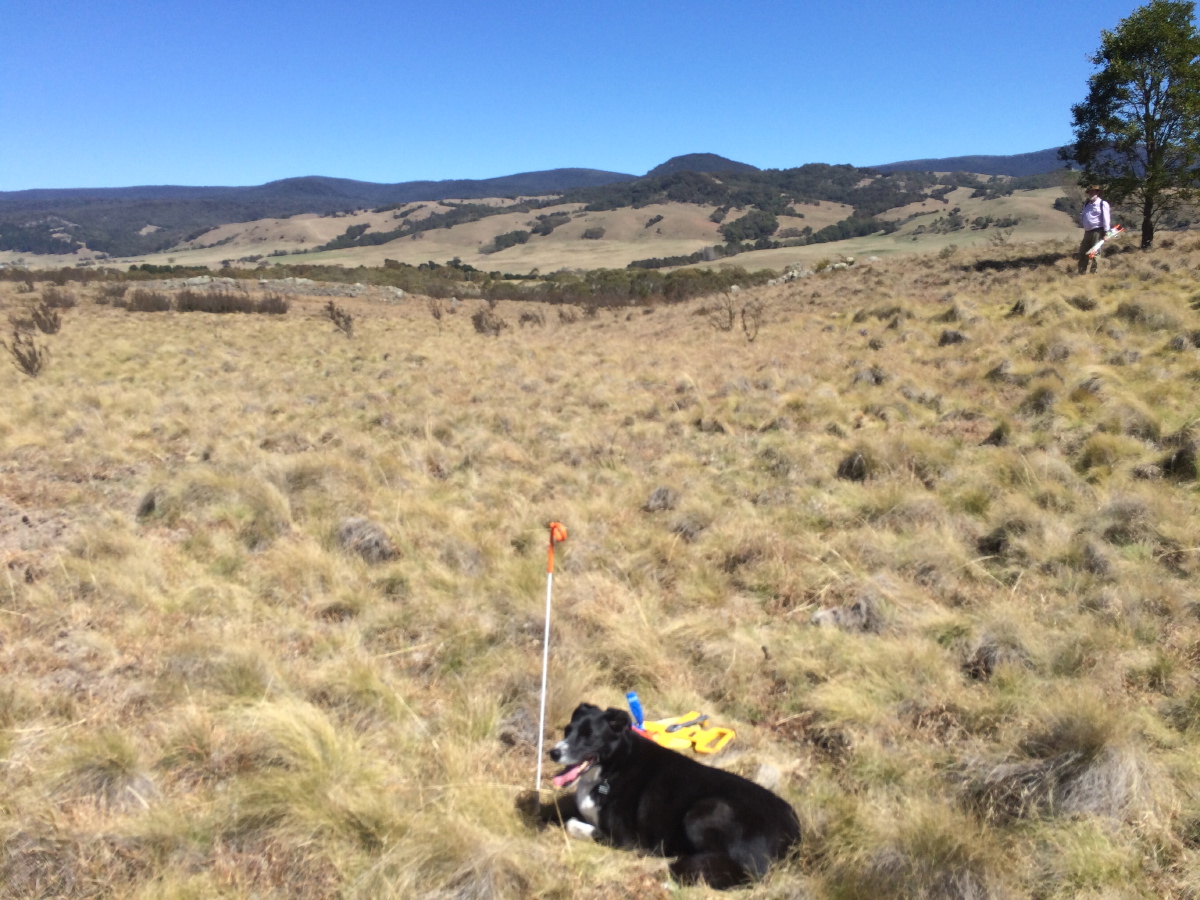 |
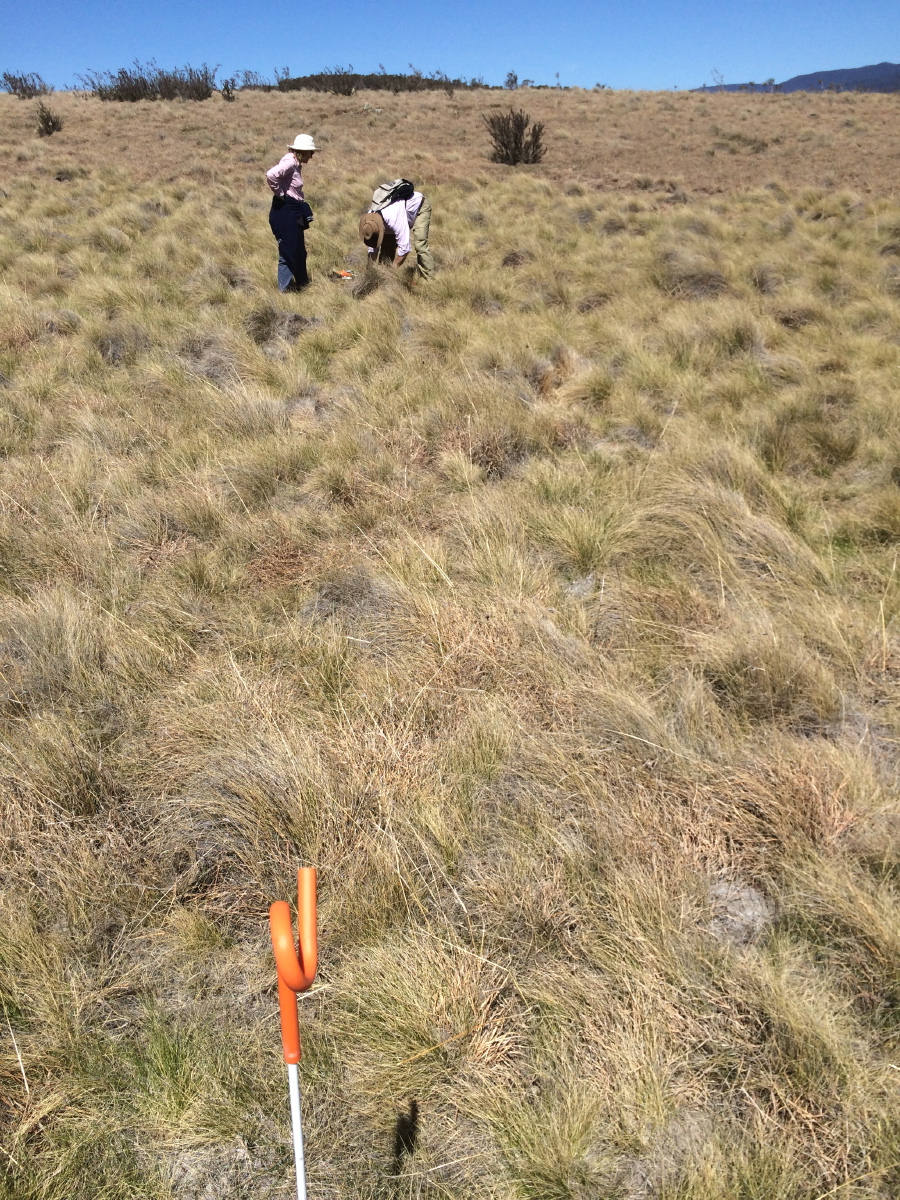 |
 |
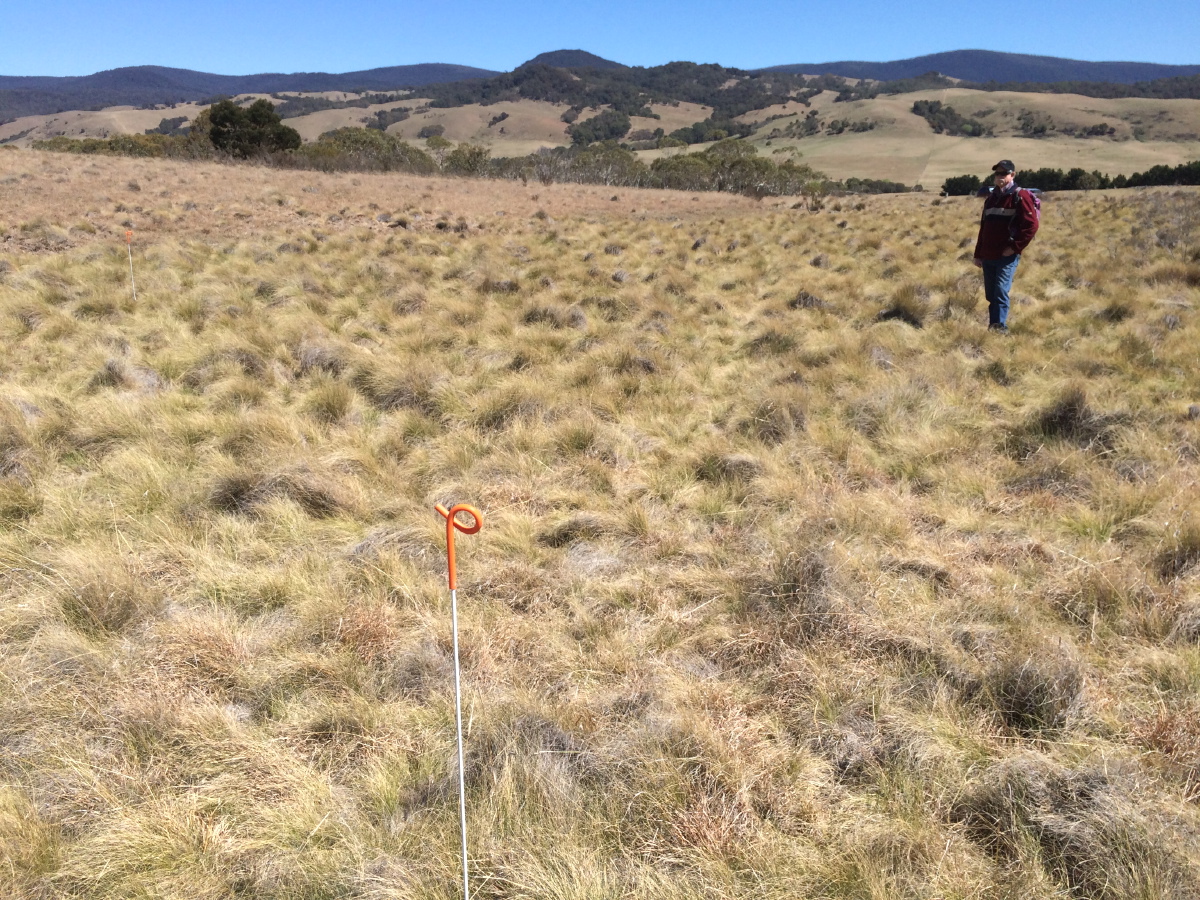 |
Burn Site 1 Location |
Bottom of Gate Gully North, N-S line |
The NW-SE Diagonal |
The Grass |
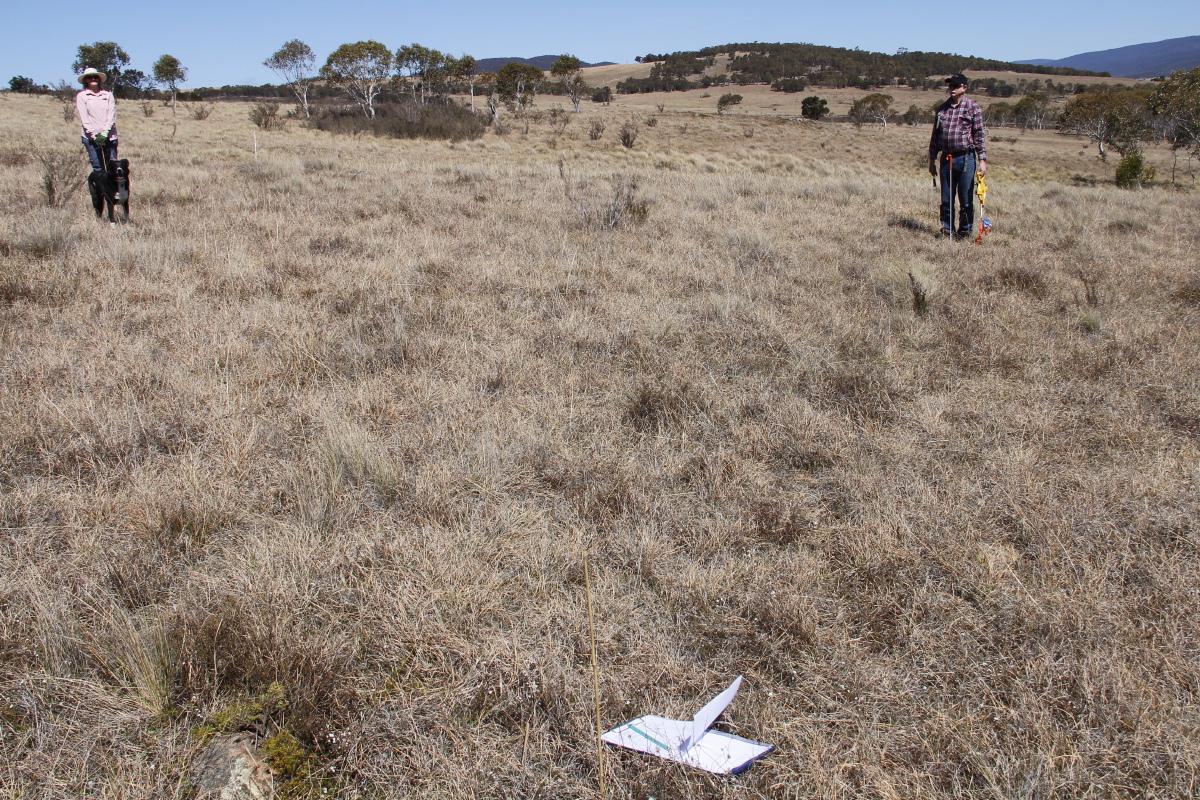 |
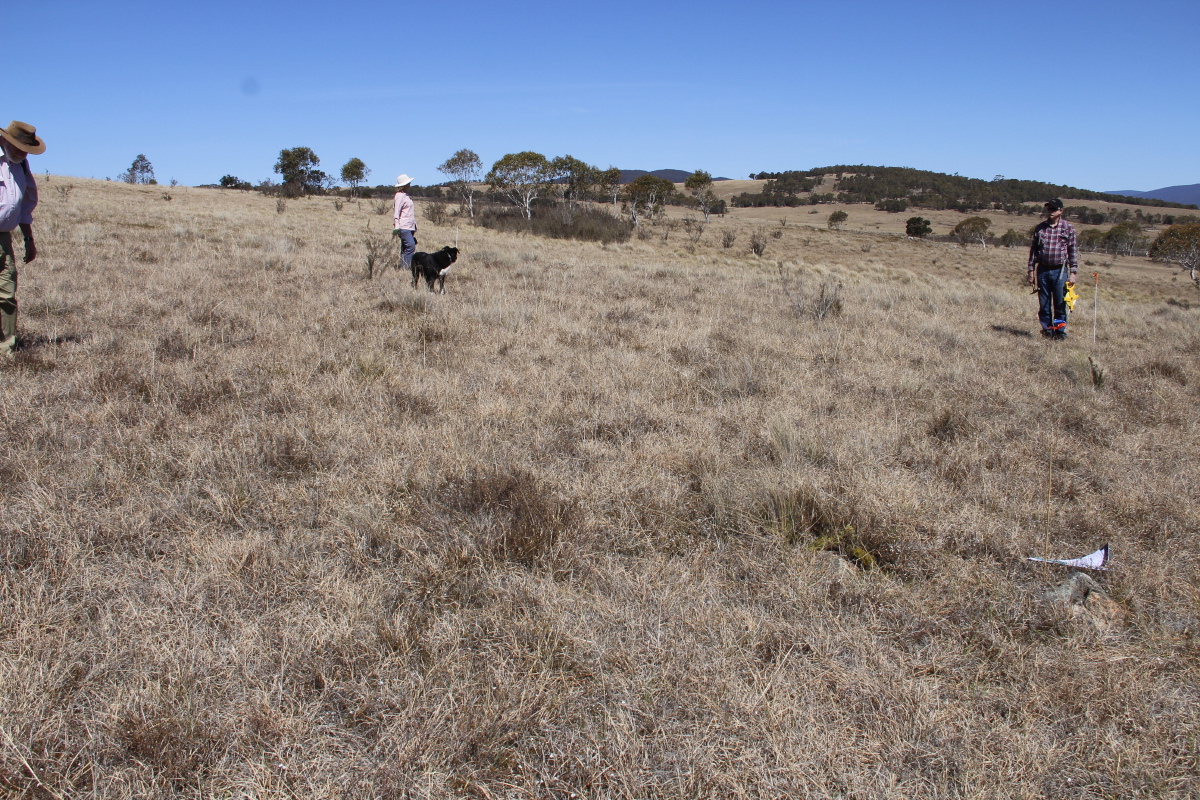 |
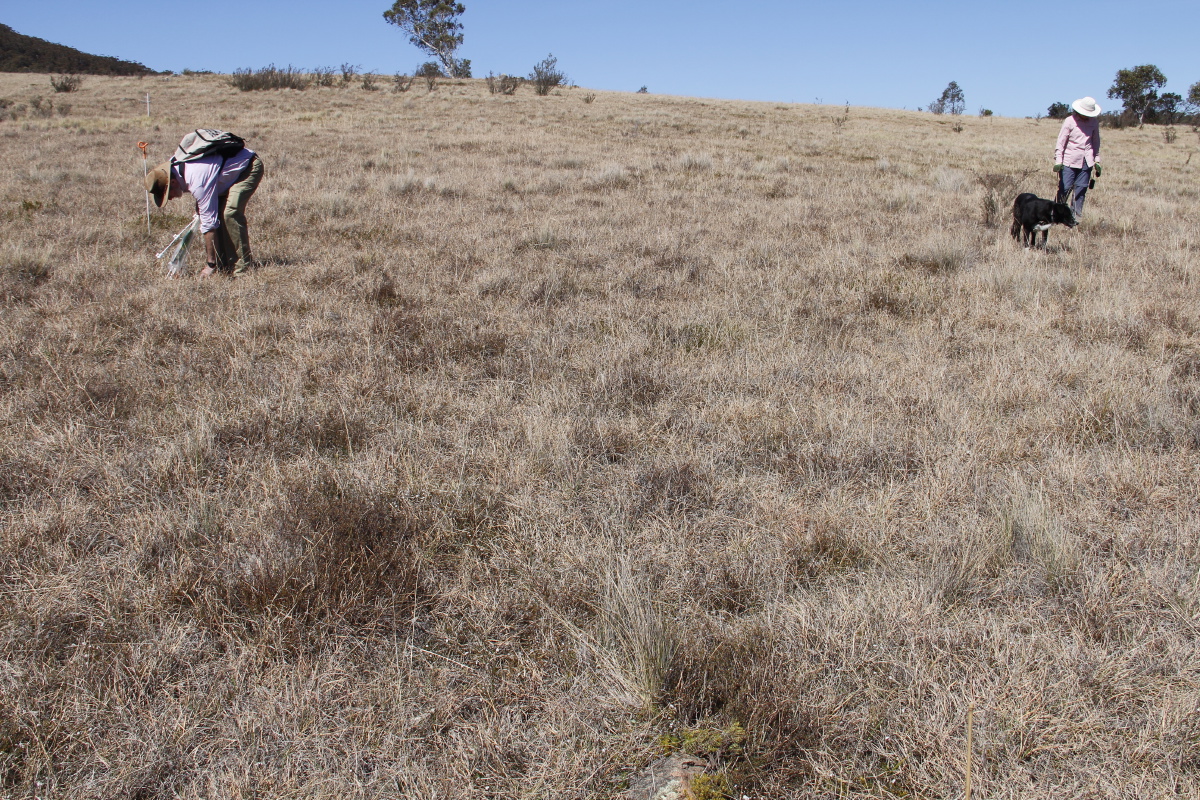 |
|
Burn Site 2 Location |
Echidna Ridge West |
The Grass |
We also marked out a pig-damage plot, in Themeda, on the ridge south of Southern Gate Gully:
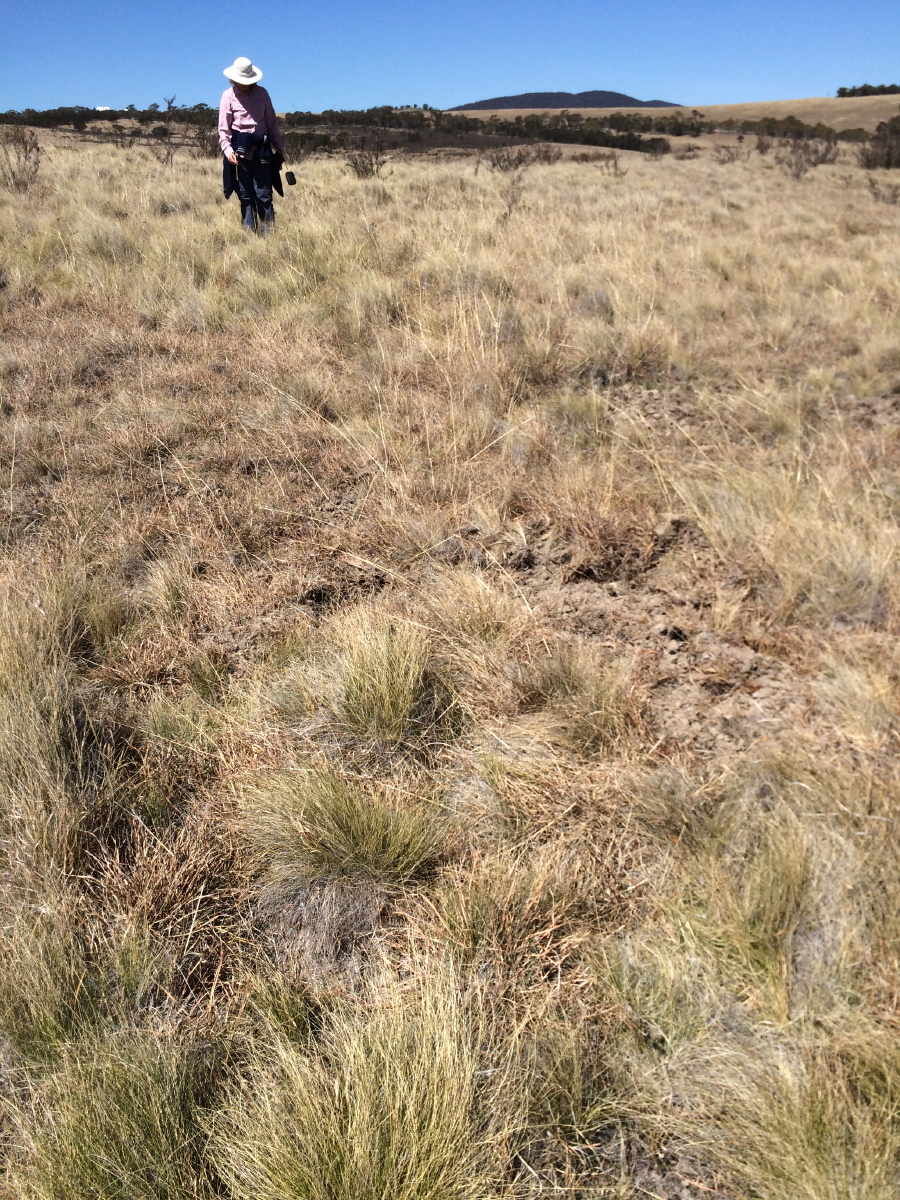 |
We need to continue checking that ... |
... pioneer species in pig-mined areas remain benign |
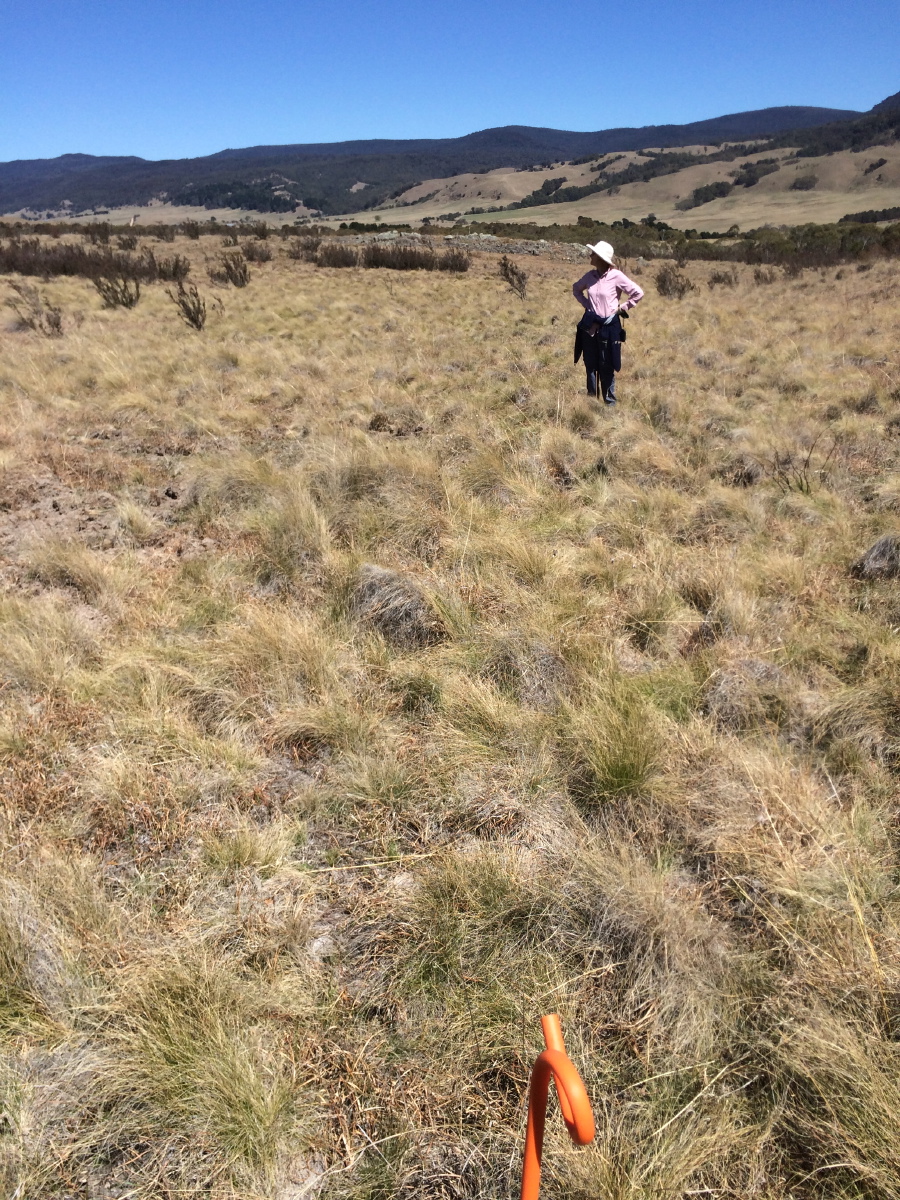 |
This was a Kunzea Attack day. There were two arms to the work. See the updated map:
Future Work, intended to be 1 day in December (and perhaps 1 in January, if it's not too hot):
 |
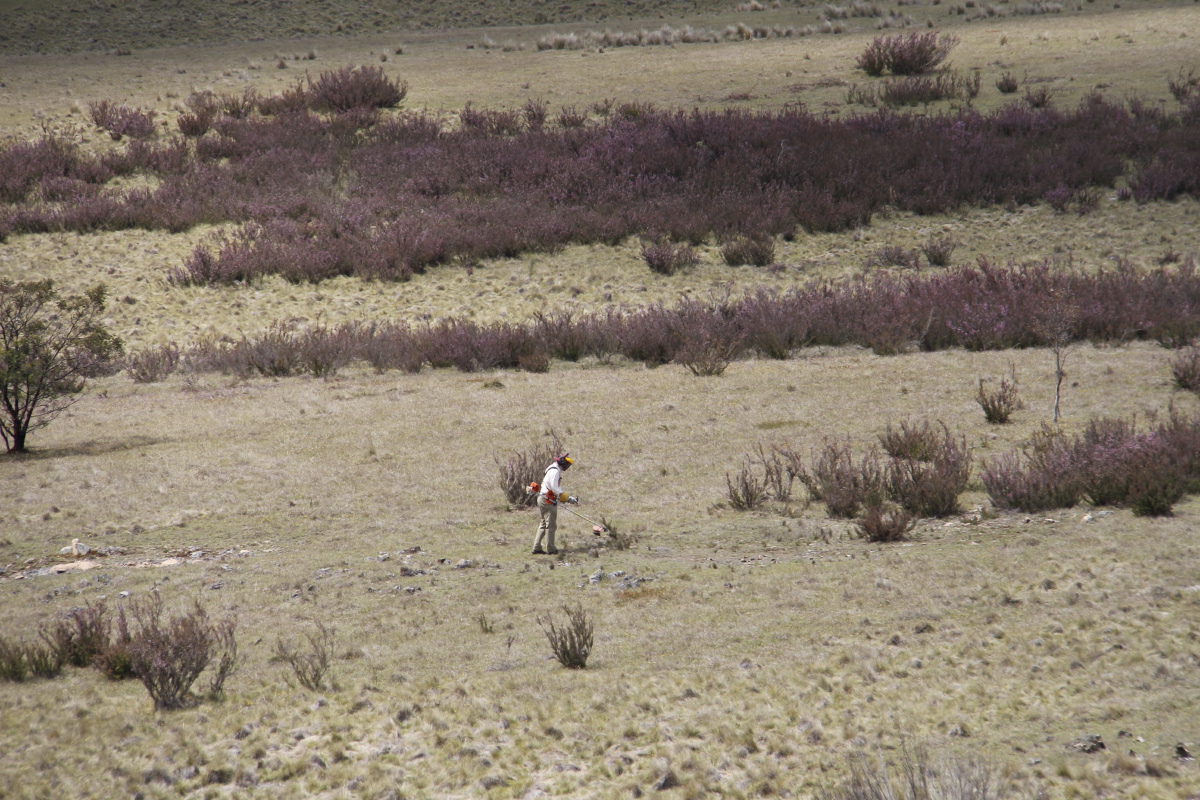 |
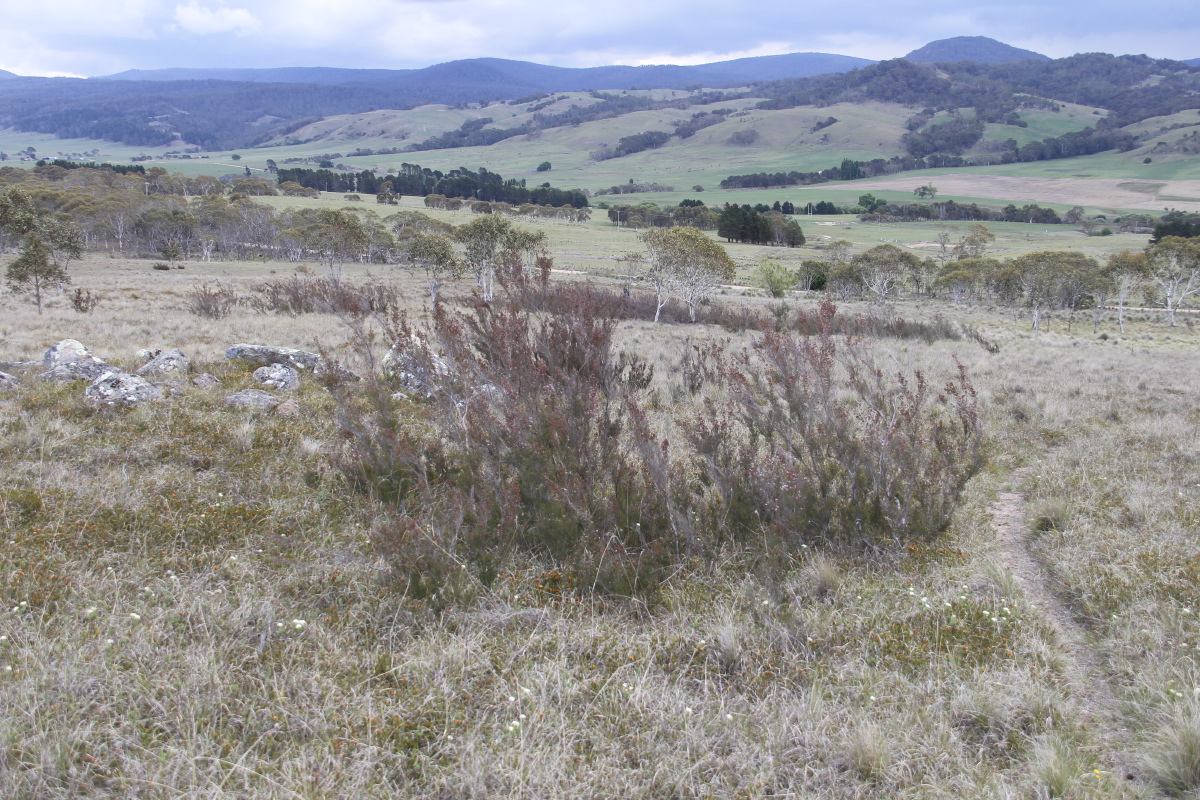 |
Slashing Kunzea ... |
... closer up |
Patch to go, Echida Ridge SW threatening forbs, incl. Thysanotus |
Continued the attack on the excessively enthusiastic Kunzea parvifolia. We moved to the Centre Block, to the areas marked 'E' on the updated map. We used two treatments:
Linda spent the afternoon on the Northern Block Serrated Tussock run, drawing and bagging the glumes, and using the miner's hammer to excavate the tussocks and leave them upturned with the roots exposed.
This was a later-than-usual start to the 'autumn' rubucide visitations. In fact, the summer has dragged on (28 degrees on 5 April), and moderately dry (2017 was 76% of long-term averages, and 2018 has been lower again). We did the following:
Day 2 of the blackberry blitz. Very warm (c. 30 degrees), drying winds, and the southern swamp pools had reduced a lot in 6 days, and were almost completely dry.
We worked in the southern 'swamp', cutting-and-painting blackberries. We finished the couple of remaining infestations in the upper/northern end, did the middle, and made progress with the lower/southern end. We used the same mix as the previous week: glyphosate and water, plus 1 teasp. of Grazon Extra per 100ml.
We removed a very few of the modest numbers of Rosa rubinagosa and a few still-viable thistles.
Day 3 of the blackberry blitz. Cooler at last (22 degrees). Southern swamp even drier than the previous week.
We finished the southern end of the the southern 'swamp'. A family of bushes took Roger 3 hours, and Linda spent about 2 in the area as well.
Linda also planted three more Calotis on Echida Ridge, and then inspected the eastern side of South Block. Unfortunately, the mass of blackberries at the eastern (upper) end of the southern waterline have not been defeated by our several previous, painstaking cut-and-paint glyphosate attacks. So we'll schedule a spray attack with a stronger mix, this year if possible. Otherwise the southern waterline has merely sporadic, small plants and needs a walk and cut-and-paint morning.
A few other isolated blackberries and briars were cut and painted. Some still-virile thistles, briars and fleabanes were beheaded and bagged. The large blackberry bushes close to the fence in the central and southern blocks were showing no sign of the spraying done a fortnight earlier.
A couple of hours strolling from Echidna Ridge around the edges of the northern half. It was 20 degrees, but the wind was gusty and 50-60kph, so if we'd planned anything we couldn't have done it anyway.
The winter was cold (as in the number of frosts), and the drought less bad here than elsewhere, waterlines almost entirely dry, dams low but okay. Rainfall over the last 20 months has been c.70% of the average. (That's Braidwood's figures. No Gilston data because, regrettably, O'Connell's been ailing):
The grass was very low, with a large mob of kangaroos evident, off the property to the SE at the time.
An echidna was on the NE side of the northern watercourse.
There was a great deal of upturned earth in the area 100m north of the northern watercourse and 50m from the eastern fence – presumably multiple large pigs, but much more extensive than we've seen previously.
We resumed the attack on the excessively enthusiastic Kunzea parvifolia. We returned to the Centre Block, to the areas marked 'E' on the map:
Linda also used 5 liters spraying regrowth in area ?E? south of Southern Gate Gully
The ground showed little of the 40mm that was supposed to have fallen early in the week. The soil was reasonably soft, however, and the native forbs were putting on a pretty good display.
We did the following:
The dam wall and environs will need a blackberry attack in autumn.
A late start to the 'autumn' rubucide visitations. We're off to Europe early this year, so opportunities at Byb are few.
Unfortunately, David and Janette O'Connell's Gilston rainfall measures ceased at the end of 2017. There was no running water, the ponds in the southern swamp were dry, but there were scattered pools in the upper southern line. That's consistent with a low water-table soaking up a significant proportion of recent rain. The nearby country is relatively green. Braidwood Racecourse, 30km north, had an 80% 2018 (622/792mm), but good summer rains incl. a 90% Jan-Feb (144/162mm), and a wet Mar (128/82mm).
Our focus was on the southern block. Linda inspected her spraying of some large infestations near the road, on 4 April the previous year, using Bowman Metsulphuron (with a surfactant) — the first time we've used this weedicide. It was a startling success, with the bushes definitely gone to meet their maker.
Given that several areas, particularly in the southern block, have been resistant to our persistent use of glyphosate cut-and-paint, Linda used 3 x 10-litre containers, each with 5gm of Metsulphuron. Metsulphuron is particularly dangerous to aquatic wildlife, so we're only using it in dry areas.
Linda worked in three areas:
Linda used the left-over mixture as a trial to spray some Kunzea around the dead-tree at the north end of the swamp. Quite windy by this time, so she sprayed using the wind-direction from the west to assist the spray on the plants, but stopped after a short time, because the wind was too strong.
Roger did cut-and-paint in the moister areas of the southern swamp waterlines, with a mix of 50% glyphosate with water, plus a little Grazon. He also did a few up along the waterline to the east, along Tosca's Chain-of-Ponds. He's becoming unsure how many more years his body will continue to cope with the bending and the groundwork, but he slept well.
There were a few (in most cases pretty healthy) fleabane, and a small number of thistles in the swamp. We were too late to intercept the seed of both, of course.
NOTA BENE RE METSULPHURON: The product is Apparent Bow Saw 600. The herbicide booklet says to use 1g per 10 litres, which is difficult to measure out even in the small cup they provide. That's why the first time Linda used 2-3 g per 10 L, with a surfactant. For this run, she used 5g per 10L because she had read other info regarding metsulphuron-methyl and it had recommended 5g per 10L, which was certainly easier to measure accurately. Plus Surfactant 50ml per 10L.
A fine, 23-degree day, with minimal wind. The main dam was 2/3rds full.
Having done the primary areas in the south, we switched to the central and northern blocks:
Linda's spray was c.10 litres of Bow Saw 3g/10L plus surfactant.
Metsulphuron is broadleaf-specific and doesn't affect grasses (both in principle and from observation at Bunhybee). But of course it would be death to native forbs. Hence, in the huge Coronidium patch just beneath the main dam, Linda used cut-and-paint rather than spraying.
Bushes thay we missed were just inside the fenceline at Playing-Possum-Wombat Gully, beneath the willow at the small dam, and under the front gate (2 strands).
An inspection day, up South Gate Gully, along the eastern side up to Picnic Corner in the NE, around Di Izzard's enclave fence-line, back to the gate.
Although a few storms had come through in the previous couple of weeks, it was very dry, with the main dam low, the small dam okay (thanks to lost of rushes slowing down evaporation), waterlines basically empty.
Almost nothing to see in the way of weeds, e.g. no fleabane, Yorkshire Fog. Exceptions were:
Inspection Day for the Southern and Central Blocks.
Well, 2-1/2hrs anyway, mid-afternoon, en route to Ted and Suzi's.
The purpose was to establish a work-plan for the coming 1-2 years.
We walked from the Gate, south along the woodland / fenceline, then north up the (dry) Southern Swamp, then east up the southern waterline, then NNW to the top end of Wombat Gully, west down the Gully, and back to the Gate.
The whole area was very dry, and a 35kph wind was blowing and 1℃ overnight).
The Shoalhaven was deep puddles, but not flowing. The only water we saw on Bunhybee
was in the two topmost pools in the southern waterline, north and south arms.
By area, here's the work to be done:
The following day, we worked on Lower Wombat Gully:
We participated in FOG visits to two parts of the Deua - Michael and Karen's place on the Shoalhaven at Berlang, and beneath the Trig at Wyanbene.
On the way home, Linda patrolled Echidna Ridge for Serrated Tussock. She chipped out about 10 plants, a few on the western end, but mostly in the centre and the eastern end of the Ridge.
A recce / social visit, with Troy (11) and Misha (7) visiting for the first time as children rather than babies.
The block (like most of the rest of NSW) had suffered 3 years of intense drought (locally, 70% of average annual rainfall in 2017, then 80% and 60%, but exacerbated by very high evaporation-rates). Most of the district had entirely de-stocked by early summer 2019, which has seldom happened, and is very difficult and slow to recover from. (For comparison, Stromlo Forest near us was 75%, 58% and 54%, for an average of 62%).
That was followed by a vicious summer, massive fires the length of the NSW coastal ranges and into Eastern Gippsland, plus the Kosciusko Parks (NSW and Vic sides) and Namadgi (ACT). This included most of the Palerang area, a massive fire from East of Mongarlowe to Bateman's Bay and up to Nowra right down to the coastline, and Big Badja northwards, and Jingera eastwards, and the Eden and Malacoota areas. Dense smoke persisted for many days in many places. Then came hail (at least in Central Canberra), and 100-250mm of rain, and floods.
Our near-neighbour Gilston has recorded rainfall very reliably since Oct 1971. However, David O'Connell was very ill for several years and passed away late last year. There were no measurements recorded for 2018 and 2019. But they resumed in Jan 2020!! The figure shown for Feb 2020 was 279mm. Braidwood Racecourse was 155mm. (Stromlo station, 5km North of Chapman, recorded 101mm).
The dams were completely full. In the northern waterline, the pools were generally full, with a little still trickling. Lower gate gully had a few pools left, and evidence of flow beside the gate not many days previously. We didn't get down to the southern waterline.
We'd feared a lot of weed-growth, but the rains came late enough in summer that for many exotic species it was too late in the season for them to get going. The things we noted, and did something about, were as follows:
We plan:
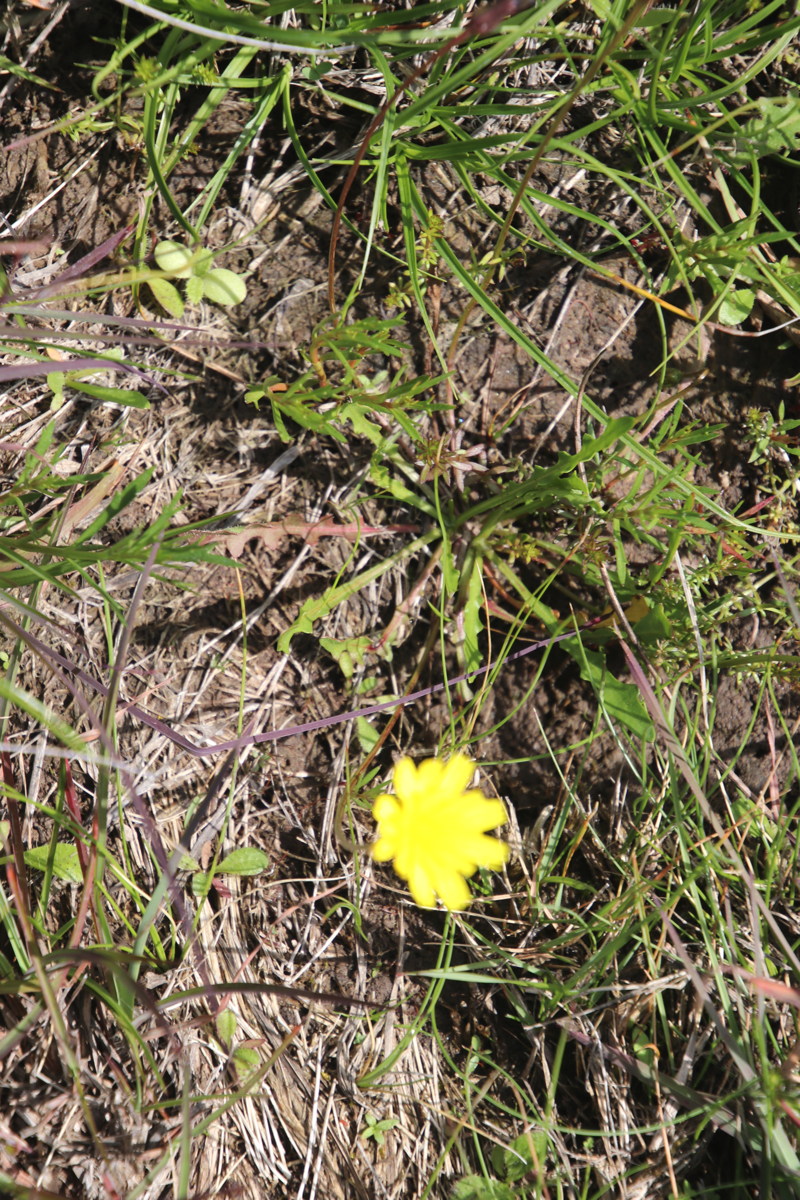 |
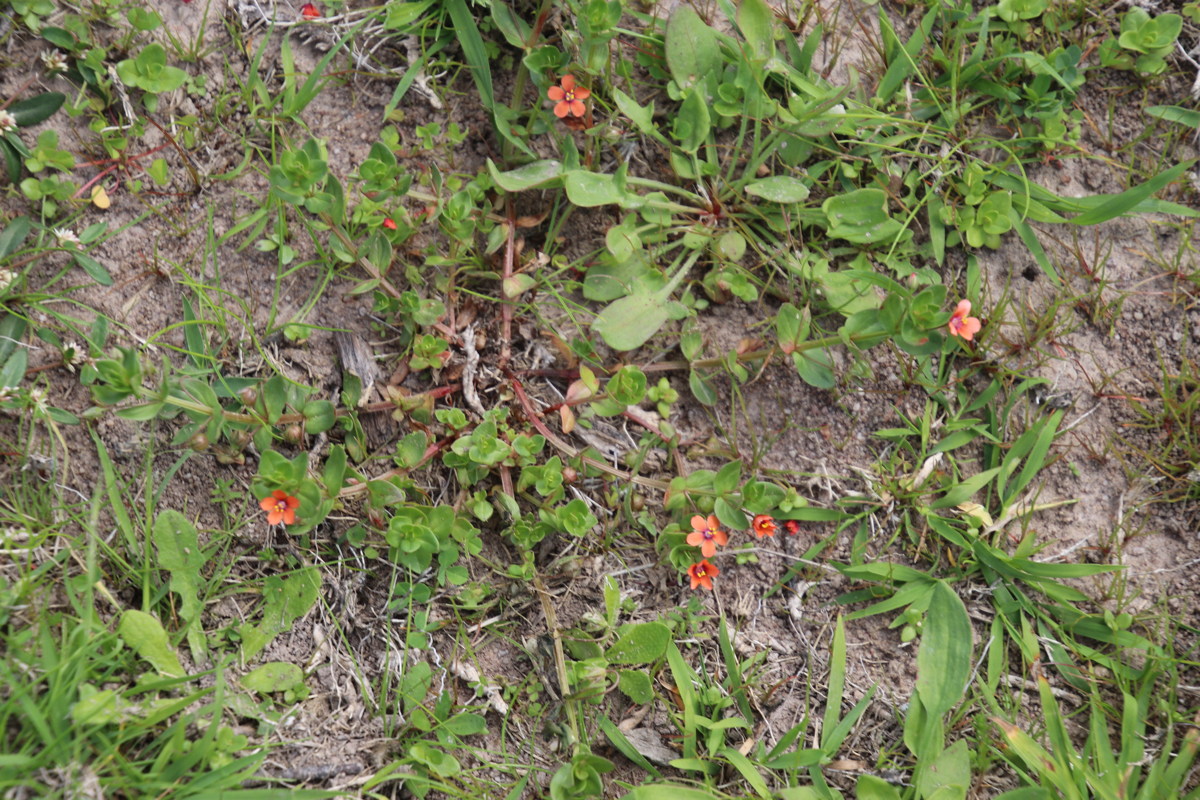 |
Hypochaeris glabra Smooth Cat's-ear |
Anagallis arvensis Scarlet Pimpernel |
This was the day for the southern loop. Ted and Suzi dropped by for 45-minute chat, maintaining the coronavirus-dictated 5m separation.
We did the following:
We noted the following for the next visit(s):
The metsulfuron spray has been very effective on infestations 2 and 3, and on the biggest of 5, with very little apparent collateral damage. But there's new, small growth on the edges of the old areas of bush.
So we'll very likely attack all of the large plants with metsulfuron spray, reserving cut-and-paint for the little ones (where the collateral damage would be worse because the target's small).
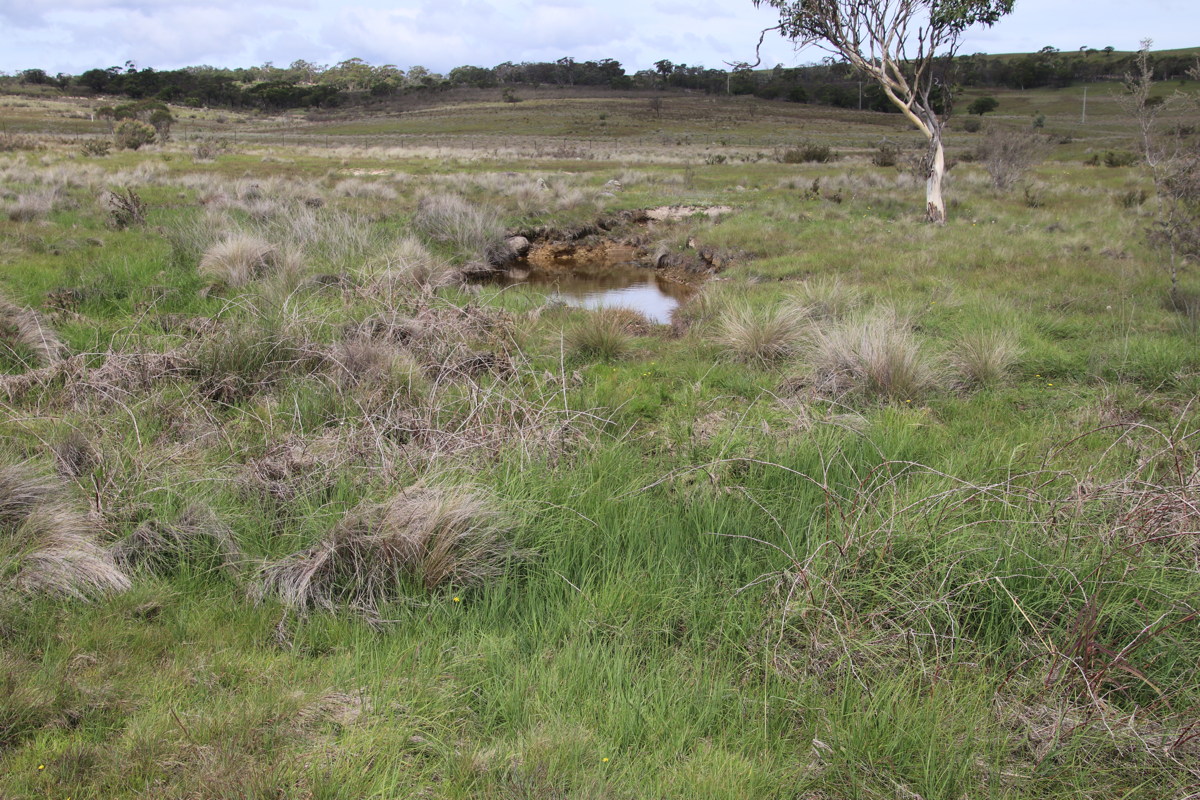 |
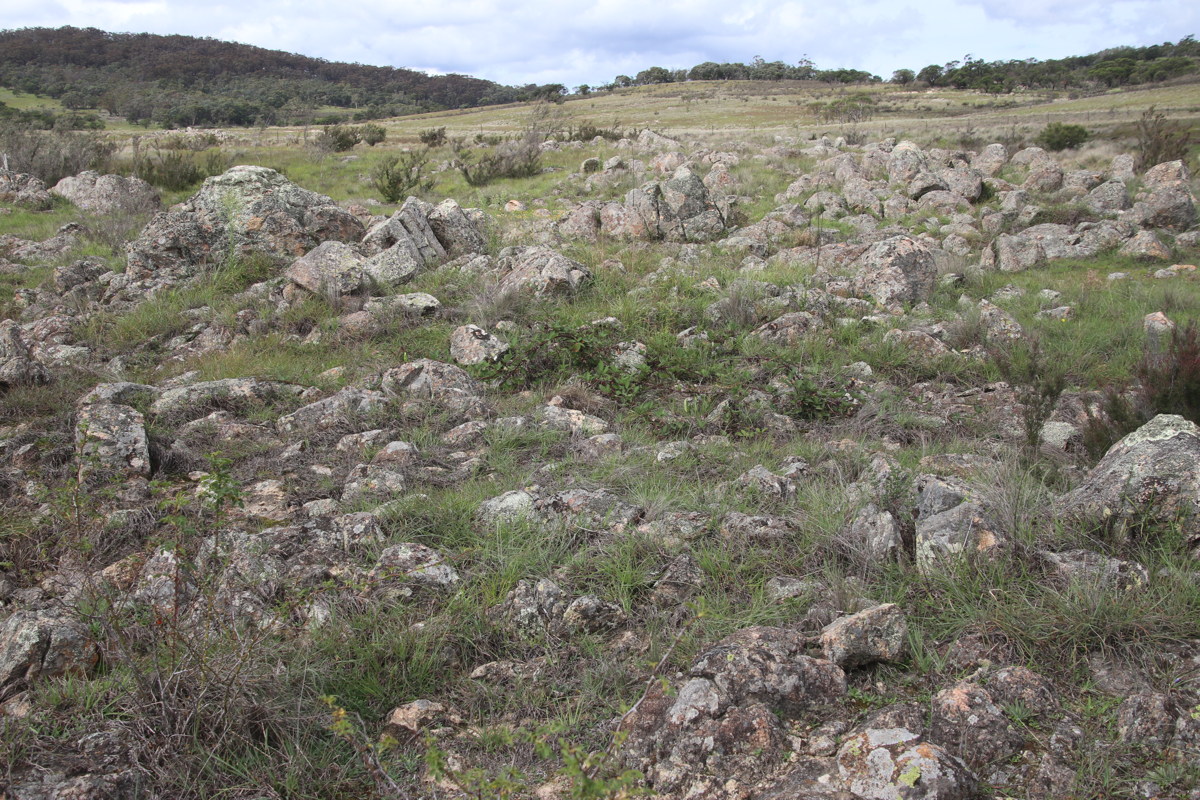 |
After a successful metsulfuron spray |
Awaiting treatment |
Heroically, as the NSW Police flexed their newly-won COVID-19-virus powers, we ran the gauntlet of boys in blue, and risked the 250km return drive. Well, actually, they'd burnt up all the available overtime on Good Friday, pinging Canberrans for trying to get down to the coast for Easter. The traffic was maybe half was it usually is, and we didn't see the 1 patrol car that we normally see during the drive out in the morning. *And* we stopped for a (take-away only) coffee in Braidwood, so we came down to a 1.5m separation once today, to order the coffee.
We parked on the road, beside the banksia, almost beneath the electricity line that crosses the SW corner of the property.
It was a fine day, with very occasional gusts of wind.
Linda attacked blackberries with 2 x 10 litre-loads of 5g metsulphuron per 10-12L water, plus surfactant:
Roger brushcut Kunzea in new area F, as per the revised map, 100-150m due East of where we parked the car. The aim was to:
 |
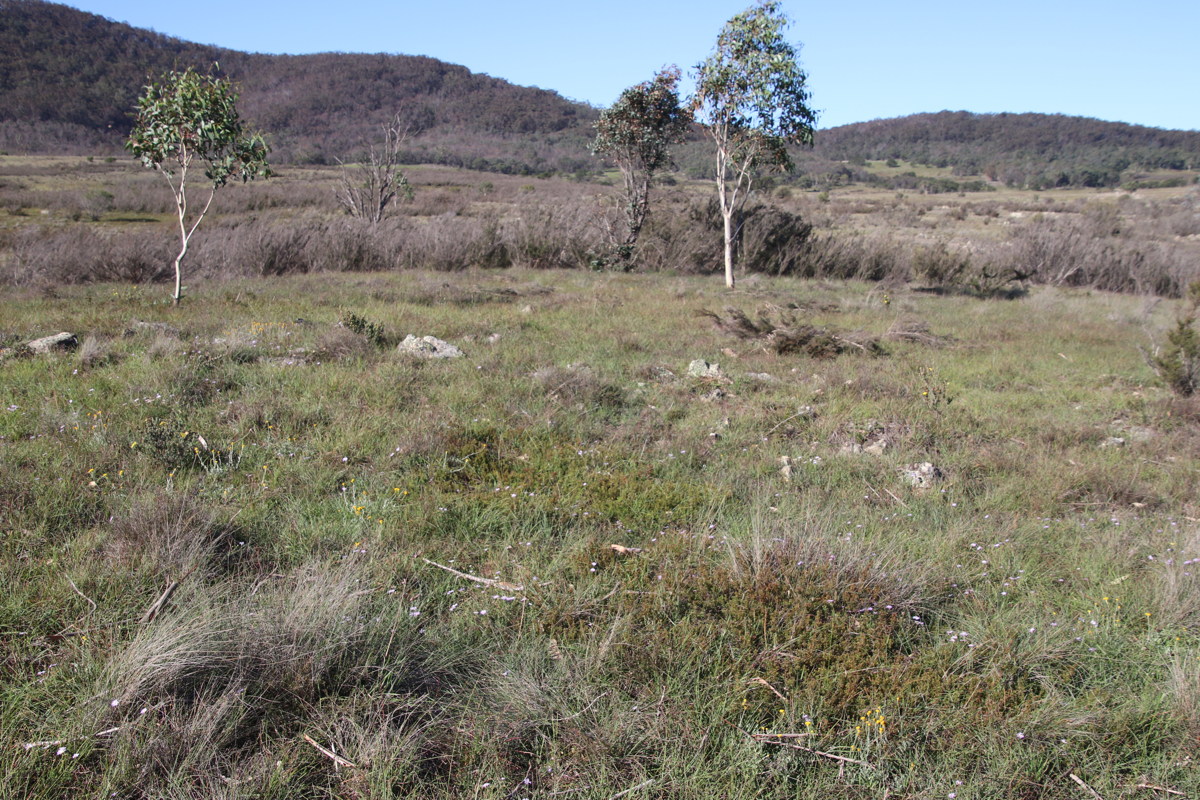 |
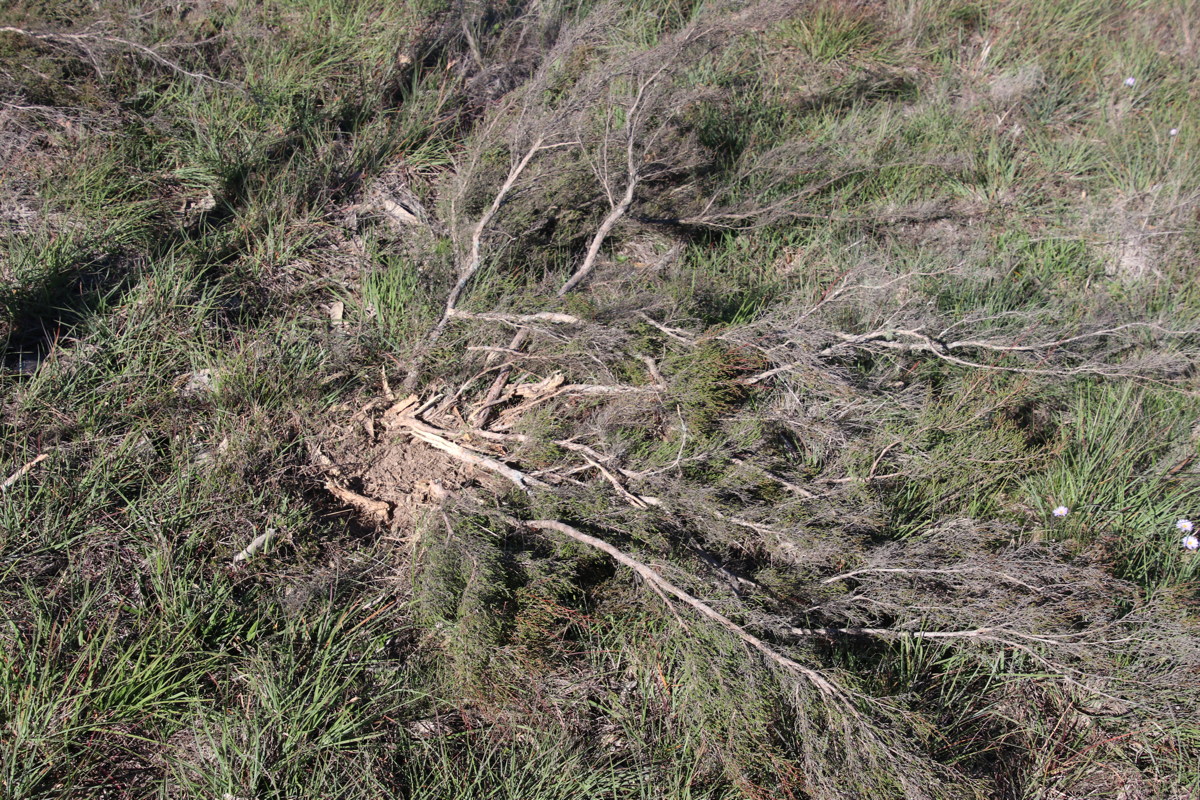 |
Keeping it clear of the waterline |
The floriferousness (Brach rigi, Chryso, Hibb) |
The broken roots |
 |
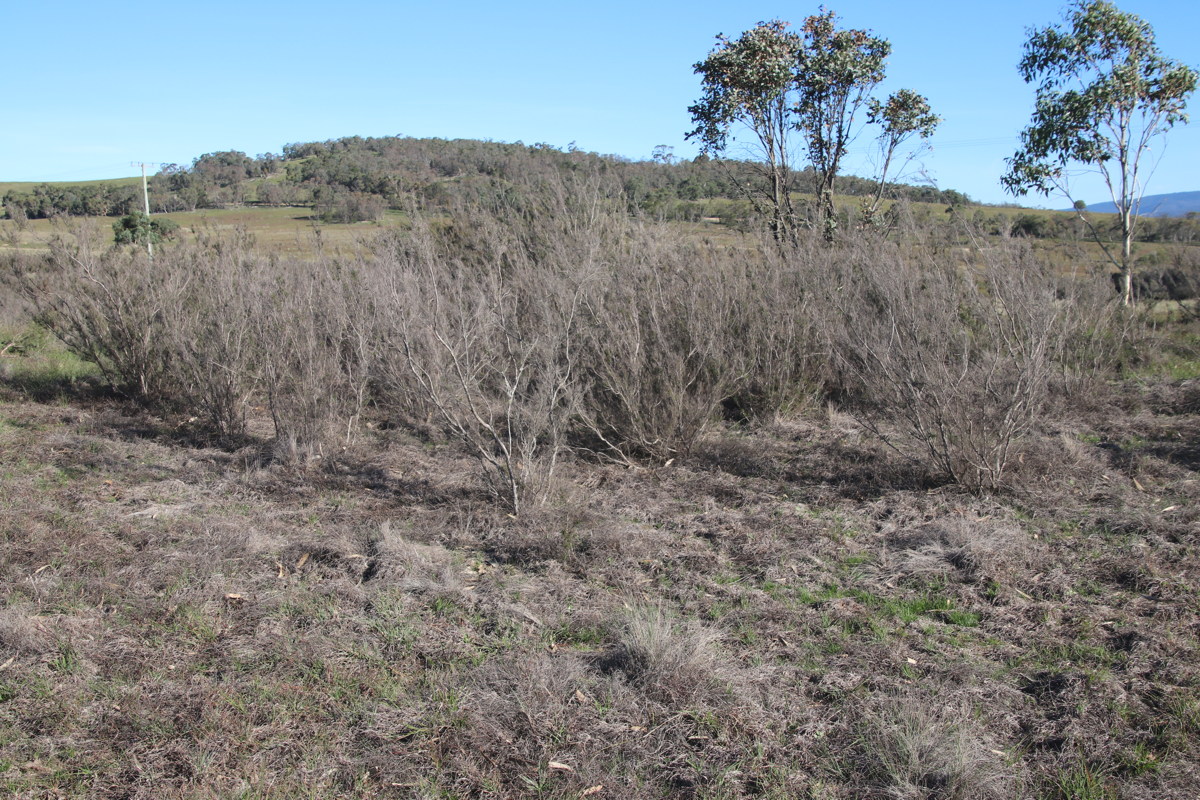 |
|
Linda's previous spray-area nearby, 5 months ago, on 9 Nov 2019 ... |
... using Metsulfuron with surfactant, and having an impact |
There had been a lot of rain in an episode ('east coast low') 6 weeks earlier.
Gilston, operational again, says it was 100mm in 2 days in late July.
Dam full, northern and southern waterlines with water in them, some springs running, damp patches in some waterlines.
On the other hand, the small dam was very low, and the grass mostly looked very parched.
Presumably there had been high winds and evaporation rates before and after the deluge.
The day was pleasant, but it was barely spring, and almost everything was quiescent.
From Gate Gully to the North Block, there was little sign of Yorkshire Fog, no Fleabane, few blackberries.
Linda found and removed two Serrated Tussock beside the copse.
Until Tussock Time, and Blackberries in autumn, the priority will be Kunzea.
This was an attack day on Kunzea in lower-mid Wombat Gully, clearing channels.
Linda did the first shift on the brush-cutter, and wasn't rapt.
Roger did the second. We needed to be back early, so that was enough for the day.
 |
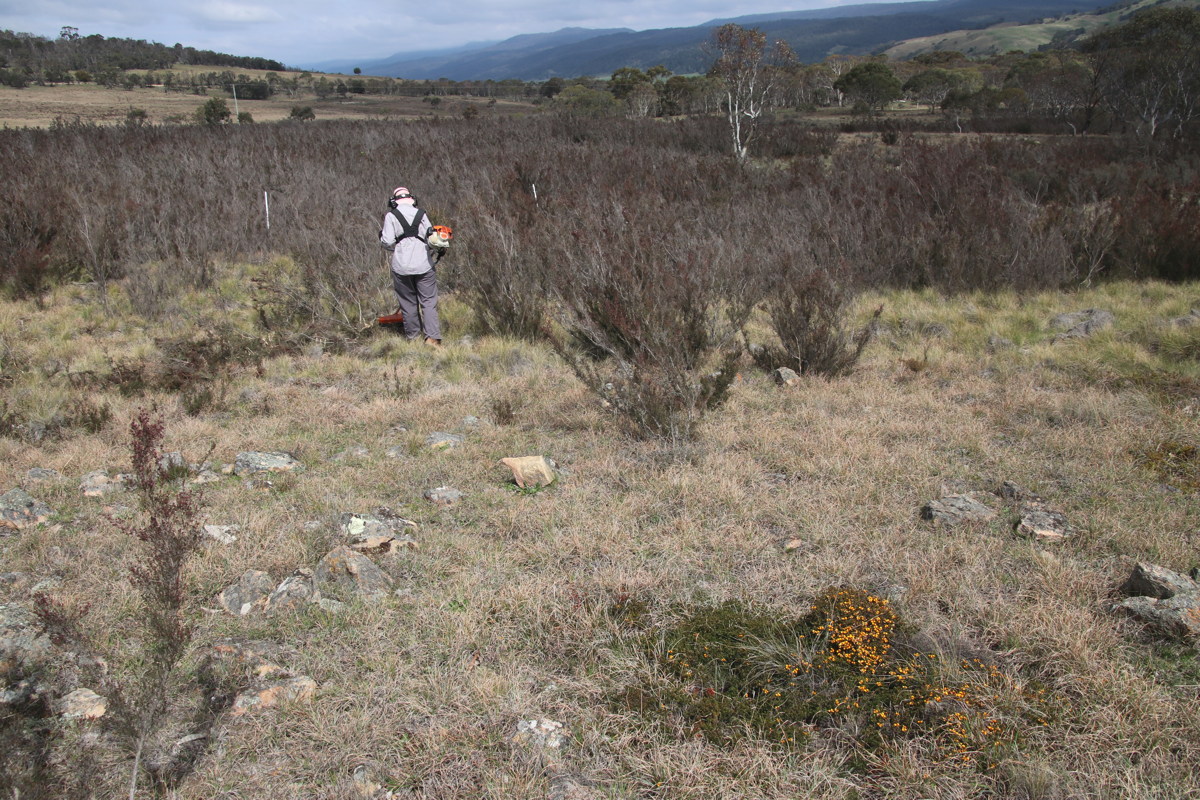 |
Linda attacking Kunzea ... |
.. and the view southwards |
During a recce, Roger came cross two areas of blackberry in upper Wombat Gully (an angle we seldom walk) that will need a few hours' work this year.
Having been kept from doing any Late Spring and Early Summer work by family circumstances, we got out for a quick day's work on Central and South Blocks. It was a 25-degree day, and felt almost like the end of the summer, almost a month early. It's been a strange summer, especially after the scorcher that was the summer of 2019-20.
The Themeda was very red, and as high as we've ever seen it. There was Microlena actually rolling over in spirals along beneath the snow-gums. The waterlines were no longer wet, and the dam was lower, but the soil had been pretty moist during the growing season, and the summer sun warming rather than scorching.
Linda sprayed kunzea with two 10L backpacks of metsulfuron and surfactant, in Area A of in the centre and southern blocks – which was first attacked 4-1/2 years ago.
The first load was sprayed on some outliers near the old marked spots, and then along a wombat track heading towards a small eucalypt, and then further southwards to the edge of the kunzea patch. This avenue is planned to break-up the kunzea patches and allow other native vegetation grow in-between the patches of kunzea. Yellow ribbons marked the path.
The second load was sprayed to the east of Area A, concentrated on the many small, but vigorous, outlying plants, in an effort to maintain the kunzea patches as they are, rather than letting them grow. A yellow ribbon was put on a leptosperm which was in the middle of the sprayed area.
Roger worked the western quarter of Centre and South blocks, pulling the modest amount of Fleabane he came across, and heading-and-bagging then pulling thistles. He also checked the impact on blackberry of earlier attacks, and spotted plants for the autumn visits.
The driving track up to Echidna Ridge was invisible. Thanks heavens for the series of 6 markers that Peter Hofer had set out in November 2011! Linda found and chopped out a couple of young Serrated Tussock at the bottom of the dry patch east of the copse (glumes long since gone, of course).
Our normal visits during autumn didn't happen, for various busynesses, including multiple Sydney trips. This was the latest feasible time for a rubucide day, with half the leaves solidly-red.
Unlike Canberra's bone-dry April, the area had enjoyed reasonable rain. The waterlines had ponds, showed evidence of waterflows (suggesting at least one heavy or prolonged fall), and the ground was moist although soggy only in the southern swamp area itself.
Our focus was on the south. (The 'grand tour' can be done in a 4-5 hour day, but not if you want to actually work on weeds). We cut-and-painted blackberries and briar-roses in the following areas, using Glyphosate and Grazon and water (1:1:1):
We inspected the mid-southern waterline, the southern swamp and the western fenceline, and other areas en route. We were pleasantly surprised with the effectiveness of recent work. Three approaches have been:
After a 10-week, COVID-induced lockdown, with high humidity and a fair bit of rain, with Jan-Sep at 160% of average, with big overloads in Feb-Mar, and high in 4 of the 5 moinths May to Sep, plus decent falls in Oct. (Even on 24th, no data was available).
The waterlines all had full pools, and were tricking, even the northernmost, which we've seldom seen with any apparent water in it. The dams were of course full.
We toured N from the copse to the northern boundary, E to the corner, and back S to Echidna Ridge, and back to the copse. After lunch, along Echida Ridge and S to the Calotis Knoll (the main work of the day was Calotis planting in three areas). We then walked E and S to Karen and Peter's for a glass of water, plant inspections, and a chat.
Far less weedy than we'd feared, although of course the summer is young. The bad bits:
But no suspect Nassella trichotoma / Serrated Tussock was seen.
It was a very late spring this year.
This was mainly a visit by a small FOG group to Karen and Peter Treyde's conservation property, above us and Parlour ('159 Hart's Road').
After touring their grasslands, Roger slipped across the fence to check the Byb southern waterline. It was (still) wet, with some flow still evident and lots of waterholes. The upper-waterline blackberry patch has gone mad, despite the time we'd put into it over the last few years.
I didn't venture into the southern swamp out of respect for my walking-boots.
A long, long delay between workdays - 13-1/2 months! (It was a busy year, COVID ending, Roger deeply embedded in ACS constitutional matters, Linda deep in dogs, CDC and Ridge matters, 2 weeks in Tassie, a long weekend in Mooloolaba, 5 weeks in the Alps, etc.).
Oh yes, and a La Nina spent the year soaking everywhere, and flooding parts of the country two and even three times.
Mean and median rainfall at Gilston, a few km South of Bunhybee, are 750 and 765mm p.a. 2017 was only at 72%, and 2018-2019 wasn't recorded (due to O'Connell passing on). But 2016 was 124%, then 2020 133%, 2021 165% (98th %ile), and now 191% to 31 Oct 2022 (1197 cf. 626mm). Another 200mm in Nov-Dec will break the previous high mark since records started way out in this unpopulated corner in 1971, and 150mm will beat the highest in the only town nearby, 30km north ATCF, since 1887.
The last 6 weeks have been pretty dry. So the waterlines are no longer running, but the dam has clearly only just stopped overflowing, and the main waterlines all have pools.
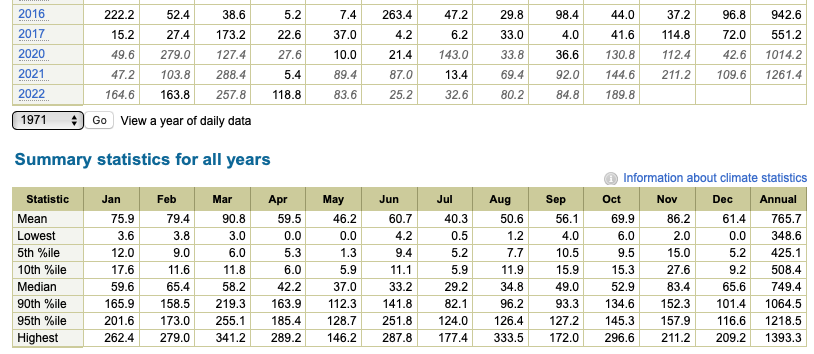
(One byproduct of this was three new species of shrub, documented on the T&S page).
Unsurprisingly, pulling fleabane was fairly easy, and a light miner's hammering around thistles meant they could be eased out pretty simply. OTOH, the blackberries were having a great time, and some flowers were already visible - despite fruiting being pretty uncommon on Byb (thanks to the hard time we've given them, we like to think).
Linda sprayed metsulfuron on the large blackberry plants:
Roger walked Echidna Ridge, along the north-eastern fenceline to Picnic Corner, and back across the middle of northern block. After lunch he checked the bottom of the northern waterline below the dam (and indeed they need a lot of attention). The main weeding-work he did was:
As for the main target, serrated tussock, Roger saw none at all, but Linda found and chopped out 2 small ones in 'the usual spot' just east of the copse.
Oh, and one other item of significance: It was Capelin's first visit to Bunhybee. He mostly accompanied LInda, but also shuttled between us a few times, variously 300-600m of it. Brünig was respectful to his age and more circumspect, having little rests between surges of activity.
The annual-rainfall record was just missed, with the necessary extra 60mm not accumulated until 19 Jan. For Jan-Mar '23, it was something like average.
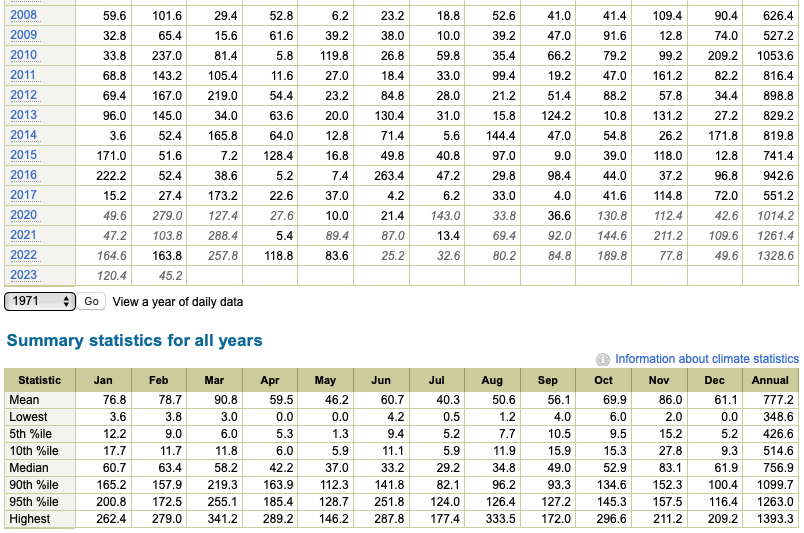
One result of the wet was that the gate's very hard to open, with the area it swings out into needing to be cleared of grass. In principle, rain like that should significantly advantage introduced species over most natives. It did that for the Yorkshire Fog and Sweet vernal, but by this late stage they were no longer prominent. And, apart from the scatters of blackberry, fleabane here and there, occasional thistles, and a lone Hawksweed on east Echidna Ridge, it looked pretty good!
This was rubucide time of year, although we were a bit late, and a lot of the leaves were red, although not dead yet. The sicker red ones were where Linda had sprayed on 10 Dec. So, although autumn is the best attack-time, there does appear to be some benefit in summer attacks.
With Roger's ability to do lots of ground-level cut-and-paste receding, and a lot of blackberries to attack, we changed strategy. Linda's had reasonably good results using her 15-litre hand-pumped backpack to spray Metsulfuron, with little evidence of collateral damage. So she continued with that, and Roger did the same, using an 7-litre battery-operated tank owned by Ridge-member Paul, for which Paul had resourcefully set up a backpack. Roger did a couple of reloads for a total of 14 litres plus a fair bit of walking. And the battery didn't quite run out. Linda did about 40 litres' worth. We started at the gate, and the areas we worked over were:
Next time (but has to be very soon), Linda will do the remainder of the fenceline to the south, and Roger the remainder of the northern waterline incl. the big one above the main dam and the several along the dam-wall. Then we may both attack the area beneath the dam, particularly near the fenceline where it's entangled with a Leptosperm forest.
That will leave the southern waterline untouched. Both the very persistent upper area and the thick southern swamp will need a lot of attention some time, plus scattered ones elsewhere in south block and one out in the Kunzea-dominated midlands.
Day 2 of the annual blackberry attack.
Roger did the remainder of the northern waterline, plus the small bushes on the dam wall, using 11 litres of Metsulfuron with wetter in Paul's 6-litre pack.
He then prep'd the big bushes on the SE and SW corners of the dam, by drawing all of the long runners and throwing them back over the host bush.
After lunch, he did the same down the lower part of the northern waterline, but cutting-and-painting with Glyphosate some of the vines most badly intertwined among the leptosperms.
Linda used 20 litres of Grazon with wetter inside and outside the fenceline on South Block, then 15 litres on the larger bushes at the main dam and in the lower northern waterline. There could have been off-target damage to the leptospermum down towards the western fenceline, but most of the spraying was below the level of the leptosperm canopy.
That covered everything we'd found on the northern and central blocks, but in the southern block only the (considerable) growth along the western fenceline, and hence leaving all of the southern waterline incl. swamp, plus a scatter out in the open.
Day 1 of the annual blackberry attack.
It had been a mixed summer, somewhat mild, high humidity, and periods of heavy rainfall, with a couple of washouts 2km north, on the western side of the Shoalhaven just north of the junction with Jerrabattgulla Creek.
The substantially above-average falls 2020-23 can be seen below, alongside the deep-drought years 2000-2009:
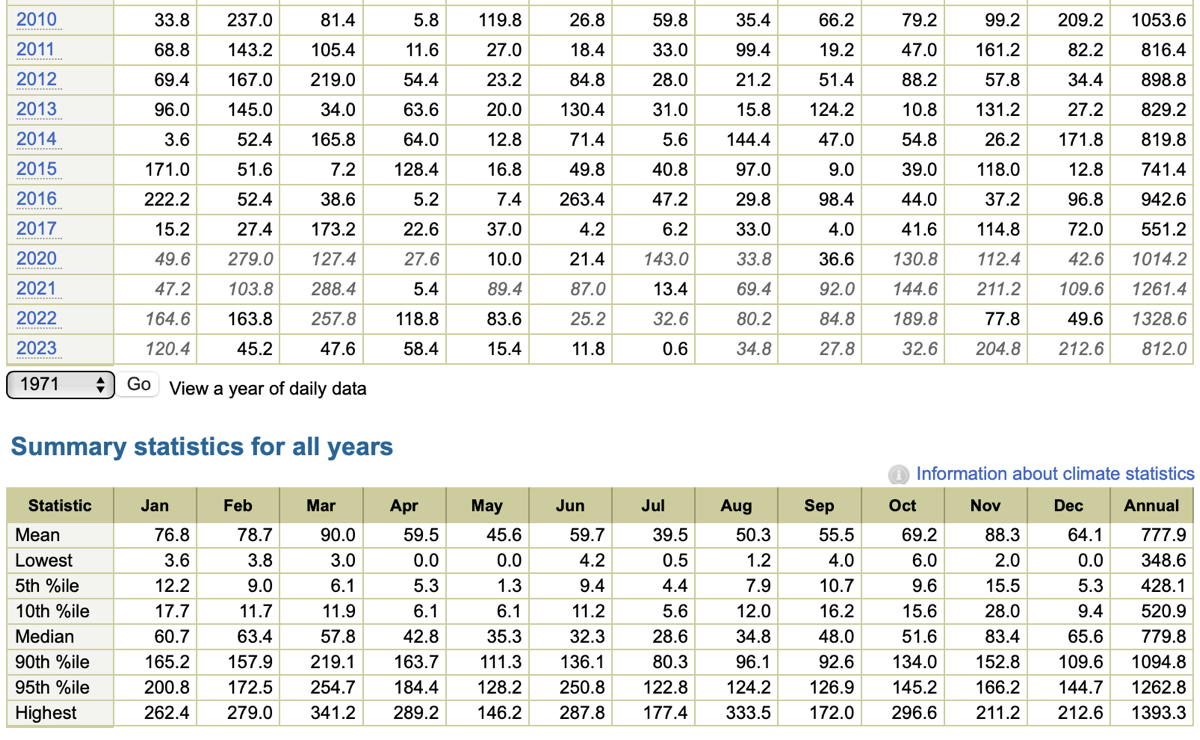 |
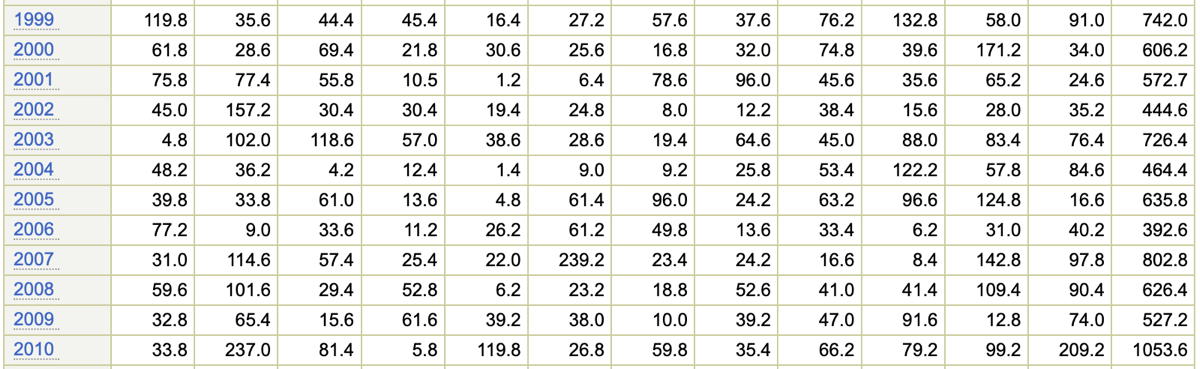 |
There was substantial pig-damage, some by large hooves. Karen and Peter have had pig-shooters in, and already trapped 3 for elimination, with financial support from BCT.
We sprayed on the southern and central blocks, Linda 22 litres, Roger 18, as follows:
We checked out other areas across much of the southern and central blocks. There was little evidence of fleabane, thistles or hawksweed, and not a lot of Briar Rose. We found the following in need of further treatment:
We sprayed using 1gm Metasulfuron and 35ml Grazon per 10 litres. That seems to be the most effective mix.
We're less precious about avoiding collateral damage to forbs than we once were, because the native species have proven to be pretty resilient, especially in moist conditions like those of the last 5 years.
Day 2 of 2 of the annual blackberry attack.
Linda finished the work on the southern and south-central block, and the two of us covered the north-central and northern blocks.
It was still very wet, with not just flows in all of the southern, gate-gully and northern waterlines, but also water lying in all other gullies, even those with quite small catchment areas.
Native grasses were all late-season but thick, there was healthy growth of quite a few shrubs and trees, and small numbers of specimens of 7 or 8 flowering species were still evident.
New blackberry growth was remarkably limited, although in a few cases fairly vigorous.
The Metsulfuron-Grazon mix used in the last two years has achieved very effective knock-down everywhere, with some bushes even entirely dead.
We sprayed on all three blocks, Linda 11 litres, Roger 6, as follows:
We also headed-and-bagged two vigorous late thistles on the dam wall (but were too late for four other others). There was very little fleabane evident, and there were very few briar roses.
The top few priorities:
Other targets:
This is a page within the Bunhybee Grasslands Web-Site, home-page here, and site-map here
Created: 11 January 2009; Last Amended: 15 April 2024