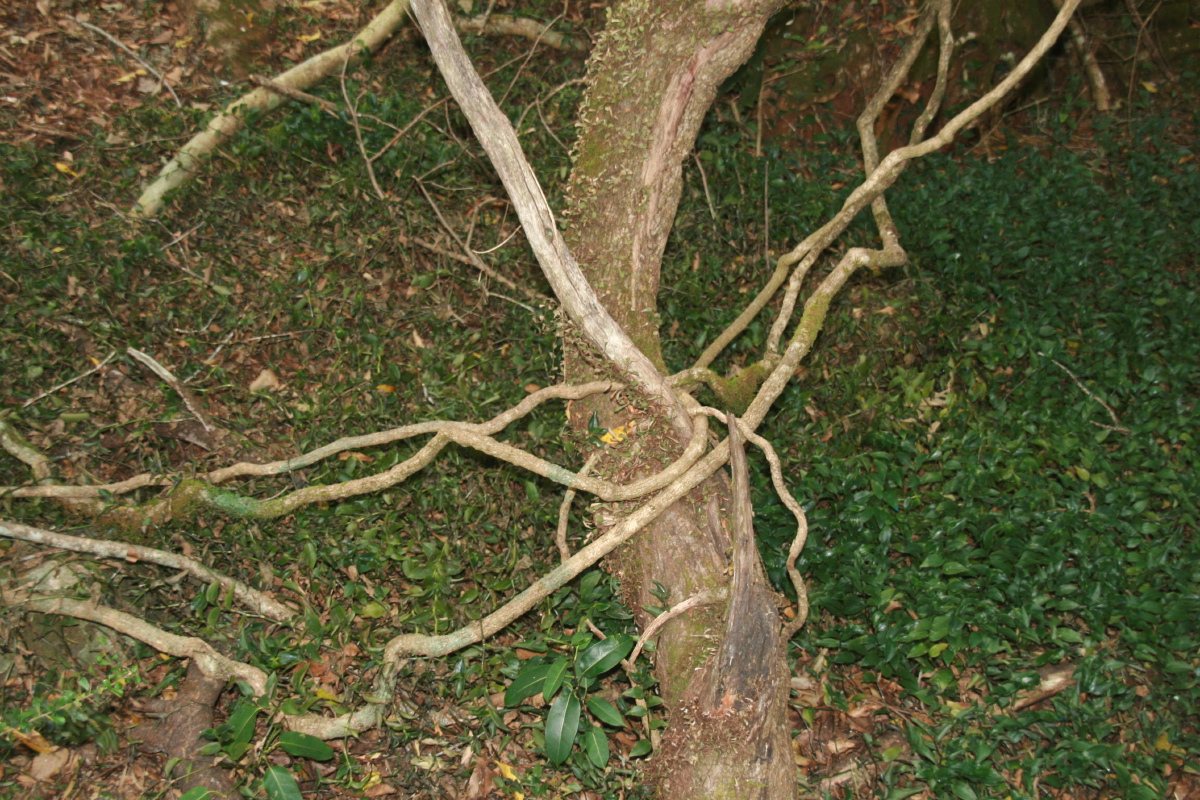
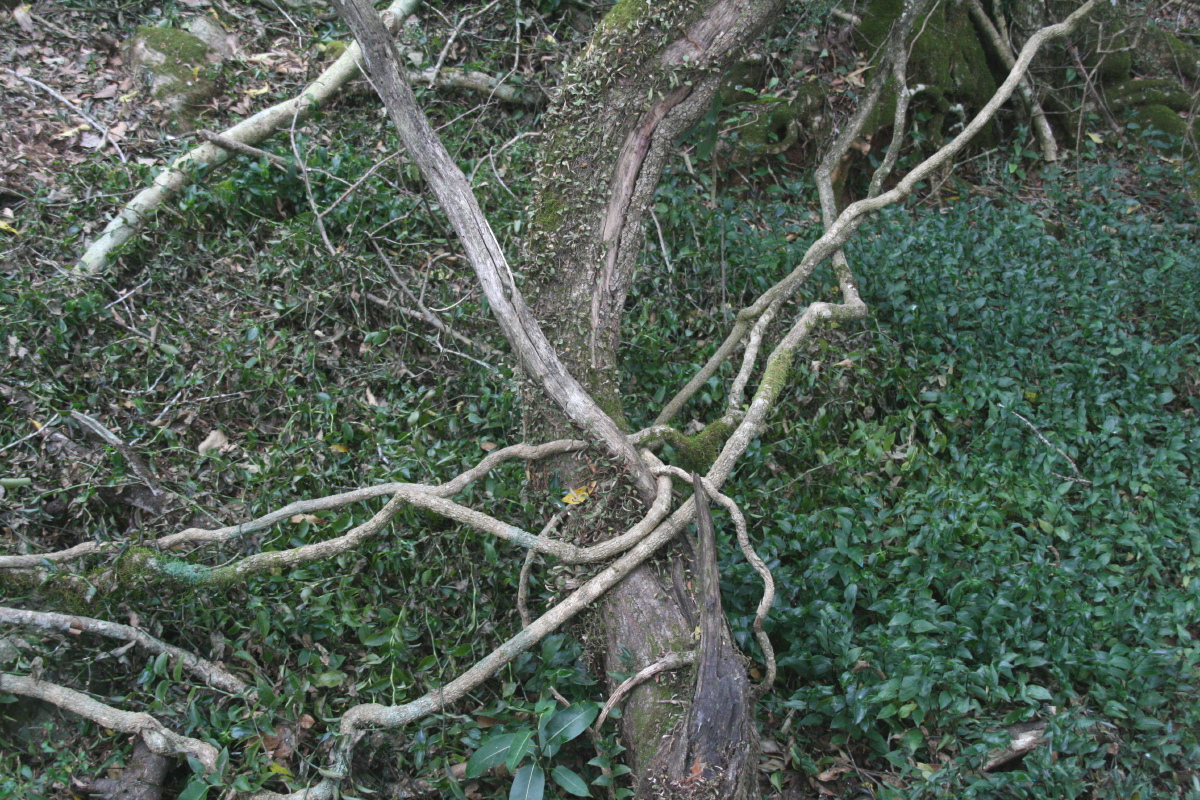
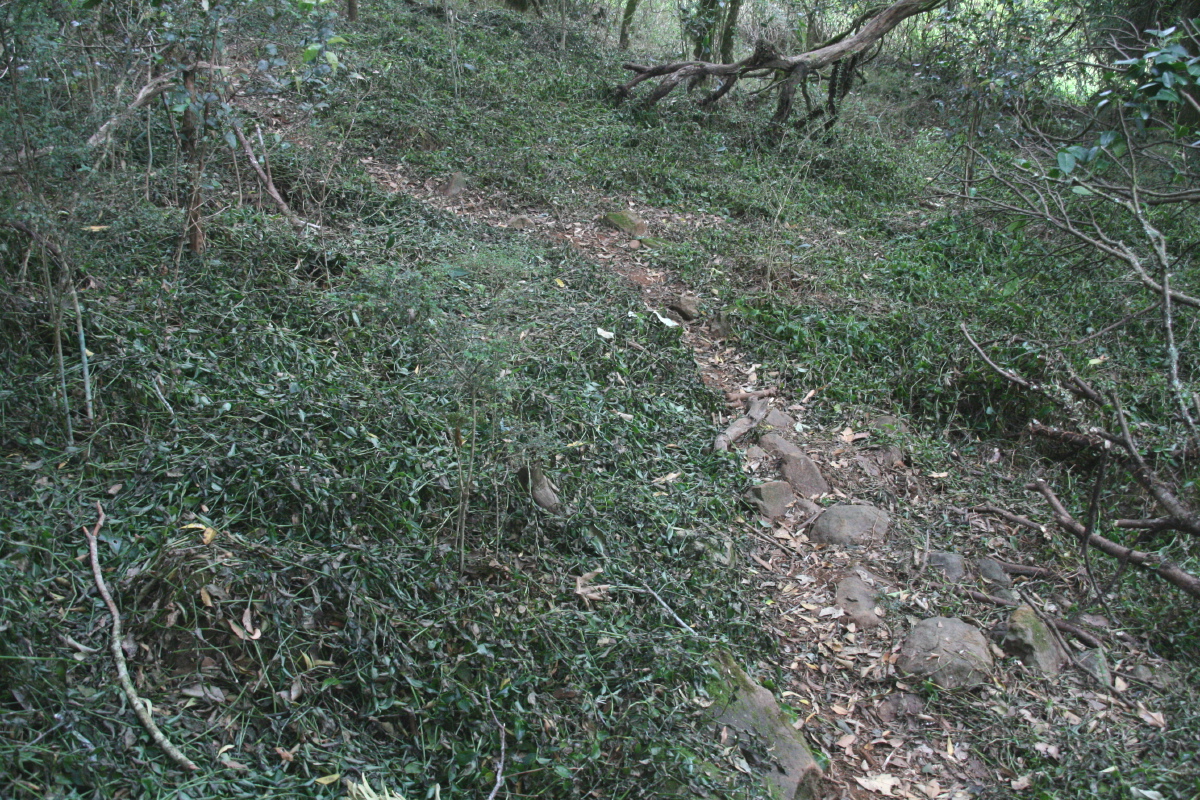
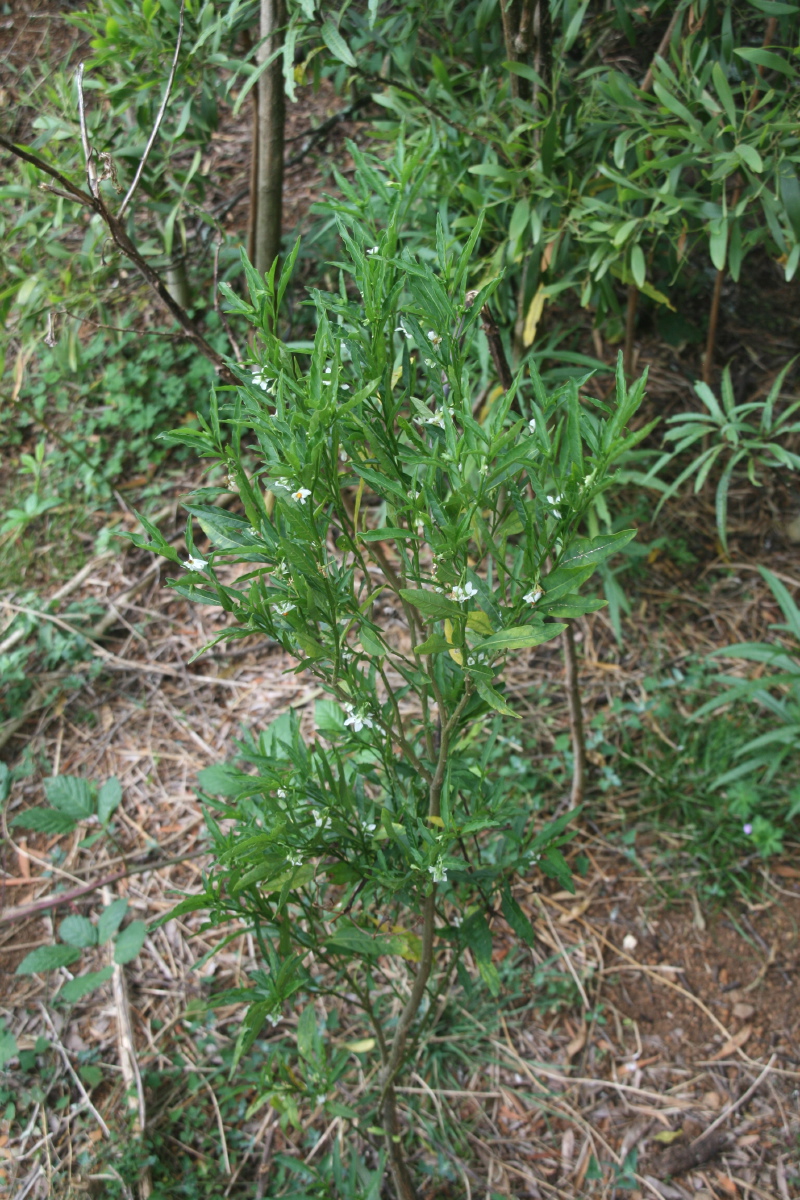
Linda and Roger's Southwater Downs
Weed Control Implementation
This is a page within Roger
and Linda's Southwater Downs Web-Site.
This page contains information about the activities we've undertaken on the
property to address weed problems affecting the rainforest on the property.
Here's what we've done most recently, and here's
what we plan to do next.
We've also made some notes on the care needed when addressing
a weed problem.
The Baseline
Following purchase of the property in 2002, we saw that the up-hill edges of
the rainforest were under attack from blackberries. During 2003-04, we used
a weeding contractor (commercial rather than conservation-oriented), who sprayed
them, and dragged some of the largest bushes out.
During 2005-06, the Catchment Authority provided advice on native species in
and on the edges of the forest, and the major weeds that needed to be attacked.
At this stage, the blackberries were worse at the bottom of the property than
at the top. We negotiated a contribution towards the fencing of the northern
edge, a second round of blackberry attack, some initial work on the wandering
jew, and plantings in the riparian grass area.
The fencing was done in 2007. In 2008-09, the blackberry-spraying and planting
were conducted by a conservation-oriented contractor ('bush regenerator' rather
than 'weeding contractor'). The work that was done was fine, but we weren't
impressed with the value-for-money, nor with the failure to attack the wandering
jew and to provide the required weed-list.
In early autumn 2010, we applied our 'cut-back, then cut-and-paint-every-cane'
technique to the blackberries on the edges at the top, the bottom, and beside
the path between them. The technique is discussed generally
here and in more detail here. In
late spring 2010, inspection suggested that we'd had a lot of success. We
repeated
it in 2011, with significant effect, and the same again in 2012, and in 2013
we didn't need any spraying on the western edge where the problem
had been! An annual cut-and-paint attack is necessary, and the work is non-trivial;
but it's within our
capabilities (2 people working 4-5 hours for 1 or 2 days p.a.)
and it's effective. In 2014, we didn't quite get the job finished in an attack
of 2 of us x 1.5 hrs one afternoon plus 4 hrs the next day.
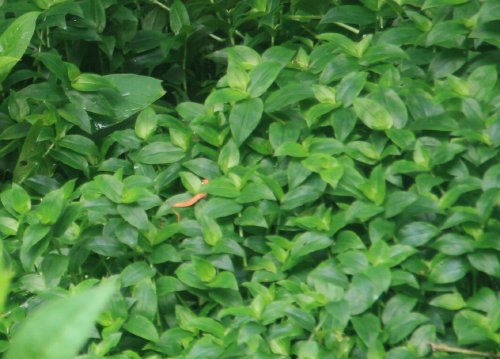
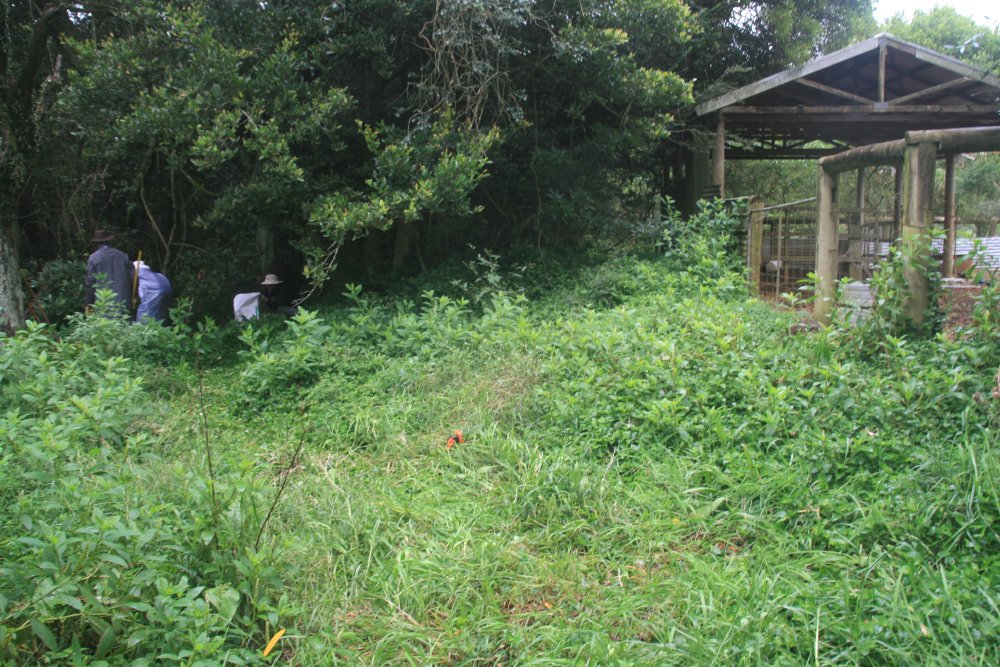
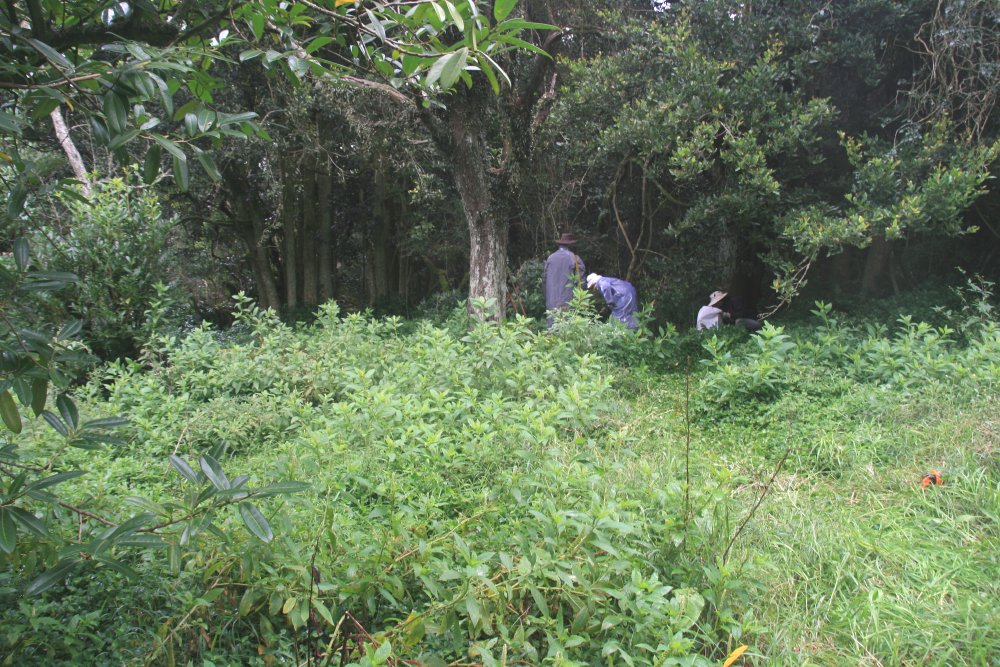
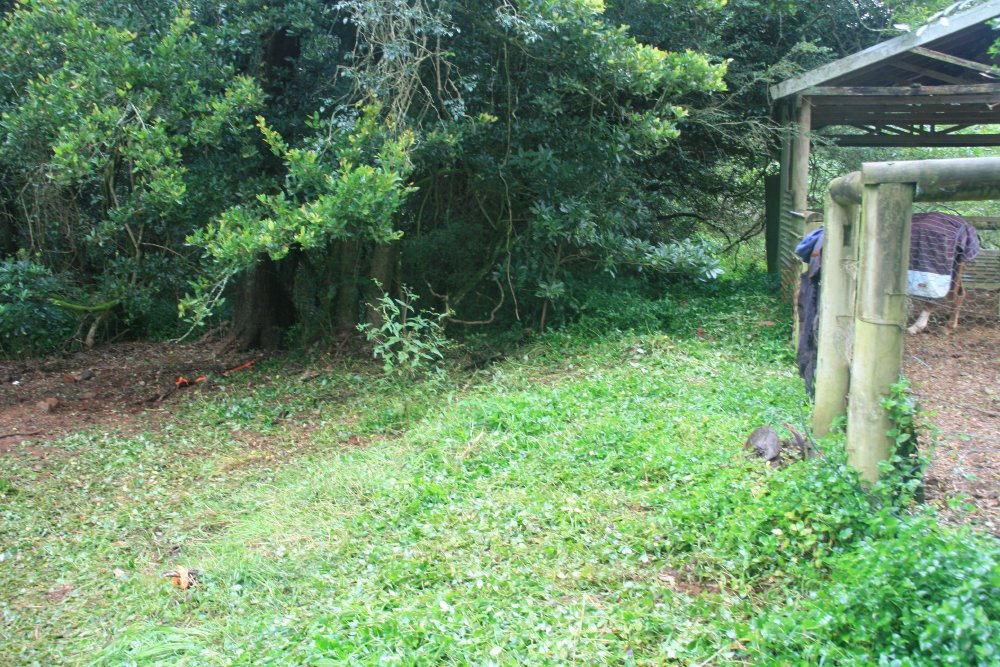
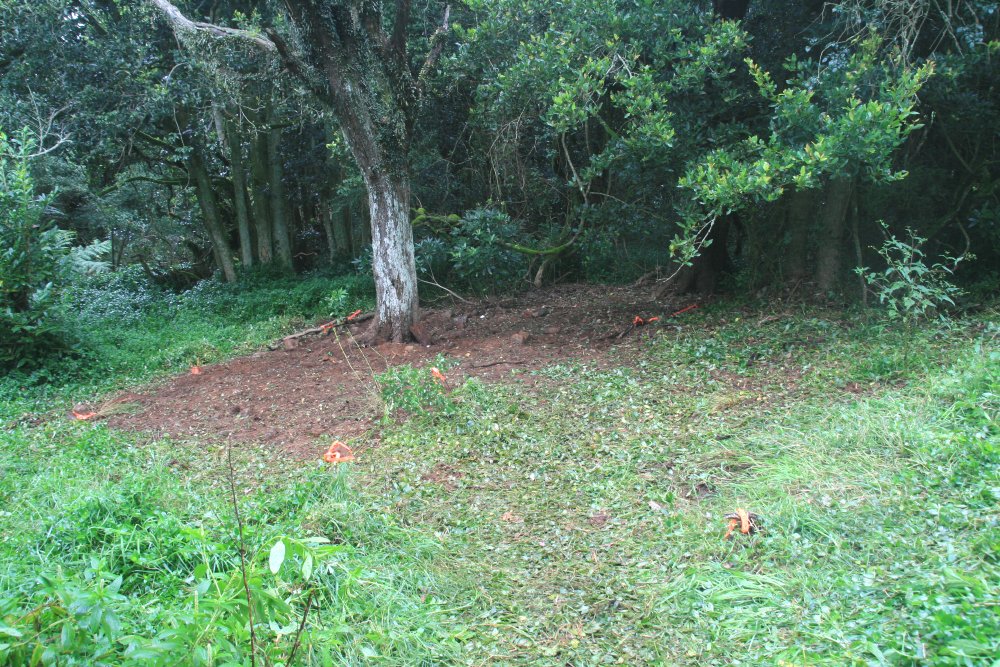
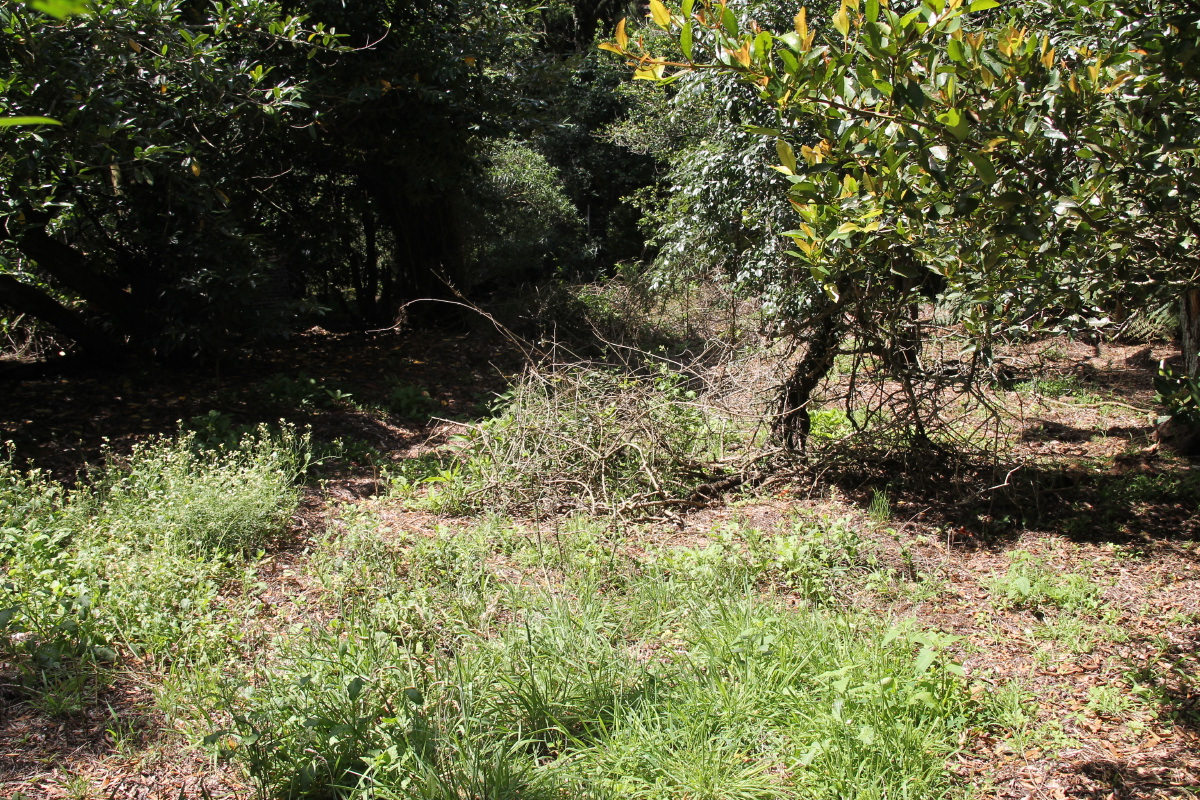
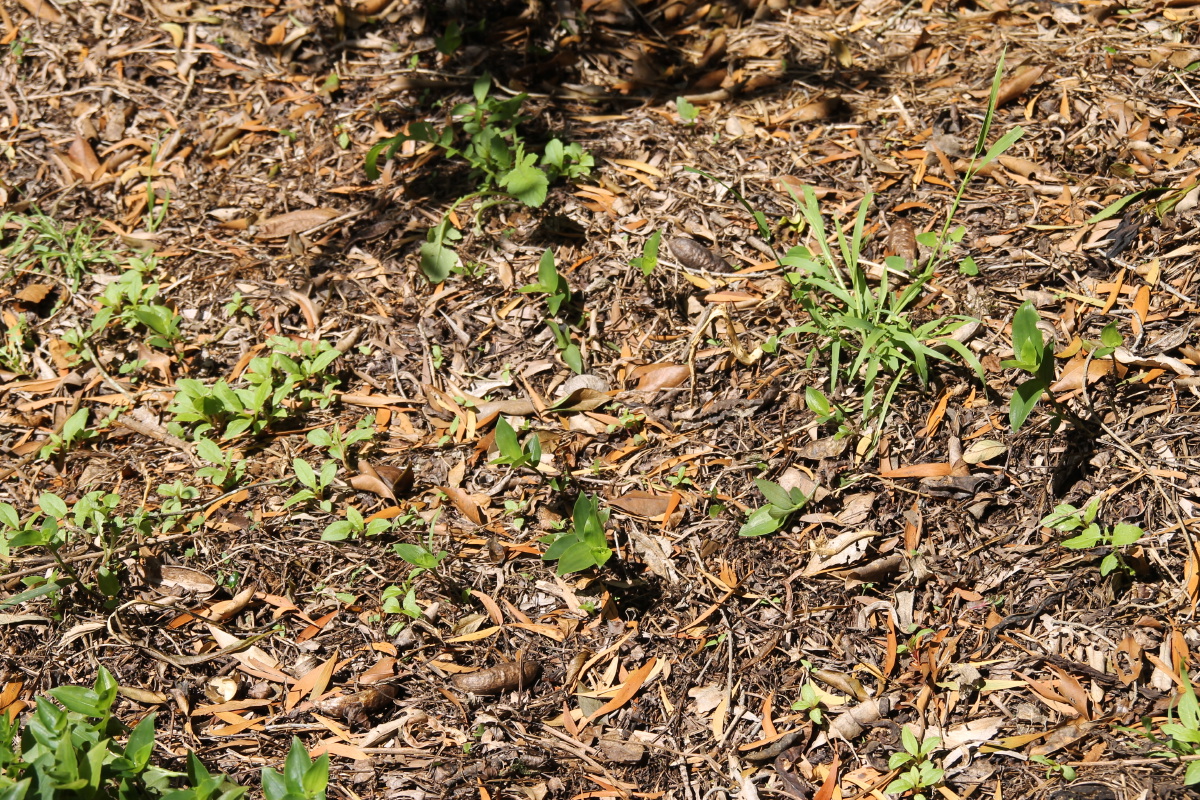
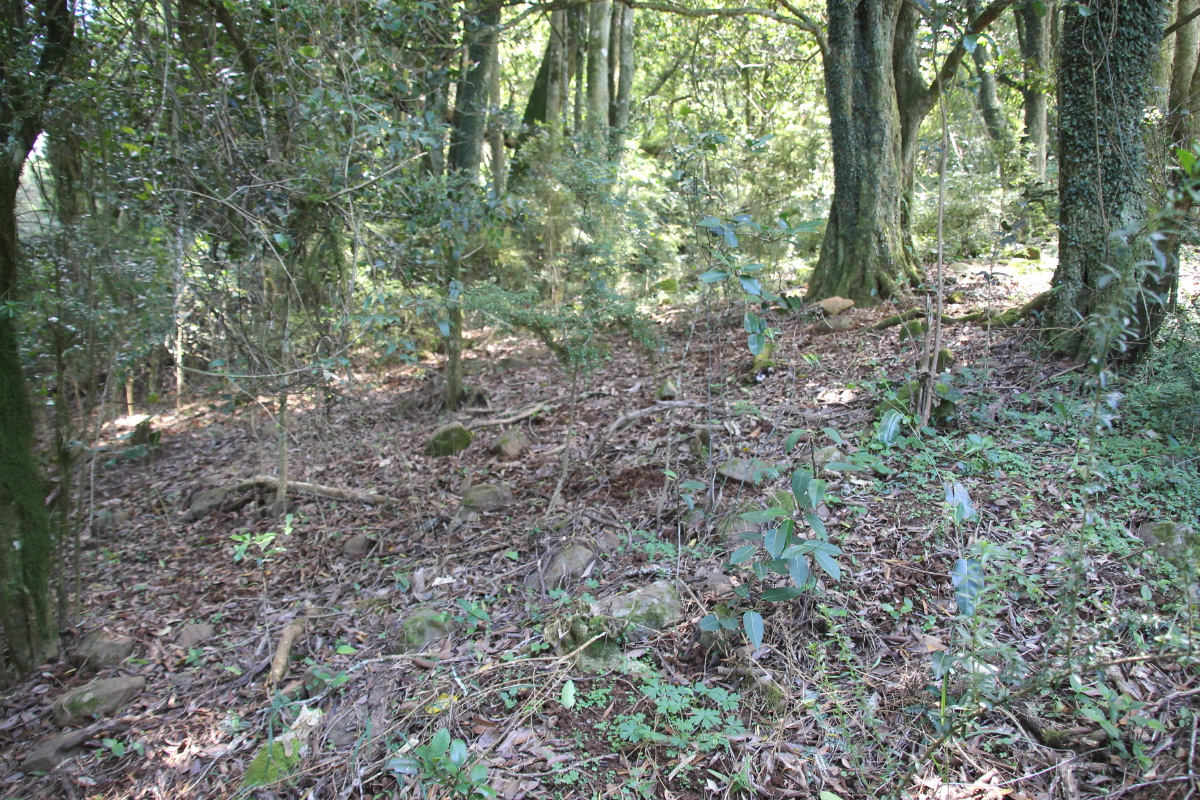
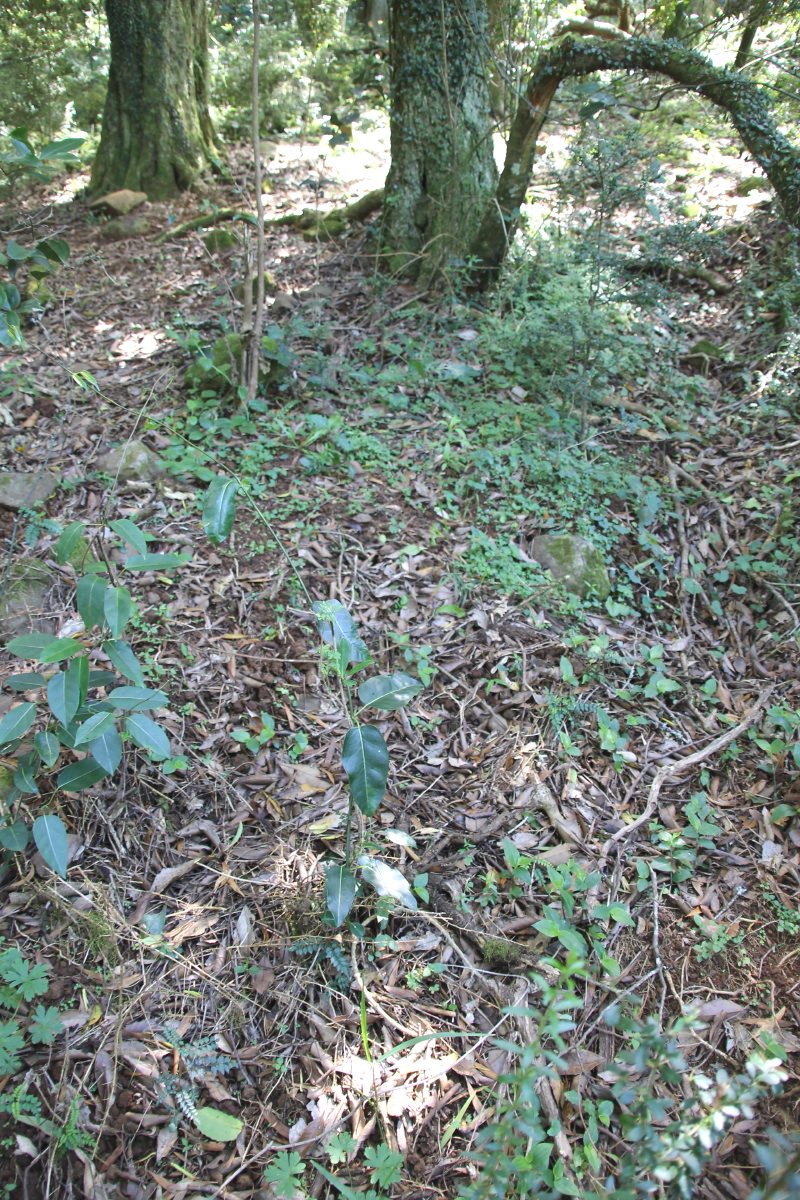
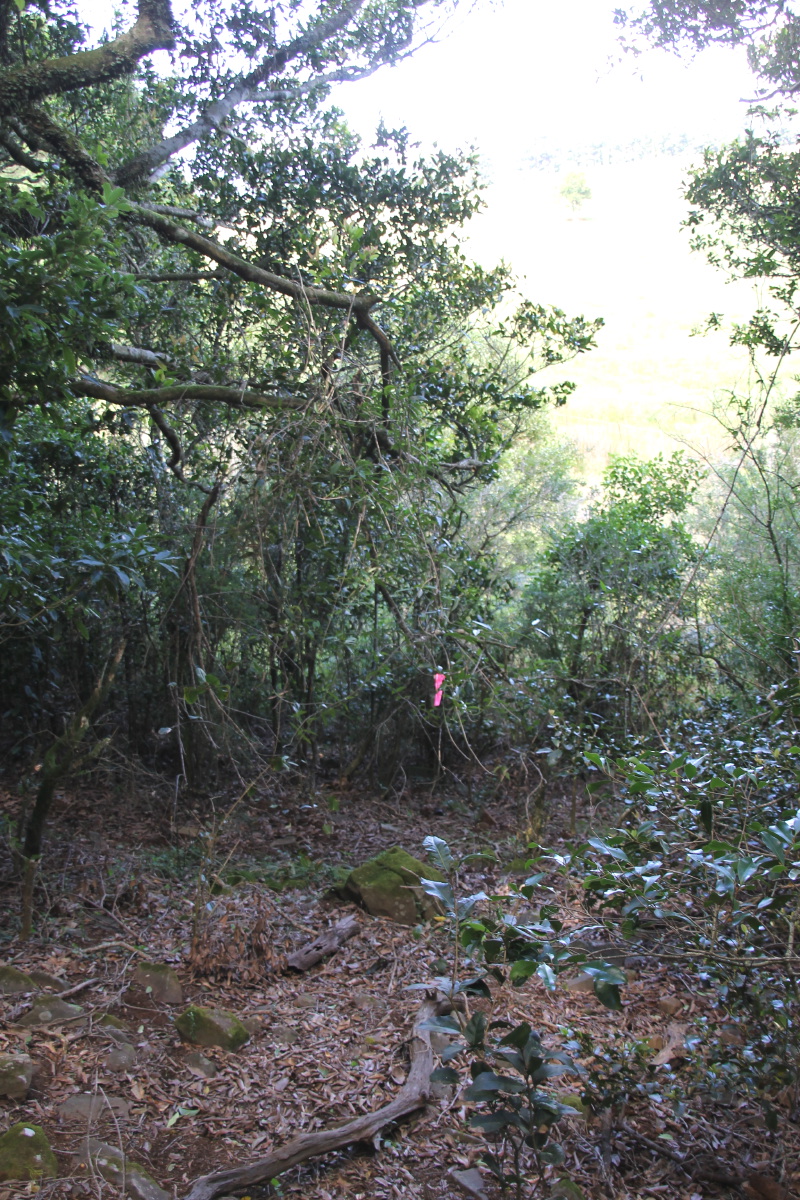
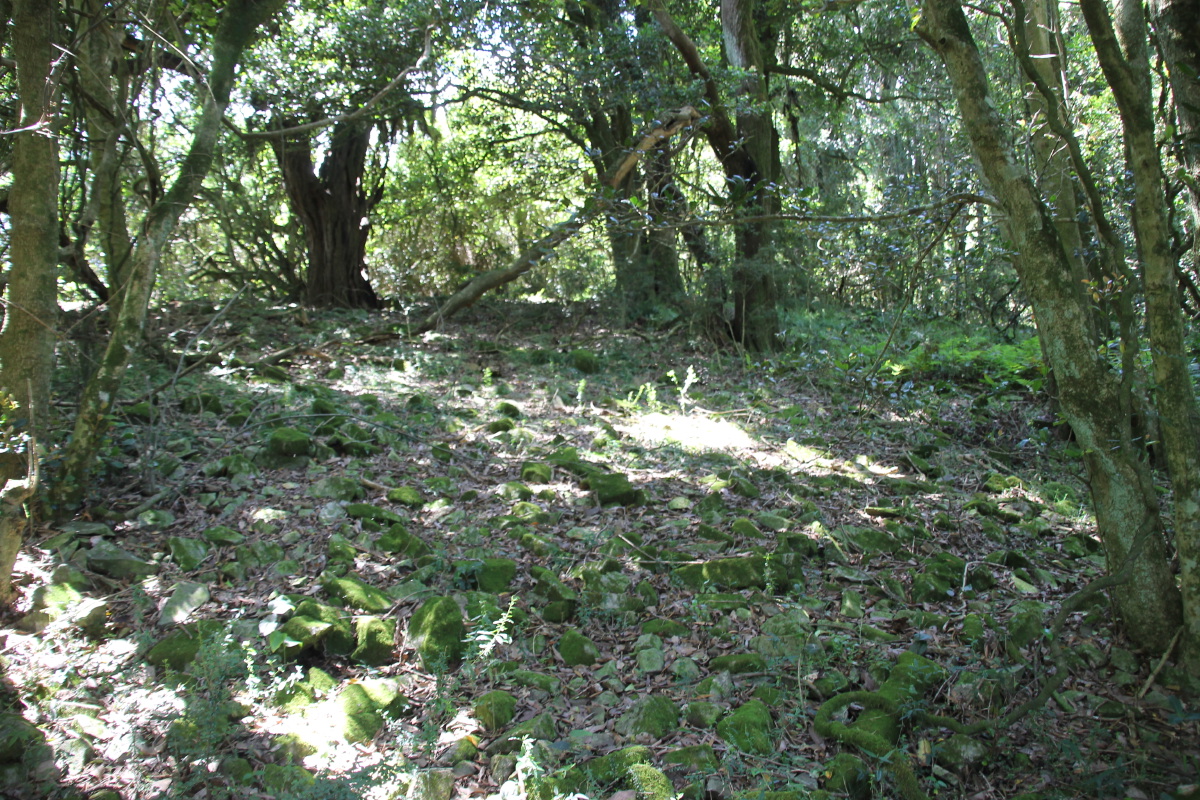
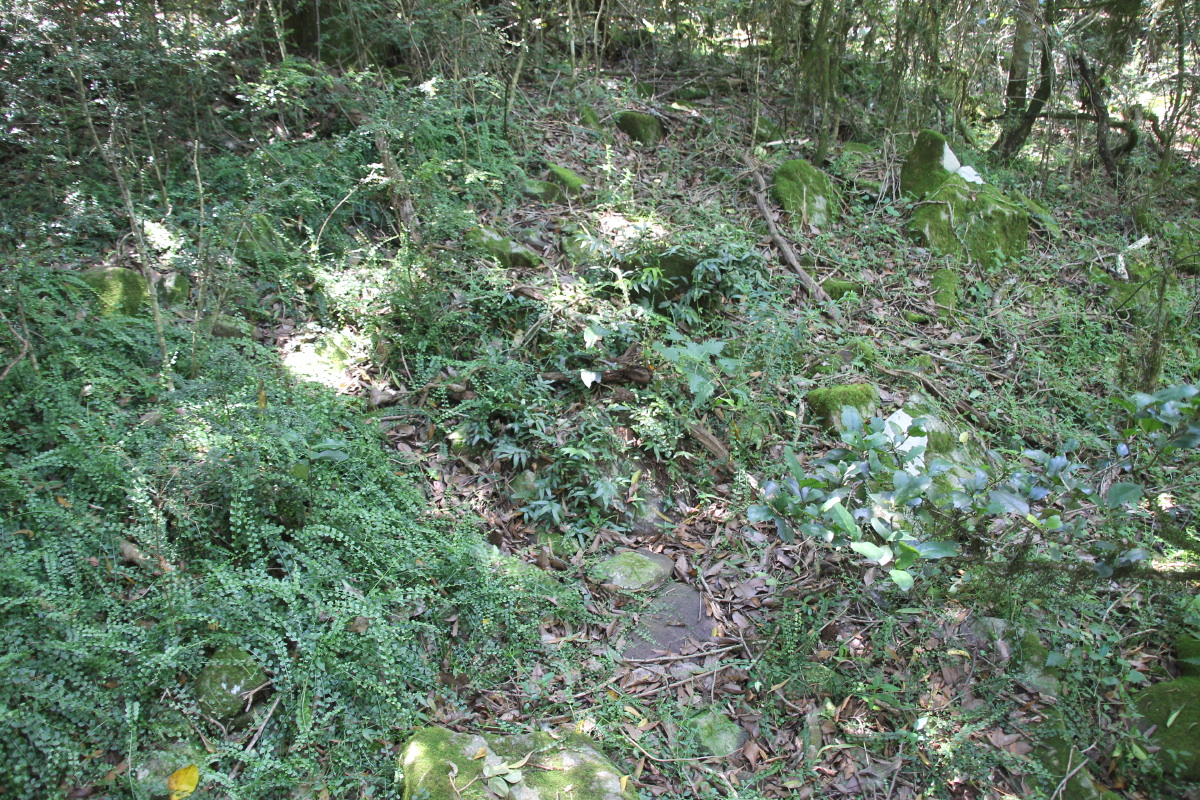
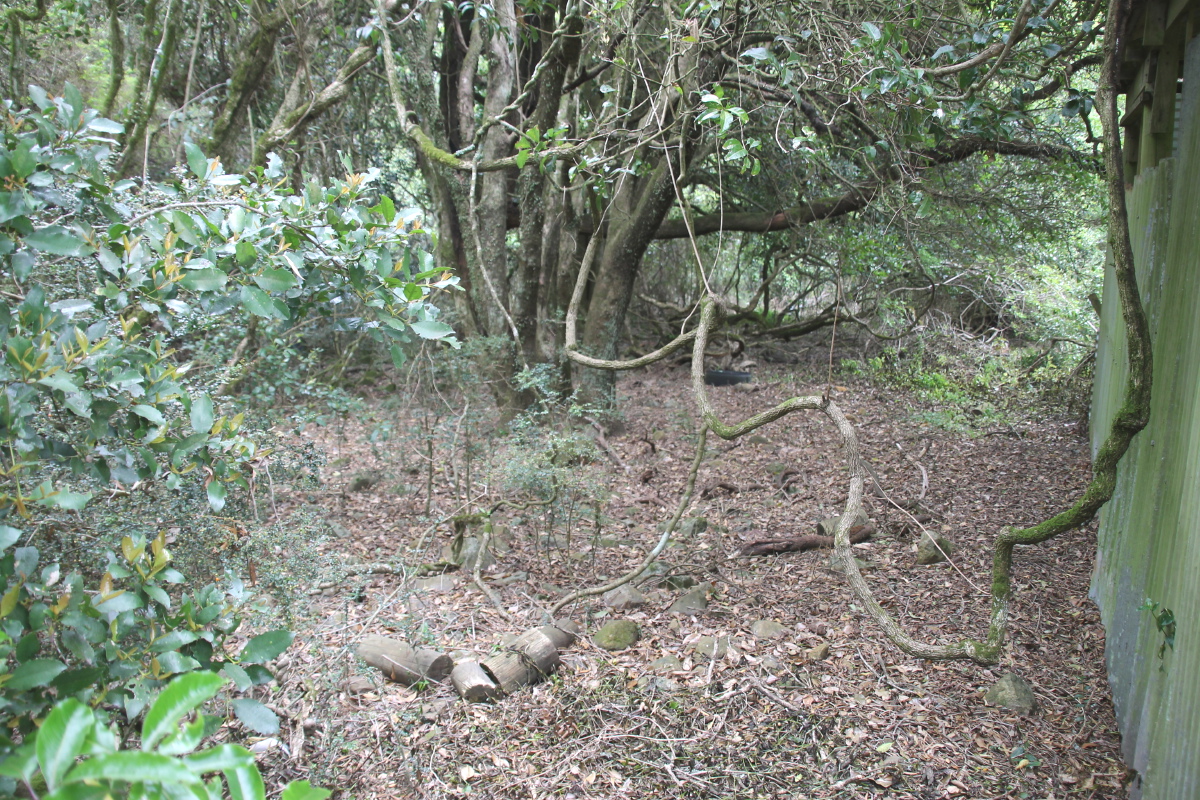
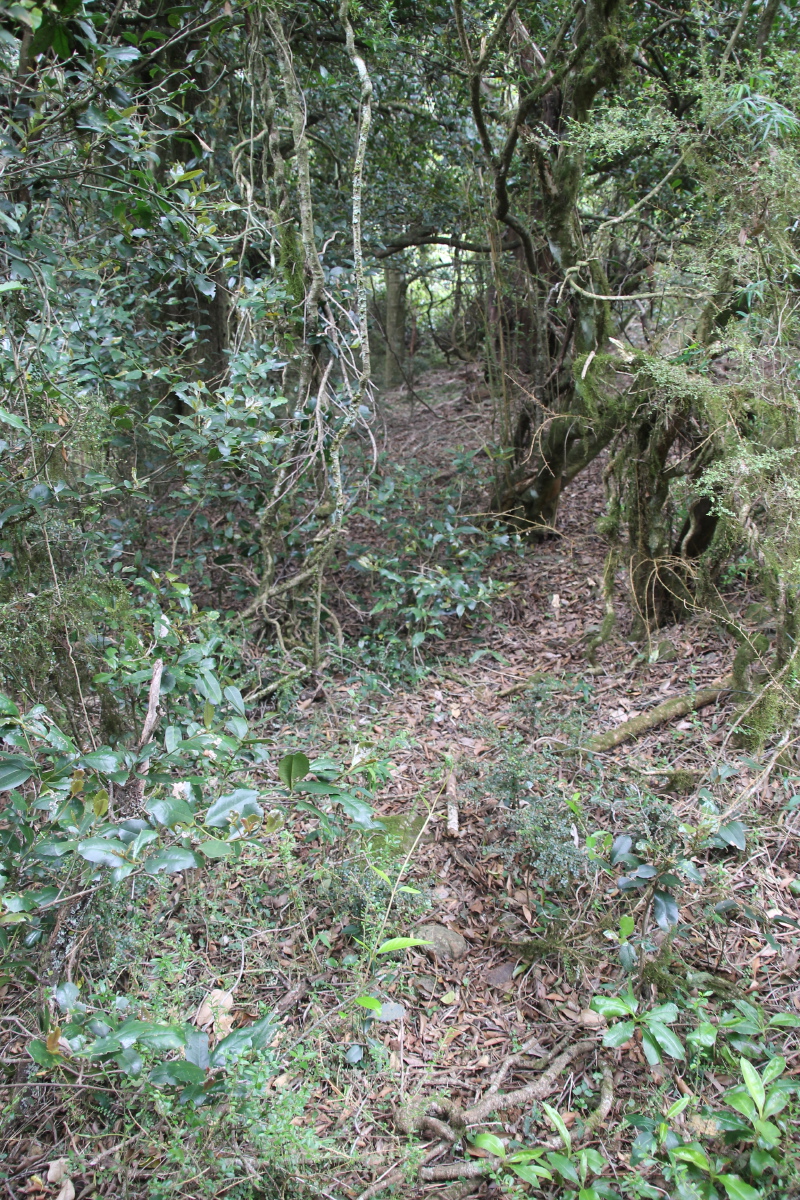
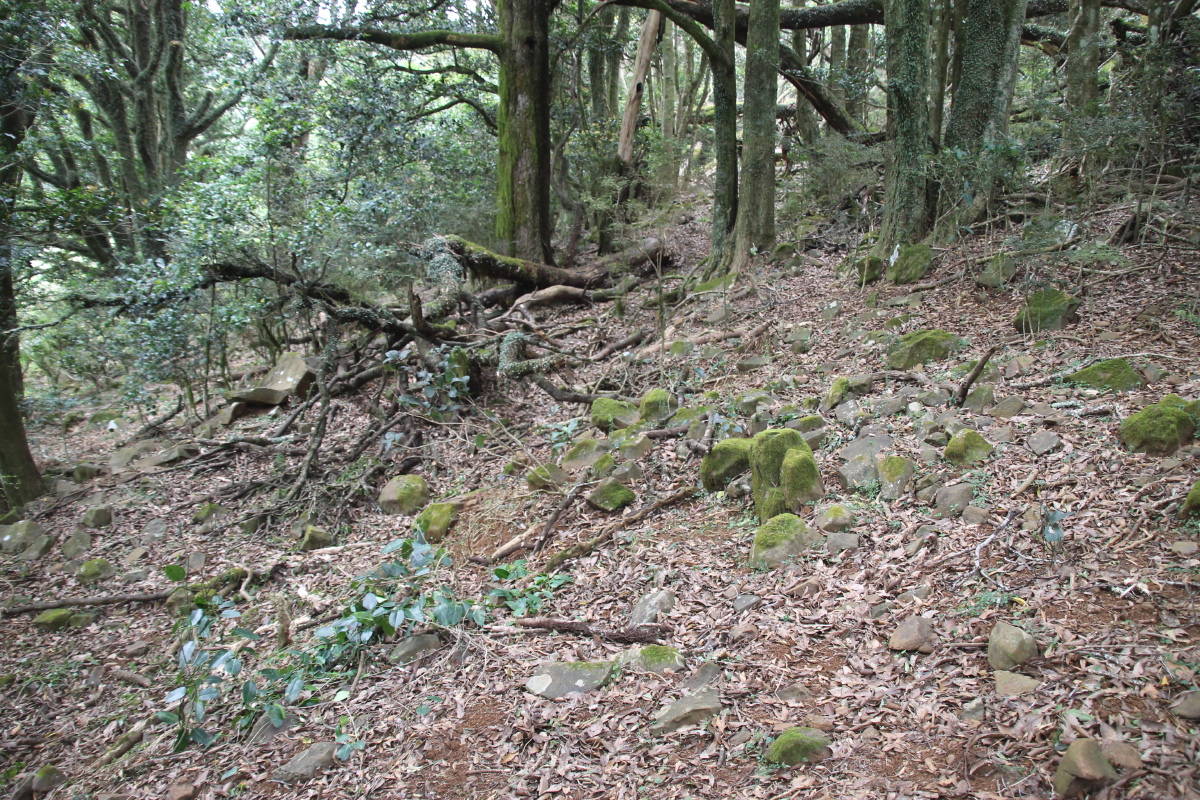
Here are baseline photos of the forest and forest-edges.
Activities To Date
The following activities have been conducted since 2008:
November 2008
- Blackberries – Riparian, Path-Side and Top-Side
- Contractors (ecoLogical) sprayed the blackberries
April 2009
- Native Plantings on the western (downhill) edges
- The contractors planted pioneer species to to encourage extension of the
rainforest down towards the water. The plant stock was sourced for us by
CMA's Daniel Anderson, from the Landcare & Bushcare Network. The species
planted were:
- 40 Acacia melanoxylon (Blackwood)
- 40 Acacia mearnsii (Late Black Wattle)
- 40 Eucalyptus radiata (Narrow-leaved Peppermint)
- A report after 4 years is below
July 2009
- Blackberries – Riparian, Path-Side and Top-Side
- The contractors conducted brushcutting and re-spraying of the blackberries
- Wandering Jew
- The contractors said they sprayed the wandering jew – but they again
failed to perform according to contract, and won't be used again. They seem
to find that work too hard. (They were also contracted to provide an inventory
of weeds and their locations, and failed to do so)
13 Dec 2009
- Riparian Blackberries
- As a follow-up to the contracted work, we first inspected the blackberry
work and plantings of native species, then hacked-and-removed, then cut-and-painted
the backberries (with Glyphosate), and weeded around the new plantings
- Riparian Thistles (Carduus nuttans and/or Cirsium vulgare)
- Pulled and laid roots-up. (No seed appeared to be viable, so head-bagging
seemed unnecessary)
21 Mar 2010
- Riparian Blackberries
- Out from the forest-edge, Linda sprayed using 70ml of Grazon (Triclopyr)
in each 15-litre backpack of water. It took 2-1/2 packs to do virtually
all of the plants, although a few were out of reach of a controlled spray.
She also sprayed re-sprouting blackberries closer to the stream amongst
the grass, and a patch near the southern fence which the contactors had
missed (or couldn't reach)
- Downhill Forest-Edge Blackberries
- At the bottom of the path, and 10 metres from the northern boundary, Roger
cut-and-painted (with neat Glyphosate) two large bushes that were inter-twined
into the edge of the forest. The cuttings were heaped on some dead blackberry
on the path end, and in a tree-fork at the northern end
- Path Blackberries
- Half-way down the path, in the area opened up by a tree-fall, Linda cut-and-painted
a number of young plants
22 Mar 2010
- Topside Forest-Edge Blackberries
- We worked along from the top of the path almost to the northern end,
hack-clearing and then cutting-and-painting four bushes that were intertwined
into the forest edge. Linda also did cut-and-paint on some small blackberries
intertwined in the grass.
- Yellow-Flowered Spears (Verbascum macrurum?)
- We pulled and removed half-a-dozen plants in the north-eastern corner
of the the triangle
- Thistles (Carduus nuttans and/or Cirsium vulgare)
- Linda test-painted with neat Glyphosate the hearts of some first-season
plants (which, in the rich soil and moist growing conditions, are plate-size!)
12 October 2010
The visit was primarily to work with the surveyor to mark out the boundaries
of the area that is to be the subject of the Conservation Agreement.
I used the opportunity to do some experimenting with the Trad:
- It looked all too healthy.
- I conducted a trial roll-and-bag exercise on a 2.5m square section behind
the stable
- That took over 10 minutes in two passes, without going
back over the section with a fine tooth-comb to pick up the many broken segments
- The work is physical to the point of impracticality over the large areas
that we have. It therefore appears essential to use a combination of glyphosate
and roll-and-cover
When we checked the bags 5 months later, they were deeply embedded in the re-grown
Trad. And as the photos below show, the bagging was a failure, because the plants
were alive, and shooting merrily. Clearly the bag needs to be not only black,
but also out in direct sunlight.
The other activities were:
- I took a series of photos of the forest edges (to provide
a baseline), and of a number of species (to provide a starting-point for the
Plant Species pages)
- I inspected the blackberries – which were looking
thoroughly defeated after the sustained attacks on them last season, with
only small outbreaks evident in the bottom section, plus more in the paddock
above and the eastern forest margin
- A number of inkweed were evident behind the stable
- A lone verbascum is on the eastern margin
- A large Carduus nuttans is west of the stable
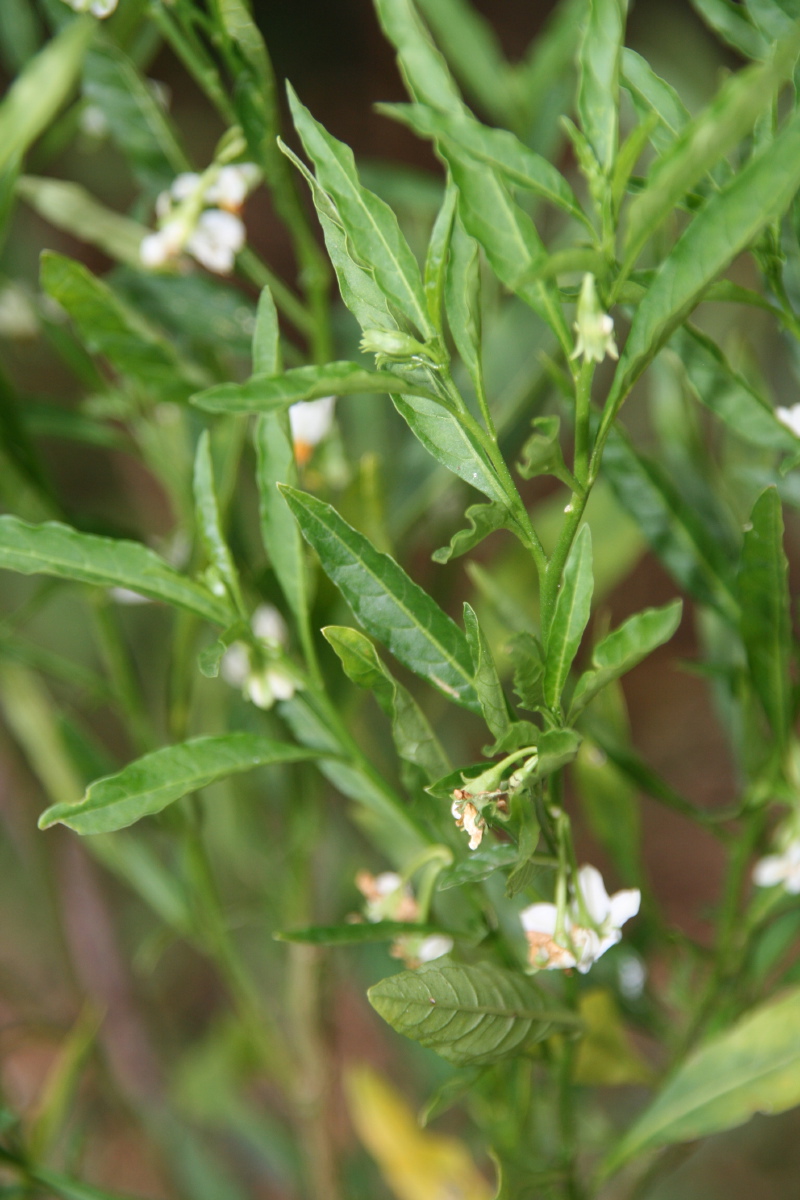
- An unidentified ground-cover with a purple flower, black stem and spikes
on the leaves pointing out at right angles to the plane of the leaf (probably
a Solanum) is in the same area, at the edge of the stable-paddock.
We've since worked out that it's an unpleasant South African import, Solanum
linnaeanum
26 March 2011
Rubucide day for 2011 came after a moist and not-hot summer,
and just after very serious rainfall in the area which had flooded Albion Park
at the bottom of Macquarie Pass and washed out a bridge on the Jamberoo Road.
The inspection was challenging because of the lushness of the
grass (even by Robertson standards). What we found was:
- along the track down:
- the work the previous year had reduced the outbreaks to only a very
few small plants
- at the bottom of the forest, northern side:
- the spraying of the large area of bushes a year earlier had been remarkably
successful
- there were of course outbreaks within those areas and closer to the creek
- at the bottom of the forest, southern side:
- following the spot-treating the previous year, there were many small blackberries
and a couple of large ones in the upper area close to the fence
- at the top of the forest:
- the cutting-and-painting within the forest the previous year had been
very effective, but there were some outbreaks
- along the fence to the paddock, and in the fields above – which
have not been treated in some years – there was a mass of mostly small
growth
The attack work conducted on the day was as follows (spraying
with Grazon/Triclopyr, painting with Glyphosate):
- along the track down:
- spot-sprayed such plants as were found
- at the bottom of the forest, northern side:
- sprayed the main body of bushes, this time reaching almost all the way
in to the forest edge
- spot-sprayed the many new plants within the outer body of bushes that
had been worked on last year, plus many more scattered through the grass
down to the stream
- at the bottom of the forest, southern side:
- cut-and-painted the couple of large bushes and the small ones on the forest-edge
- spot-sprayed the many small plants
- at the top of the forest:
- along the fence-line, sprayed the many small plants and the several large
bushes
- within the forest edge, cut-and-painted the small number of well-developed
bushes (which we didn't get to last time) and the few small new ones that
we found
- in the lower paddock, spot-sprayed
27 March 2011
We finally ran the long-intended controlled experiment on Trad / Wandering
Jew. For once we had four sets of hands, because we were assisted by
Roger's sister Carole and her husband Peter Waters. It made a big difference.
We spent from 11:30 until 16:15, with a short lunch-break. It was overcast with
occasional light drizzle, and about 16 degrees.
We selected the flat area behind the stable.
It's partly within the back yard of the house, and partly within the
Conservation Area.
The reasons for choosing this area were that:
- the Trad is almost entirely on slopes and in forests. But this is
the one area that's flat and hence an easier place to experiment
- it's relatively free of low-flying branches and vines
- we could do tests of the weedicides in somewhat degraded forest just
outside the conservation area
|
Click on any image to enlarge it
 |
The Trad was 12-18 inches high and very thick.
Only occasional flowers were visible.
They were white, which confirmed that it was indeed Tradescantia albiflora
and not the similar native.
|
|
We conducted three experiments.
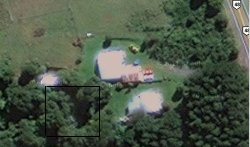
They were in the three different areas, shown on the diagram.
The forest canopy in Area 1 is thin compared with the normal forest,
and in Areas 2 and 3 it's lighter again.
Oops. The satellite image has north at the top, whereas
the diagram has north at the bottom.
Sorry 'bout that.
|
|
1. Manual Treatment Experiment:
- We defined an area of about 5m x 4m, just within the conservation area
- We started by using the technique recommended in several places, which is
to rake and roll it and remove it in bulk. But there were too many rocks to
allow effective 'rakin' and 'rollin'
- Instead we mainly did handwork removal in bulk, sitting on the ground –
which generated less scatter of small pieces to be picked up afterwards –
then using a small trowel or other digging implement to dig-and-remove the
many remaining rooted segments
- The volume of inkweed was so great that we chopped out at root-level some
20 large plants first, in order to make access to the Trad easier
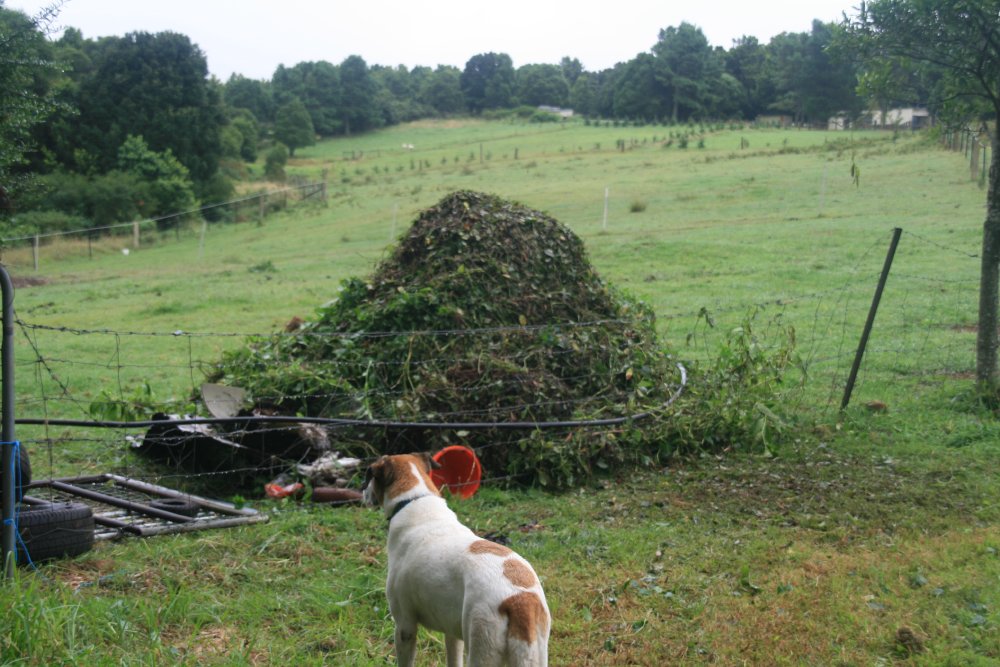
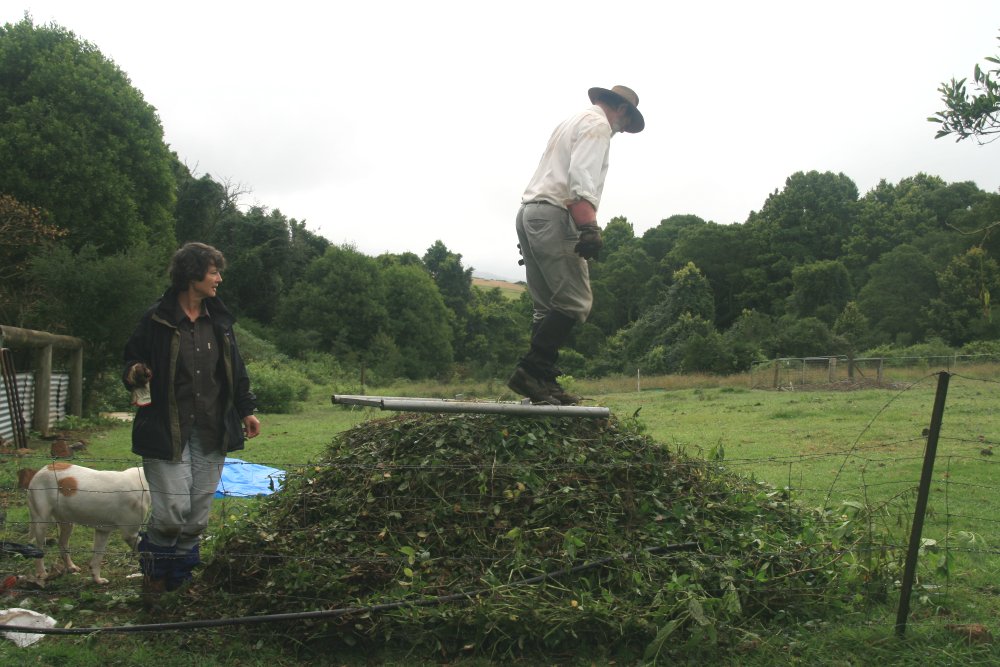
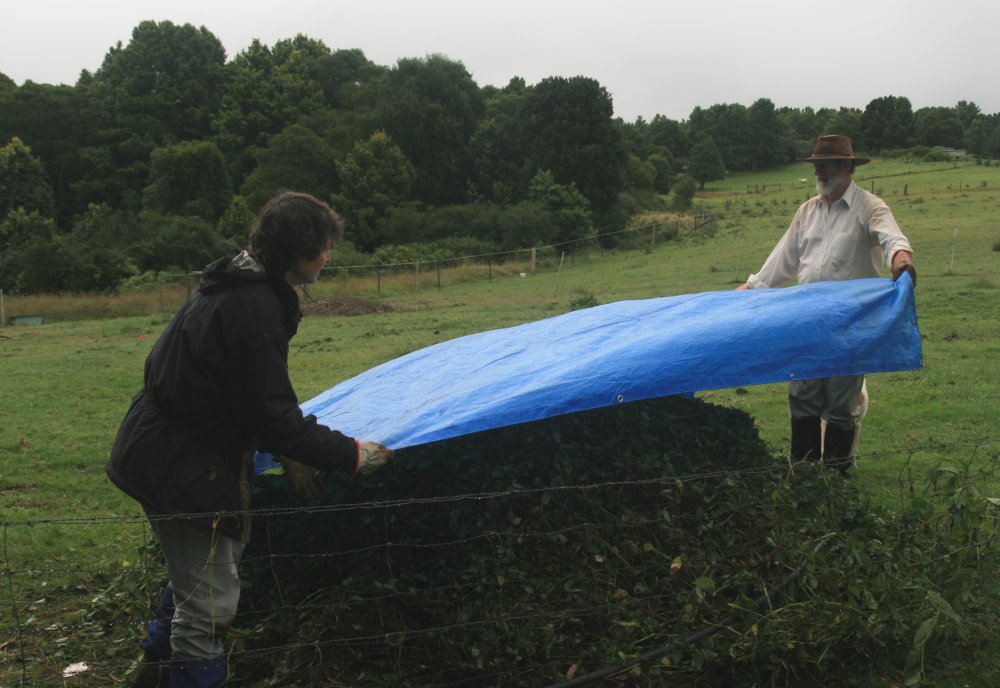
- We piled the cuttings in the horse-paddock, and covered it with a tarp in
the hope that there would be sufficient sun to cook it
- The labour involved was 3 people for 4 hours each, two sitting on the ground
cutting, and one carting the residue 15m to pile it in the horse paddock
- The work was done relatively efficiently, so at best it might be able to
be done in two-third's the time, or 20sqm in 8 person-hours, or 2.5sqm per
person-hour
- That's prohibitive for the large areas we have on the property, almost
all of which are in much more difficult locations than this
Area 1. |
Looking West from J9 |
Looking South-West from J9 |
Before Clearance |
|
|
After Clearance |
|
|
2. Triclopyr Treatment Experiment:
- We defined an area about 8m EW x 5m NW, outside the conservation area
and close to the southern boundary-fence
- We sprayed using 20ml of Grazon (Triclopyr) in 5 litres of water with
a small amount of dishwashing liquid as surfactant
- This was done when the plants were just a little moist from the mist
- Triclopyr is
a weedicide fairly specific to broadleaf plants, which has a moderately
nasty residual which lasts for a few months
- The photo is looking East from J2
- The Trad has been somewhat trampled, because the spraying was done
from 2 feet away
|
|
3. Glyphosate Treatment Experiment:
- We defined a complementary area outside the conservation area, and to the
north of the previous one
- In total it's about 4m EW x 10m NS, but it's irregular because of the large
[laurel?] in the centre-east of it
- We sprayed using 50ml of Glyphosate in 7 litres of water with a small amount
of dishwashing liquid as surfactant
- This had to be done done when the plants were fairly moist from drizzle
- Glyphosate is a broad-spectrum
weedicide effective on actively growing plants, which has the advantage of
leaving little residual in the soil
- The photos look East from J7.5 in the North and then J5.5 in the South
- The Trad has been somewhat trampled, because the spraying was done from
2 feet away
The pile of residue was put 15m away, in the horse-paddock:
6 March 2012
Regrettably, we didn't manage to re-visit during the following 12 months, with
the result that we couldn't monitor changes in the treated vegetation.
It was almost a year later when I did a quick recce, primarily to plan the
2012 rubucide day.
The areas we had worked on in March 2011 were completely smothered in trad.
The only observations of note were:
- in the area that we'd cleared, the volume and height of the Trad appeared
to be lower than it was in the areas where we'd sprayed
- there appeared to be a higher incidence of natives poking through the mat
of Trad than had been the case a year earlier (when native species were basically
non-existent at ground level)
We then contacted three potential weed contractors, with the idea that we would
do some experimentation, and apply for a grant from the Private
Land Conservation Grants Program for Community Bush Regeneration (current round
closing 15 April). A better URL may be the
Foundation for National Parks and Wildlife (FNPW) itself.
These two were no-bids:
- Ecological, who we used once before, http://www.ecoaus.com.au/contact/,
HO (02) 4443 5555
- Jamberoo Natives, Geoff Bailey, Ph: 02 4236 0445, mail@jamberoonatives.com.au
The only positive response was from:
- Proust Bushland Services - Gerard Proust, Kelly Upton
(02) 4443 6537, M: 0417 236 181, 0419 123 539
Gerard emailed back:
- We have worked with Trad (Tradescantia fluminensis) in all its myriad of
shapes and forms and across a broad geographical landscape
- When the manual removal is not the option we have trialled a range of herbicides
(we try not to use where ever possible and when we have to do with the minmial
harm to the surrounding environment)
- I am not a big fan of using diesel
- Roundup has best but minimal effect when used in late autumn or early Spring
in the highlands
- Starane with surfactant had the best result during active growing season
and had least residual effect on the area [Starane's active ingredient is
Fluroxypyr, which attacks broadleaf plants]
- Grazon was less effective and had a longer more detrimental residual effect
However, Gerard is away for a month, and then we go, so it will have to wait
for a while.
(We also heard from Brett, the tenant, that a mate had successfully attacked
Trad with a mix of diesel with a fairly small amount of salt – or was
it sugar? – a ratio something like 10 litres to a couple of cupsful).
7-8 April 2012
We did a 2-day x 5-hour working weekend on Easter Saturday and Sunday. It was
entirely focussed on blackberries, although we did cut-and-paint
a dozen large inkweed at forest edges. We saw only a couple
of verbascum, and only a couple of old thistles and first-year rosettes. We
found some ivy again near the concrete blocks on the right-hand
side of the upper path, and cut-and-painted four small vines.
The 2011 blackberry attacks with both cut-and-paint and spray had been very
effective. There was plenty of work to do this year, but there were fewer plants
than in 2011, and only one patch remained that was too large for cut-and-paint
attack.
On the first day, we started at the bottom part of the property. Linda did
the cutting-and-painting of the large number of small plants in the riparian
zone and the lower slopes. Roger worked the forest-edge, mainly on the northern
end (the right as you look down at the creek). The central area contains the
remaining large infestation. The bottom of the path on the right appeared to
have been effectively cleared last year.
We then came up to the forest edge below the paddock. Linda did the open areas.
Roger went into the forest and came back out to the forest edge from within.
The native re-growth on the forest-edge has been very substantial, making it
difficult going. The blackberries comprised vigorous single- and double-strands,
many growing from old roots; but nothing like the tightly-entangled infestations
of the past.
On the second day, Linda loaded up with 10 litres of water plus 50ml Grazon/Triclopyr.
She sprayed:
- the major infestation down at the bottom
- tested the effect of spraying on about 8 plants on the forest edge to the
south (left) of the path, from below the stable to the point where the path
narrows
- 3 sqm of Trad just South of the horse-stable gate
- the many isolated plants in the smaller paddock
- the infestations to the right of the driveway out near the road
Roger went back to the top of the forest beneath the paddock and attacked isolated
blackberries that could be reached from outside the forest, plus a small patch
of inkweed amongst the vigorous native re-growth. There was also one low, grass-entangled
infestation just below the stable-paddock gate, which took quite some time and
30 cuts.
The large paddock still has many blackberries that need to be sprayed next
year.
21 February 2013
Meeting with Gerard Proust of PBS re the Trad flum work we want him to quote
for.
Then a quick reconnaisance, to plan the next visit and the blackberry attacks,
the plan being:
- cut-and-paint the top and bottom edges of the forest on one trip, in March
- finish the cut-and-paint in the upper areas, and spray the big paddock,
on another trip at Easter
17 March 2013
Linda cut-and-painted blackberry at the western / creek end. None were extensive
enough to require spraying this year – the last two years' work on the big
patch has reduced it to individual bushes. There were plenty of stragglers
in the grass, and it took the full 4 hours before and after lunch to get them
done.
Roger cut-and-painted blackberry at the eastern end of the northern forest.
The bush on the northern fenceline needs more work yet. Several previously-attacked
root-bases had sprung further stalks, some up to 5m, others less vigorous.
They were mainly attacked from the forest outwards, tracking the high stalks,
cutting them and piling on top of other vegetation. Then, once the roots were
located, crawling in underneath, cutting-and-painting low down, and parking
the cut stalk high enough that it can't re-grow. It took almost all of the
4 hours on about 8-10 such infestations, none fearsome, all awkward. A start
was made on what turned out to be a large complex of blackberry and inkweed
on the southern side of the V.
In several patches there were also very vigorous inkweeds to be pulled – up
to a dozen stalks each up to 2 metres, off a single root, which, once located,
could in most cases be pulled out of the soft ground.
The edges of the forest along the eastern V need to be attacked next time,
by Roger, while Linda sprays in the large paddock. There's plenty of inkweed
to be pulled in the V area as well.
No other serious weeds presented themselves for attention, in fact few other
weeds serious or otherwise.
29-30 March 2013
We spent Good Friday and Easter Saturday on the property, about 3-1/2 hours'
working-time each day, overnighting in Campbelltown.
Down the Y to the creek, Roger first widened the entrance to the path, which
had become uncomfortably overgrown with (native) vegetation. He
then
cut-and-painted
about
20 young
blackberries down the pathway. The 15m 'blackberry alley' incursion into the northern forest
was comprehensively beaten by our previous attacks. But unfortunately the
Trad has since invaded into that area as well.
Roger then worked on the southern (left) side of the Y, below the stable.
We haven't had time to do a comprehensive attack in that area for some time.
The
good news
is that the blackberries have to be virile, because the edge
of the forest is extremely vigorous. The blackberries have all had to fight
upwards
to
the 2-3m level, spread along and through the pioneer vegetation, and develop
2cm diameter ground-stalks. Roger cleared the trailing stems into a pile. As
it wasn't practical to store all of the cuttings off-ground, Linda sprayed
the pile to limit the new growth. Roger then used natural access points into
the forest where possible, but in some cases had to battle into the edge of
the forest, in order to locate and cut-and-paint the main stems.
Roger continued along the fence-line below and behind the stable, clearing
both blackberry and some vigorous inkweed. He also cleared a massive complex
of inkweed in the stable paddock. The roots were so strong and intertwined
that he had to cut and clear the stalks into the rubbish-hole in the middle
of the paddock, and then chop into the roots with the miner's hammer (but had
no glyphosate handy at the time, which should have been brushed onto the exposed
root-flesh).
In the large paddock, Roger pre-cut the large blackberry bushes,
and Linda
sprayed most of them (maybe 300) with 50ml of Grazon/Tripochlyr
to 10 litres of water.
The cluster of smaller blackberry bushes on the southern
edge close to the shed and house she cut-and-painted with glyphosate
and water 1:1. Roger carried the
residue
(a
dozen
armfuls)
and
tossed
it over the paddock fence on top of the blackberries on the wide strip above
the road.
Linda sprayed into the densely blackberried triangular enclave
beside the driveway, from both the northern and southern fencelines, and
also cut a path in and sprayed east and west from it.
Linda then cleared a massive blackberry growing through the 10-foot hydrangea
between the house and the shed. It turned out to be a seven-stalk monster,
plus side-shoots growing westwards into the edge of the forest. The main stems
were left hanging above-ground, with both ends painted with glyphosate.
30 March 2013 – Inspection of the Plantings
of April 2009
This comprised:
- 40 Acacia melanoxylon (Blackwood)
- 40 Acacia mearnsii (Late Black Wattle)
- 40 Eucalyptus radiata (Narrow-leaved
Peppermint)
Initially, the growth had not looked hopeful, with some dying immediately,
and others looking not particularly healthy.
During the second and third years,
some did get moving, however.
After 4 years, when we looked at the area critically, we
concluded as follows:
The A. melanoxylon did not fare well. But enough of the A. mearnsii
and E. radiata are now sufficiently well-developed that a protected enclave
exists, and there's
a real prospect of the south-western
corner of the forest eventually extending itself by as much as a 15m x 15m
area down closer to the creekline.
On the right-hand side of the path (NW side), there are:
- 12 E. radiata
- 3 A. mearnsii
- 0 A. melanoxylon
On the left-hand-side of the path (SW) side, what is in effect
a 'forest edge' been developed around the N and W sides, comprising:
- 11 E. radiata
- 9 A. mearnsii
- 5 A. melanoxylon
On the left-hand-side of the path (SW), in the gap between
that new 'forest edge' and the rainforest, some filler has been provided, comprising:
- 2
E. radiata
- 14 A. mearnsii
- 1 A. melanoxylon
The survival rate appears to have been:
- E. radiata 25/40 = 62.5%
- A. mearnsii 26/40 = 65%
- A. melanoxylon 6/40 = 15%
Most of the E. radiata and A. mearnsii are 3-4m in height,
most of the A. mearnsii with considerable spread, but the E. radiata more
varied and generally
with less spread
that the A. mearnsii. The A. melanoxyon are smaller.
So the A. mearnsii
have sustained their reputation as a pioneer species, and the E. radiata
as well. Hopefully A. melanoxylon might
develop of
their own accord,
now
that a protected section has been established. Perhaps we should
plant a few more in that area?
11-22 October 2013 – PBS Work on Trad
Proust Bushland Services (PBS) attacked the Trad flum on the forest floor,
with Gerard Proust some of the time, and a team of 3 on-site. The dates on site were:
- Fri 11 Oct 2013
- Wed 16 Oct 2013
- Tue 22 Oct 2013
I turned up on the third morning, to get an idea of the process, the weedicide,
progress, issues, prospects, next steps.
Process:
- In delicate areas where natives are in evidence, prepare as follows:
- physically clear the Trad from around the natives,
bag it, and remove it (18 bags removed)
- where necessary, cut back natives, particularly vines,
to protect them from the spray
- spray the remaining Trad, using
a narrow spray-nozzle (which is slow work)
- In dense areas where natives can hardly be seen, use a broader spray (so
the work gets done faster)
The Weedicide:
- Starane Advanced (333g/L Fluroxypyr), 1:100 (e.g. 100ml to 10 litres)
- Surfactant – non-oil-based – Consume?, not Cinerol
- Dye
Progress:
- In the small forest, Area A, behind the house:
- the lower level (the leading tongue) had been attacked, gently in the
middle
- the upper areas had been left for the final day, or more likely the
next visit
Gerard and I walked the area up to the house. I said that all
non-natives are fair game
for removal, up to but excluding the very edge of the house-garden
- in the large forest, Area B:
- a lot of the mid-level (the leading tongue) had been attacked
- the sprayed Trad was not looking well, whereas adjacent natives looked
fine – click on thumbnails:
|
|
|
|
|
treated left ...
with flash |
... untreated right
noflash |
treated and
protected |
treated and
protected/flash |
& wombat path for access/noflash |
- the lower level had not yet been attacked
- the far west against the fence is dense and awkward and was being worked
on
Issues:
- few additional problems were discovered
- a couple of small Ivy were removed (and there's a large vine near the house
that we'd missed)
-
Solanum pseudocapsicum (Madeira Winter Cherry) is a nasty
invasive – click on thumbnails:
See Plantnet,
RBG Sydney,
RBG Sydney Image
Like ivy, it needs to be removed whenever seen
- the nightshades, broom, inkweed, etc., are primarily edge-weeds and less
of a concern
Prospects:
- The seed-bank in a moist rainforest is shortlived (except a few hard-seeded
species)
- Of the colonisers that move into the space, some non-natives can be
acceptable colonisers
- And some natives may be too boisterous and may need thinning
Next Steps:
- That's the first 3 days done, and a little ahead of plan
- The next 1-2 days will be in late November
14-31 January 2014 – PBS Work on Trad
Proust Bushland Services (PBS) continued the attack on the Trad flum on the forest floor,
with Gerard Proust some of the time, and a team of c. 3 on-site. The dates on site were:
- Tu 14 Jan 2014
- Tu 21 Jan 2014
- Tu 28 Jan 2014
- Fr 31 Jan 2014
The focus was on consolidating the core areas already done by attacking re-growth,
and expanding into some of the remaining zones.
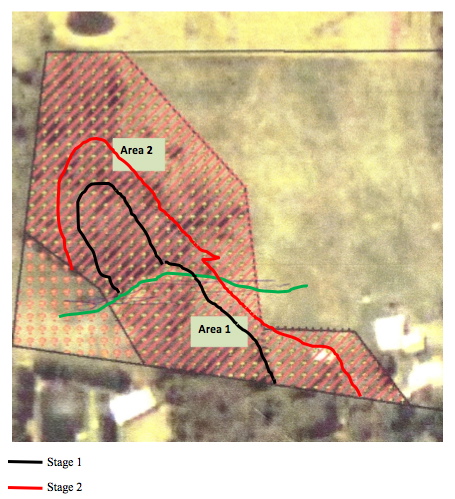
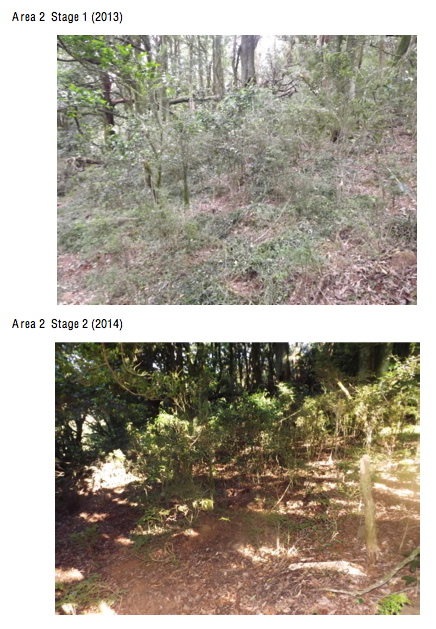
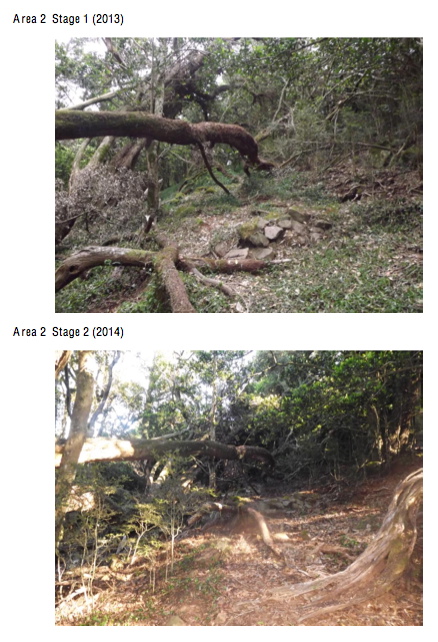
Gerard Proust provided the following:
|
|
|
Site-Map of the Works |
Pre- and Post Shots ... |
... of Nov 2013 and Jan 2014 |
9 March 2014 – Annual Blackberry Attack
The autumn was going to be very busy, so we arrived a little early, spending
1.5 hrs on Sunday afternoon plus 4 hrs on the (Canberra holiday) Monday, 10
March. Apart from blackberry, the forest edges had few major weed problems,
e.g. 2 or 3 inkweed, just turning their awful purple, two thistles at the
bottom of the stable-paddock, one large Conyza beside the creek.
The work done comprised:
- Linda sprayed the blackberries in segments of the large paddock,
with Grazon (335ml to 10 litres of water)
That
required about 2.5 10-litre loads and 2.5 hrs
- Linda did most of the lower path and grass area outside the forest verge,
cut-and-paint
That's back-breaking, because it's all hidden in the grass
- Roger did the left-hand side of the Y (upper path area)
That took all
of the available 5.5 hrs, incl. pre-cutting, battling into thick pioneer vegetation,
cut-and-paint, then crawling through beneath the verge of the forest proper,
to find the canes
that had established further in. The previous work in the lower half of the
Y had been pretty effective,
but it needs an annual attack, rather than the once-every-2-3-years I'd hoped
- For cut-and-paint, Roger used neat Glyphosate
Linda included a splash
of water to slow down the evaporation (Canberra work-groups use 50-50)
What we did not get done was:
- We didn't spray the small paddock. There's not a lot there at the moment
- The bottom forest-edge – which isn't too bad, but needed some attention
- The top forest-edge – which we didn't even get time to inspect
- The stable and house-block edges – although we took out a couple
19, 26 November 2014 – PBS Work on Trad
Proust Bushland Services (PBS) continued the attack on the Trad flum on the forest floor.
[Awaiting photos]
16 January 2015 – Inspection
This was the next available opportunity to inspect PBS's work on the Wandering Jew.
It's been very effective. After 6 weeks, there was only scattered re-growth, with some areas remaining fairly bare,
some showing the early stages of re-growth of both Trad and native species, and some areas showing vigorous re-growth
of natives, and as-yet not-vigorous re-growth of Trad.
|
|
|
|
Behind the Stable
looking South |
Looking SE |
A sample of
the re-growth |
|
|
|
|
|
Northern Forest |
Across the slope |
Down the slope |
Indetail |
|
|
|
|
Southern Forest |
At various levels ... |
... of detail |
More regrowth here |
I also did a check of the blackberry situation. All areas will need a patrol,
but no one area is bad enough to be regarded as the primary target area for
the Autumn Rubucide Attack. I removed the sole Thistle that I saw. I had no
time for the scattered Inkweed.
The neighbour has brought down the dozen mature Pinus radiata on his side of the fence in the extreme SW of Southwater Downs.
He had limited choice in where he dropped them, and they've demolished the fence (such as it was). There's minimal to no
damage done to vegetation on our side. There may be more vigorous growth near the fence due to increased sunlight.
2015 – Nil Report!
October 2014 saw the departure of long-term tenants. They left the property
covered in a vast array of large not-very-collectables. We spent multiple
weekends clearing the place, filling three of the largest
available skips with heavily de-constructed and packed-down rubbish. We then
had a succession of contractors in to refresh the place and fix various problems.
By the end of that, in April 2015, we'd run out of energy and time to attack
blackberries!
11 April 2016 – Inspection
On the way back from Russell and Karen's wedding celebrations near Nowra, we spent an hour checking
blackberries and wandering jew.
Giving the blackberries a year off has let them get away a bit. All forest-edges need attention,
and there are plenty of small plants in the grass near the creek and on the lower path.
We need to get the contractor back into the forest to deal with the resurgence
of wandering jew. The attacks of the previous years have been very effective,
with some previously bad areas showing a lot
of small native ground-plants. But there's also re-growth in the lower northern
forest and the central
southern forest.
The ink-weed is a bit of a problem in some areas.
But generally the forest looks pretty good, certainly much better that it
was before we got the grant, and were able to put PBS in there.
1 May 2016 – Annual Blackberry Attack
We got most of the intended work done, despite a very windy day:
- The littoral area (beside the creek) had a great many
young and enthusiastic vines. It was deeply-entwined with the grass, so
we pulled them up with a rake to expose the foliage,
and Linda then sprayed it with 8 litres of Grazon (50ml in 15 litres).
She used a coarse nozzle, to limit spray-drfit
- The regeneration-area in the SW corner has a disappointingly
healthy collection of blackberries. However, the surviving plantings are
now mature - although with quite a few recent losses of A. mearnsii
due to wind-damage causing them to split. There's a lot more canopy than
there used to be, so there's a decent chance that the forest will start
re-claiming the area. So Linda sprayed with about 5 litres
of Grazon, without being quite as careful to search out every small plant
- The lower path had quite a few small plants, and small
numbers of very aggressive young ones that were heavily entwined with the
shrubs on the edge. Roger worked his way up, cutting-and-painting.
The good news was that areas along the nothern edge that had once been
badly infested were almost entirely free - as was the case with the western
forest edge just above the littoral area
- The NE corner of the forest had a couple of large bushes that Roger had attacked in the past but not got back to
recently. Linda used several litres of Grazon on them. There are small numbers of small plants in
the grass between the forest-edge and the paddock fence, and small numbers of larger ones re-growing
within the forest edge, but we had higher priorities than those this year
- The southern edge of the Y, below the stable, had resurgent,
highly vigorous monsters, which needed a serious assault with the 'clear,
crawl and finally cut-and-paint' method. Roger cleared about seven such bushes
down to the half-way point of the Y. (The lower part was still in decent
shape)
- The centre of the Y / the upper track area had small numbers
of small plants and a couple of large ones around the gate. Linda sprayed
those
- The paddocks had quite a few blackberry tendrils winding through the grasses.
Linda sprayed those as well
We still haven't attacked the bushes that are encroaching from the eastern
road-side slope, nor the large infestation along the northern side of the drive-way.
As they're not affecting the forest, they've remained lower priority.
It was a very productive day, and after feeling a tad daunted at the beginning we felt we'd done the
necessary work for the year in a mere 4-hour day.
5, 7, 11 Oct 2016 – Final PBS Attack
After long delays due to the excessively wet season, PBS finally got into
the forest for the fourth and final attack on the Wandering Jew / Tradescantia
fluminensis / Trad.
Gerard Proust reported:
"We have eventually completed the maintenance weeding of the entire site;
despite the variable weather conditions and a car mishap.
"We hand weeded approx 75% of the site and then site prepped and sprayed:
- the denser peripheral areas to the north
- downslope in some western sections and
- up near the old shed
"We took 18 large 'feed bags' off site for safe disposal.
"Most of the site is in maintenance mode but you will
have to keep on some zones esp the area near the house on further
maintenance weeding"
27 Oct 2016 – Inspection of Final PBS Attack on
the Trad.
Roger did the inspection on 27 Oct 2016. There's still Trad. in the area behind
and beside the house, i.e. outside the conservation area. No Trad. was visible
anywhere
else.
Some areas were barer than healthy forest-floor usually is. This was presumably
where the Trad. had regenerated and PBS had attacked the re-growth. In those
areas,
I
assume
that
native
species had still been suppressed and few of them would have survived the latest
assault.
In
many
other areas, however,
there
was a
lot of
native
re-growth
evident at ground level, and in some cases a bit higher. There was little
evidence of weeds in those areas, although a few ink-weed are grabbing their
chance
in relatively bright zones where old trees have fallen and the new growth
hasn't filled the gap in the canopy yet.
Gerard didn't get any photos on 5-11 Oct, so Roger took these on 27 Oct:
Behind the Stable:
The area was clear of Trad., but so far with only modest
re-growth of native species at ground-level.
That's no surprise, because this was one of
the worst-affected areas.
We'd done our first experiments here,
with very little success
...
|
|
|
|
|
|
Southern Block, i.e. West of the House |
Some patches very good, |
a lot of litter, |
but native re-growth readily apparent |
|
|
|
|
Northern Block |
Some areas are a little barer than desirable ... |
|
... and some areas are recovering very well |
Roger also checked weeding priorities for the coming season. They appear to be:
- behind the house to the stable – inkweed and wandering jew
- on the northern fenceline, just into the forest below the paddock, a huge blackberry bush
invading from the neighbour's side
- in the two paddocks, a lot of grazable grass emerging, needing an animal
to graze it
- in the large paddock in particular, scattered blackberries re-emerging
- to the north of the gateway, a lot of blackberry entwined with a lot of native vegetation
31 March 2017 – Rubucide Day
Roger spent the first half-hour inspecting the damage to the water-tank from
the fallen 40-foot Acacia melanoxylon.
Linda sprayed with 50ml Grazon to 10 litres of water, as follows:
- in the very NE of the forest, the large bush flowing onto the property from the northern neighbour.
Roger contributed by jumping the fence to spray the 5m width from the neighbour's side
- along the eastern/ top edge of the northern forest, edge-bushes and in-the-grass new plants
- on the northern side of the Y, one large bush
- the littoral area on the western edge of the northern forest. In addition to in-the-grass growth,
there was re-growth in the forest edge, where there was once a major infestation
- the planted triangle down on the western edge of the southern forest.
Many of the remaining new
trees have fallen, making it a bit of a tangle
- in the two top paddocks, many small in-the-grass new growths.
The grass hasn't been grazed for 2-1/2 years, so its long (75cm), so some
will have successfully hidden
- in the fenceline between the stable and the shed, one large bush
Roger cut-and-painted as follows:
- along the western edge of the northern forest, to get to the bushes further in than it was
desirable to spray. A particularly virulent and persistent cluster took most of the time.
It's in a 15m relatively open area running down the hill into the forest about half-way
along that edge. This edge is otherwise colonising so well that it's becoming harder to
battle your way along it
- along the track from the bottom of the Y to the littoral area. This has excellent
native growth.
Spraying's an unattractive option because the trailers are hidden in
and intertwined with natives
- (It would have been good to attack the southern side of the Y, because 4 or 5 bushes have
got away, are again at the 10-foot level, and need the 'clear, crawl and cut at the bottom'
approach to kill off the current crop of virile, bush-borne trailers and slow down the root-balls)
The future work-plan looks like this:
- at least every second year (needs 2 days), and preferably every year
(1 day may do):
- do a complete Grazon-spray round on all of the readily-accessible plants
- do a Glyphosate cut-and-paint on all of the edge-embedded bushes
- in Spring (c. Oct 2017), trial a Grazon spray-attack on all of the readily-accessible new growth,
to see whether this retards their growth sufficiently. The competing theories are:
- Roger has the distinct impression that autumn cut-and-paint attacks get the
Glyphosate down to the roots and hence severely retard next-season growth and
after several repeats kill the root-stock. (This has the disadvantages of not getting
an immediate kill, and having to invest a lot of ground-level labour per plant)
- Linda reckons that spring Grazon attacks would achieve one-go knock-down, before
the plant grows enough to become so intertwined with native vegetation that it's
necessary to resort to labour-intensive cut-and-paint. (But of course the
disadvantage is that spraying Grazon results in more and much nastier collateral damage)
- in Spring (Oct 2017) and/or Autumn (Mar 2018), mount another Grazon-spray
attack in the area north of the gateway (and along the above-road area
to the extent accessible and necessary)
- lower the grass-height in the paddocks with some grazing
21 April 2017 – Rubucide Day
The inspection of the blackberries relevant to the forest
at the start of the day found:
- quite a lot of small ones hidden
in grass, prettymuch throughout the forest fringes
- none more than a few metres into the forest-edge (which is how it's always
been)
- the ever-re-growing large bushes on the southern side of
the 'Y' leading down to the creek
- a few big bushes on the NE corner of the forest, where the
neighbour's failure to keep the large infestation under control keeps
pushing growth over the fence at us
- moderate numbers along the upper / eastern edge of the large forest
Elsewhere:
- quite a lot in the paddocks, but none large, densest in the large paddock,
halfway along the western fenceline
- still quite a few
in the lush area on the northern side of the driveway
- bad infestations between the paddock boundary fence and the
roadside, but difficult to access and spray
The wandering jew is getting under way inside the forest
again. It's terrible behind the house, as far as the end of the stable. In
the large forest, it's
sporadic, but already becoming a real problem again in a few places. There
was modest re-growth of native species in the areas that had been cleared,
although less strong than we'd hoped. There was a newly-scraped area mid-forest
and towards the northern fenceline (presumably from wombat parties?). We should
start looking for some more funding assistance, and get Gerard Proust back
in to have a look and provide a quote.
Linda sprayed along most of the forest perimeter, along
the littoral area, and in the (nicely-developing) re-planted area in the SW
corner,
then
up the
pathway.
She emptied the tank in the NE corner and along the eastern edge. She
used Grazon at 30ml per 10 litres water. No wind. Some fog,
a few drops of rain. total of 20 litres. After lunch, she worked the
paddocks.
Roger spent the entire 4 hours working up the southern side of the
'Y'. Glyphosate,
water and a little Grazon. As noted last year, a vast amount of cutback
was needed, in order to find and get access to quite small numbers of stems,
some base-of-thumb
thickness.
He
only
got
three-quarters of the way up to the fence, so Linda sprayed the remainder before
we left.
'First, do no harm'
Two important aspects of conservation are distinguishing between weeds and
not-weeds, and avoiding doing more harm than good. The rule is to not touch
it unless you know what you're doing. That has two components:
- firstly, identify the species
- secondly, consider the consequences of removing it. For
example:
- clumsy removal that shakes off seeds, leaves roots in place, or leaves
segments of stalk lying around may encourage even more vigorous growth
of the weed in question
- clumsy removal or insufficiently-controlled spraying may harm adjacent
native species
- removal that leaves bare ground may invite even worse replacements than
the weeds that were removed
A nice case study from Southwater Downs is a Senecio, which we think is S.
linearifolius (Fireweed Groundsel). PlantNet
identifies 72 species in the Genus in Australia, of which 9 are Introduced (i.e.
generally, weeds), and several seriously so. They include Senecio
madagascariensis, which is declared noxious in much of the Southern Tablelands
and SouthEast Region.
The plant we have is a pioneer, vigorous, looks like a weed, and, if we've
identified it correctly, its common name has the word 'weed' embedded in it.
But it's a highly desirable local.
In the words of SouthEast
Weeds, "... the native "fireweed groundsel" (Senecio linearifolius)
... is a robust species to over a metre in height, which grows as a cluster
of stiff stems. 'Petals' are shorter and fewer (8 or less) than in fireweed
[S. madagascariensis] and leaves are much larger, with the veins conspicuous
on the upper surface and the margins finely and regularly toothed and slightly
rolled under. This difference in the leaves is apparent in the seedlings as
well. This species is an opportunistic coloniser of bare ground and may give
some cause for alarm by behaving in a weedy manner after disturbances such as
clearing of forest, fire or drought".
Future Activities
Our general approach to weed management, and specific approaches to particular
species, are explained in the Weed Management
page within our Bunhybee web-site.
In roughly descending priority order:
- Blackberries (Rubus fruticosis):
- the method is described generally
here and in more detail here
- by early 2012, with the exception of one remaining big patch in the
area above the creek, all areas adjacent to the forest can be controlled
with an annual autumn cut-and-paint of the new growth. The smaller paddock
has had a spray-attack, and in 2013 that needs follow-up, and the large
paddock needs an attack, and the section near the road needs a commercial
sprayer
- the old description from 2009-10 follows:
- the priority currently is to:
- clear the big volume of dead canes in order to get access to
the inevitable new growth
- cut-and-paint the new growth in autumn 2011
- attack the many young plants around the paddock boundary
- the areas for repetitive treatment (preferably cut-and-paint with
glyphosate, with controlled spray with triclopyr where necessary)
are:
- in the riparian grass
- in the thick grasses uphill, along the paddock boundary
- in the thick grass in the triangle above the path
- in the grazed paddock uphill from the forest
- Wandering Jew (Tradescantia fluminensis):
- here's what the various sources say:
- treat it, preferably during winter:
- roll it, perhaps by hand, perhaps with the assistance
of a rake
- remove the broken segments (which is what it grows from)
and/or spray with glyphosate
- remove it (but bagging is very slow), or cover it with
black plastic
- return in spring/early-summer and use controlled-spray – trying
to improvise protection for emergent native plants, e.g. using
a couple of small containers upturned over them
- but after a first experiment in March 2011, Linda proposes
a different approach:
- gently pull armfulls out, and throw them in a trolley/tarp.
This will take off the top 2/3 of the plants, without chopping
up the rest into fragments that may re-shoot
- try to avoid stomping on or breaking up trad plants nearby
- remove the rest of the plant with the root, by means of
a small digging implement
- bag the residue and leave the bags in the sun, or pile
and cover
- return [after 4weeks?] and use controlled-spray – trying
to improvise protection for emergent native plants, e.g.
using
a couple of small containers upturned over them
- we're increasingly doubting our ability to develop a technique, and
the apply it across the large areas involved
- we need a better understanding of what the pioneer native species
are likely to be, e.g. various ferns such as ceilanthes?
- Flax-Leaf Broom (Genista linifolia)
- this is among the radiata pine at the front of the property
- it's a declared noxious weed
- presumably pull it up, bag it, and remove it from the site or compost
it
- Thistles (Cirsium vulgare):
- if second-year (with shaft):
- if there may be viable seed, first chop and bag the head
- pull, and leave with roots exposed
- if first-year (rosette-only), pull if possible, or chop into the root
so that it dries out, or (depending on the success of the experimentation)
paint or narrow-spray glyphosate on the centre
- Inkweed (Phytolacca octandra)
- apparently too difficult to pull, so we'll experiment with painting
or narrow-spraying young plants with glyphosate, and chopping out mature
plants
- Yellow-Flowered Spears (prob. Verbascum macrurum)
- if there may be viable seed, first chop and bag the head
- pull, and leave with roots exposed
- where we identify young plants, we may paint or narrow-spray the rosette
with glyphosate
- Paspalum:
- Phalaris:
- Kikuyu:
- we're considering using some controlled grazing in the triangle below
the paddocks and above the path
This is a page within the Southwater Downs Web-Site, home-page
here
Contact: Linda or Roger
Created: 22 March 2010; Last Amended: 23 April 2018